 William BensonVIEW PROFILE →
Meet Your Favorite Athlete's Digital Twin: The Virtual Replica Quietly Reshaping Sports and Gaming
Every sprint, tackle, and jump a pro athlete makes is now feeding a living digital copy of their body, and it's already reshaping sports medicine, gaming, and how leagues make money.
Every sprint, tackle, and jump a pro athlete makes is now feeding a living digital copy of their body, and it's already reshaping sports medicine, gaming, and how leagues make money.
Somewhere inside an NFL data center right now, a virtual version of a linebacker is absorbing a hit that hasn't happened yet, thousands of times over, in the space of a few seconds. The real player has no idea. He's just running a normal drill. But every stride, every joint angle, every fraction of a second of contact is quietly feeding a living computer model of his exact body, one that leagues, game studios, and tech companies are now betting is worth billions of dollars. What a "Digital Twin" Athlete Actually Is The term sounds like science fiction, but the underlying idea is fairly grounded. A digital twin is a continuously updating virtual model of a real, physical thing, built from constant sensor data rather than a one-time scan. In manufacturing, engineers have used the concept for years to predict when a jet engine part will fail before it actually does. Applied to a human athlete, the same logic becomes a personalized biomechanical model, built from optical cameras, wearable sensors, and motion capture data, that mirrors exactly how that specific person's body moves, loads, and fatigues in real time. What makes this genuinely different from older sports-science tracking is precision. Older systems compared an athlete's movement against population-wide averages, a reasonable but blunt benchmark. A true digital twin is built entirely around one individual's own biomechanics, meaning the system isn't asking "is this movement risky for an athlete in general," it's asking "is this movement risky specifically for this player's body, based on everything it has learned about them."
The NFL's Digital Athlete Program
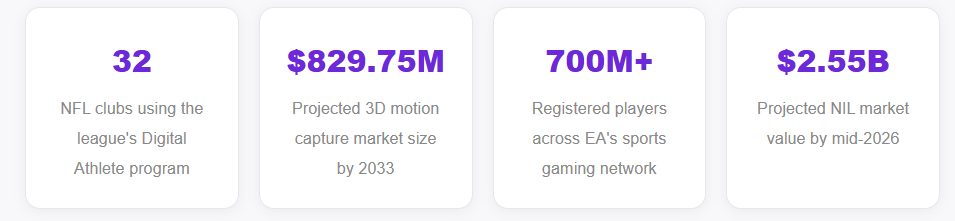
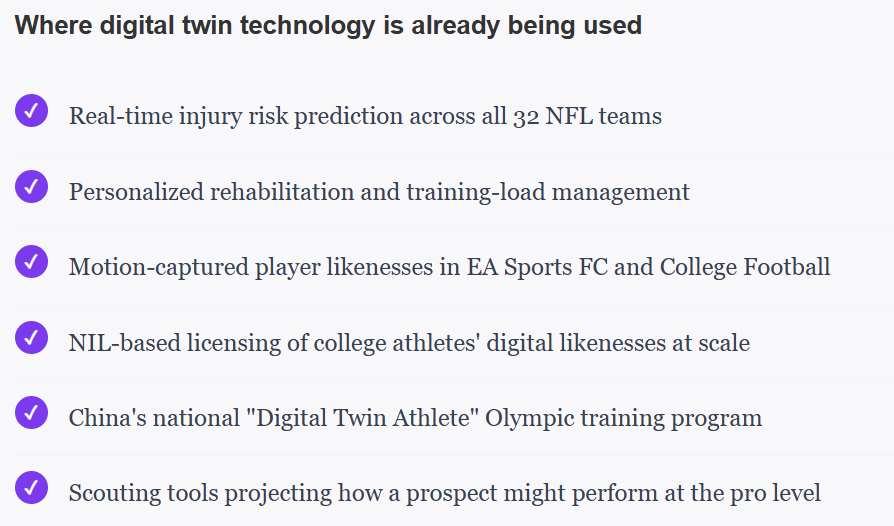
The most advanced real-world example of this technology belongs to American football. The Digital Athlete program, a joint venture between the NFL and Amazon Web Services, has quietly turned player health into a computational discipline. Every snap now generates a synchronized fusion of optical imaging and embedded telemetry, building a digital twin that mirrors each athlete's physiological load, in motion, in something close to real time. Rather than treating injuries reactively once they happen on the sideline, the system runs large-scale AI simulations that function as a virtual biomechanics laboratory across all 32 clubs.
The shift this represents is structural, not incremental. Player availability has become one of the most valuable competitive assets in professional sports, and a league where injuries can end a season's title hopes overnight has strong financial incentive to forecast risk before it materializes. What used to be reactive sideline medicine is increasingly predictive infrastructure, run on the same kind of high-performance computing that powers modern AI research.
From Injury Prevention to the Video Game Console
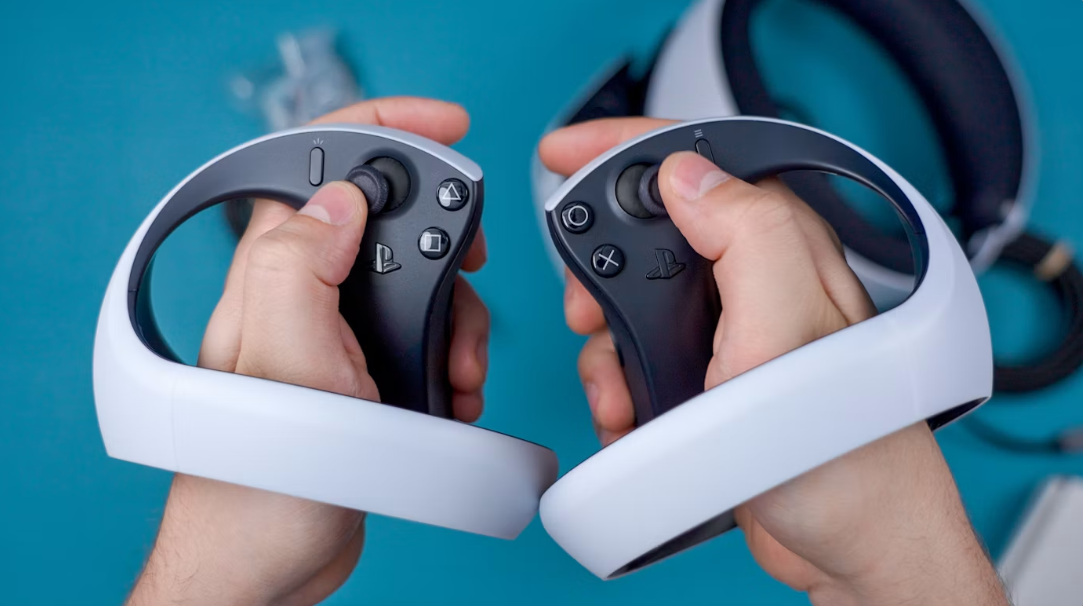
Sports medicine is only half the story. The exact same underlying technology, high-fidelity motion capture and biomechanical modeling, has quietly become the backbone of modern sports video games. EA Sports FC uses what it calls HyperMotion technology, built on volumetric motion capture that analyzes real professional matches rather than relying on a handful of athletes performing scripted movements in a studio. The result is running styles, dribbling, defensive reactions, and even celebrations that increasingly mirror how specific real players actually move on a real pitch.
College sports have taken this even further in 2026. EA's College Football 27 built its entire promotional strategy around real NIL-compensated athletes, placing star players directly on its covers, a shift only possible because of new rules allowing college athletes to be paid for use of their name, image, and likeness. EA made a historic offer to more than 14,000 FBS players, giving each one direct compensation and a copy of the game in exchange for using their digital likeness, effectively scaling athlete digital twins from a handful of superstars to an entire sport's roster at once.
The Business Model Hiding Behind the Technology
None of this is happening purely for scientific curiosity. There's real money at stake on both sides of the ledger. The NIL market for college athletes alone is forecast to exceed $2.55 billion by mid-2026, with digital likeness licensing, tokenization, and performance-based compensation increasingly central to how that value gets captured and paid out. On the gaming side, EA's sports division alone generated $7.5 billion in net revenue in a single recent fiscal year, a business built substantially on the promise of authentic, recognizable athlete likenesses driving player engagement and sales.
What used to be a one-time motion capture session for a handful of marquee athletes has become an ongoing pipeline: continuously updated biomechanical data feeding both a team's medical staff and a video game studio's animation engine from the very same underlying source.

China's National Digital Twin Athlete Program
The United States isn't the only country pushing this technology into elite sport. In China, government-backed initiatives referred to as the "Digital Twin Athlete" program are being trialed at a national level, combining 3D biomechanical modeling, longitudinal physiological data, and predictive AI to simulate and optimize individual training scenarios for elite competitors. Researchers describe these systems as a virtual testbed, letting coaches and sports scientists test training loads and scenario plans safely, without risking a real athlete's body on unproven training approaches. It's a notable signal that this isn't a niche American sports-tech experiment, it's becoming a genuine international race in applied sports science.
A Few Honest Questions People Are Actually Asking
Who actually owns an athlete's digital twin data? This varies significantly by league, country, and individual contract, and remains a genuinely unsettled legal question. NIL agreements in college sports have started addressing digital likeness explicitly, but professional biomechanical data ownership is still evolving case by case.
Can this technology actually predict injuries accurately, or is it still experimental? Researchers are candid that most current systems function better as advanced monitoring and risk-scoring platforms than as fully realized, guaranteed prediction engines. It's a genuinely promising direction with real early results, not yet a solved problem.
Could a retired athlete's digital twin keep "playing" indefinitely? In gaming terms, yes, in a limited sense, licensed digital likenesses of retired or historic athletes already appear in some sports titles. Whether that extends to more ambitious uses depends heavily on likeness rights negotiated well beyond a player's active career.
What's Coming Next, and the Ethical Questions Nobody's Fully Answered
The trajectory here is fairly clear even if the details remain unsettled. Wearable sensors keep getting smaller and more precise, motion capture is moving from studio setups toward capturing real, live competition, and AI models keep getting better at turning raw biomechanical data into genuinely predictive insight rather than just a pretty visualization. Industry researchers expect the next real leap to involve digital twins used proactively in scouting, projecting by 2030 how a promising young prospect's biomechanics might translate to the professional level before they've ever played a single pro game.
The genuinely open questions are less technical and more human. Who gets paid, and how much, when an athlete's precisely modeled movement becomes the backbone of a billion-dollar game franchise. How much of an athlete's own biomechanical data they get to control, versus a team, a league, or a game studio. And whether the same predictive systems built to protect athletes from injury could eventually be used to make roster or contract decisions in ways players never explicitly agreed to. None of this technology is inherently good or bad, it's a genuinely powerful tool. How fairly the value it creates actually gets shared is still very much being negotiated in real time.
A note on the details
Digital twin and motion capture technology in sports is evolving quickly across leagues, countries, and game studios. Specific programs, partnerships, and market figures referenced here reflect reporting as of August 2026 and are likely to expand or shift as the technology matures further.