 William BensonVIEW PROFILE →
Micro-Habits That Take 2 Minutes But Save 2 Hours of Daily Stress
The small, unglamorous routines that prevent overwhelm before it ever builds up.
The small, unglamorous routines that prevent overwhelm before it ever builds up.
Somewhere along the way, self-improvement got expensive. Not in dollars, necessarily, but in time and effort: color-coded morning routines, ninety-minute workout blocks, elaborate weekly planning sessions that require their own planning session first. For anyone already running on a full schedule, that version of "getting your life together" doesn't feel aspirational. It feels like one more thing on a list that's already too long. Which is exactly why the two-minute habit deserves more credit than it gets. There's a specific category of tiny, almost embarrassingly small routines that take less time than brewing a cup of coffee but quietly prevent the kind of accumulated stress that eats up an entire afternoon. Not because the habit itself is powerful in isolation, but because of what it prevents downstream: the frantic five-minute search for keys that were never put back, the notification pile-up that turns into an hour of anxious scrolling, the cluttered inbox that makes Monday morning feel like wading through mud. Small, consistent friction removed early tends to save far more time than it costs. Why tiny habits outperform big ones for stress specifically The psychology here isn't complicated, but it is counterintuitive. Most people assume the size of a habit should match the size of the problem it's solving: big stress requires a big intervention. In practice, the opposite tends to hold true, particularly for the kind of chronic, low-grade overwhelm that comes from dozens of small unfinished loops rather than one enormous crisis. A well-known productivity concept sometimes called the one-minute rule captures this well: if something takes less than a minute, do it the moment it appears rather than deferring it. Author and habits researcher Gretchen Rubin, who popularized the idea widely, has noted that people who adopt this rule consistently report two compounding effects, their physical spaces stay noticeably tidier without dedicated cleaning sessions, and their sense of control over the day increases because small decisions stop piling up into a backlog that has to be dealt with all at once, usually at the worst possible moment.
Stress rarely arrives as one big event. Far more often, it's the slow accumulation of a dozen unfinished two-minute tasks, each one small enough to ignore, until all of them are due at once.
Seven micro-habits worth actually adopting
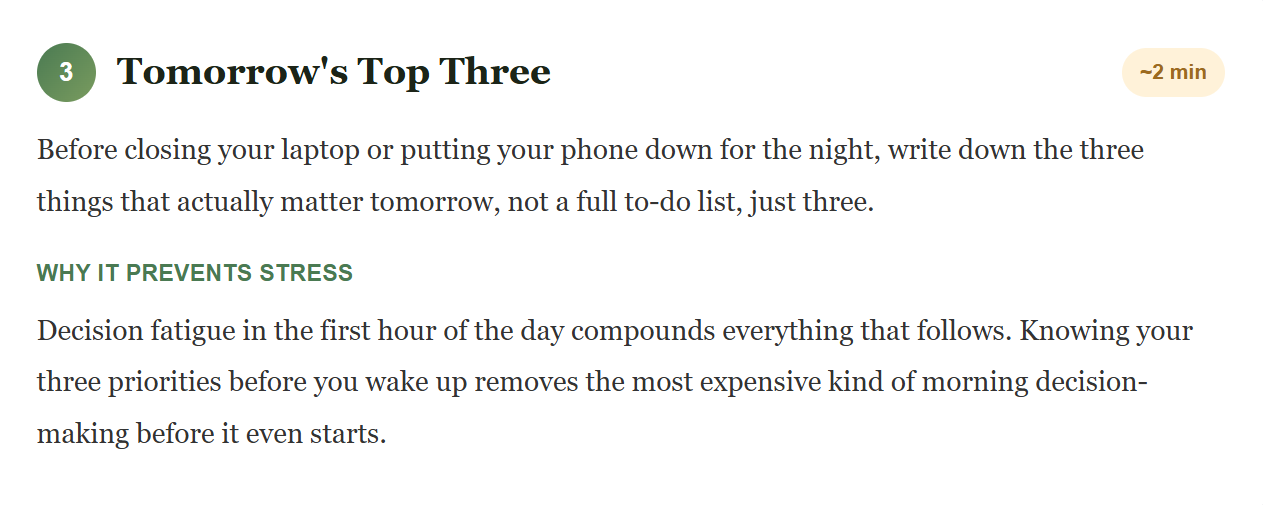
These aren't arbitrary. Each one targets a specific, common source of daily overwhelm, the kind that doesn't feel urgent in the moment but reliably costs far more time later than it would have taken to address immediately.
The digital decluttering piece, in more depth
Of everything on this list, digital clutter deserves special attention because it's the newest category of overwhelm and, for many people, the largest. The average adult now interacts with dozens of small digital decisions daily, notifications, unread badges, unsorted downloads folders, browser tabs left open as a kind of visual to-do list, each one small individually but collectively substantial.
The two-minute version of digital decluttering isn't about achieving some pristine, minimalist phone setup. It's about routinely clearing the small backlog before it becomes a bigger one: closing tabs you've been "meaning to read," deleting apps you haven't opened in a month, unsubscribing from one mailing list a day instead of ignoring all of them indefinitely. None of these individually matter much. Done consistently, they prevent the specific, modern kind of overwhelm that comes from a phone screen that feels like a to-do list you never agreed to.
A realistic way to start
Don't try to adopt all seven habits at once, that's a recipe for abandoning all of them within a week. Pick the single one that addresses your most common source of friction right now, run it for two weeks until it stops requiring conscious effort, and only then add a second one.
Why this works better than a full routine overhaul
There's a specific reason ambitious productivity overhauls fail so often, and it isn't lack of willpower. Big systems require sustained novelty and effort precisely when a person has the least bandwidth for either: at the start of a stressful period, which is exactly when the motivation to maintain an elaborate new routine evaporates fastest. Two-minute habits sidestep that problem almost entirely, because the effort required to maintain them barely changes even on a bad day.
That durability is the real advantage. A habit that takes ninety minutes gets skipped the first time life gets genuinely busy, and once skipped, it's disproportionately hard to restart. A habit that takes two minutes rarely gets skipped at all, because the cost of doing it and the cost of justifying not doing it end up roughly the same. Over months, that difference in consistency, not the size of any individual habit, is what actually compounds into meaningfully less daily stress.
What this actually adds up to over a month
None of these habits feel significant on any single day, which is precisely the point and precisely why they're easy to underestimate. The value isn't in any one two-minute action; it's in what gets permanently removed from your mental load once each one becomes automatic. A cleared inbox stops occupying background attention. A fixed spot for keys eliminates an entire recurring category of morning panic. A clear surface removes a small, ambient source of visual stress every single time you walk past it.
Add those removals together across a month, and the math starts to look less like seven trivial habits and considerably more like an actual system, just one that never required you to build a system in the first place. That's ultimately the appeal: not a dramatic transformation, but the quiet, compounding relief of a dozen small sources of friction simply no longer being there.