 William BensonVIEW PROFILE →
No Screens Before Three, No Social Media Before Thirteen: Inside Brussels' Boldest Plan Yet to Redesign Childhood Online
A commission president trained as a doctor, a panel of child development experts, and a room full of officials in Brussels spent Monday morning discussing a topic that usually gets settled, or argued about, at the kitchen table: exactly how much screen time a child should have, and at what age.
A commission president trained as a doctor, a panel of child development experts, and a room full of officials in Brussels spent Monday morning discussing a topic that usually gets settled, or argued about, at the kitchen table: exactly how much screen time a child should have, and at what age.
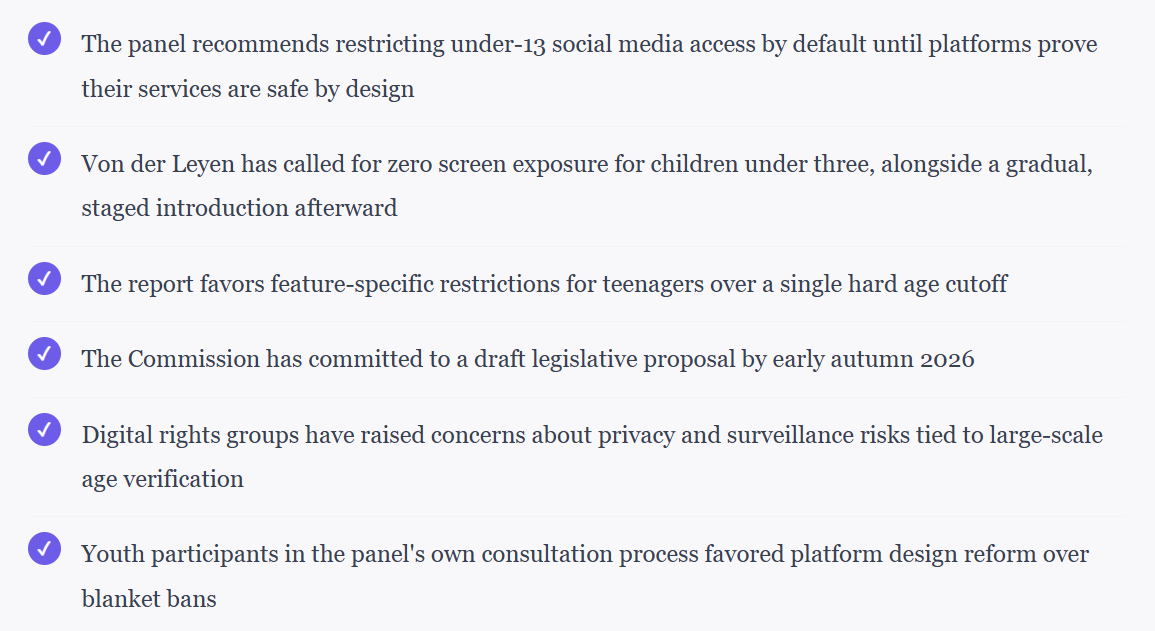
On a Monday morning in mid-July, European Commission President Ursula von der Leyen stood in front of a room of officials in Brussels and did something European Commission presidents don't often do, she spoke less like a head of a governing institution and more like the physician she trained as before entering politics. Children under three, she said, shouldn't be exposed to screens at all. Older children should be introduced to technology gradually, in stages matched to their developmental readiness rather than handed unrestricted access the moment they're technically old enough to sign up for an account. Behind her sat the outcome of months of work: a formal report from a special panel of child psychiatrists, public health researchers, and youth representatives, commissioned specifically to answer a question that's been building political pressure across Europe for over a year, what should the EU actually do about children and social media. The panel's answer, delivered that same Monday, was considerably more direct than the cautious, consultative language Brussels usually favors. Rather than recommending more parental controls or clearer platform disclosures, the report's central recommendation flips the entire responsibility structure most people currently assume governs this issue. It argues that the burden of proof belongs with the companies building these products, not with the parents and regulators currently left to manage the fallout, and that until platforms can demonstrate their services are genuinely safe by design, access for children under 13 should simply be restricted across the EU. The headline recommendation, and the logic behind it The specific language in the report is worth sitting with, because it represents a real shift in how the EU has approached platform regulation up to this point. Rather than asking whether a specific piece of content or a specific feature is harmful and regulating that in isolation, the panel's framing treats an entire category of product, general-purpose social media, as something that should be presumed unsafe for young children by default, with the burden on providers to earn access back through demonstrated safety, rather than the reverse.
That's a notably different posture from the EU's existing Digital Services Act, which already requires the largest platforms to assess and mitigate risks to minors but generally leaves the underlying question of access up to individual member states and, in practice, to the platforms' own age verification systems, systems widely acknowledged to be trivially easy for a child to bypass simply by entering a false birth date.

Why this is landing now, after years of slower-moving debate
The timing isn't accidental. Von der Leyen appointed the panel's two co-chairs, child psychiatry professor Jörg Fegert and public health researcher Maria Melchior, back in March 2026, directly in response to mounting pressure from EU member states that had grown impatient waiting for a bloc-wide approach while national governments moved ahead on their own. Denmark, France, and Greece have all separately pushed for national-level age restrictions in recent months, creating exactly the kind of fragmented, country-by-country patchwork the EU's single market was designed to avoid. Globally, the pressure has only intensified, with Australia, the UK, Turkey, and Indonesia all passing restrictions on under-16 or under-15 social media access over the past year, moves that have visibly shifted the political calculus in Brussels.
The enforcement action that set the backdrop
The Commission has also been applying pressure through existing tools while the panel's work was underway. Just days before the report's release, regulators used the Digital Services Act to formally warn Meta that it needs to disable addictive design features, specifically citing infinite scrolling, or risk enforcement action, a sign that Brussels isn't waiting for new legislation to start pushing platforms on design choices it considers harmful to younger users.
It is very clear that we need age-appropriate restrictions to platforms.
— European Commission President Ursula von der Leyen, press conference, July 2026

Not a single cutoff, but a staged approach
One detail that got lost in some of the initial coverage is that the report doesn't actually recommend a hard ban for every age group. For children over 13, the panel calls for "further precautionary age restrictions" to be considered, without mandating a specific higher cutoff, alongside a staged model that would introduce different platform features gradually based on age and developmental readiness, rather than granting full, unrestricted access the moment a child crosses a single threshold.
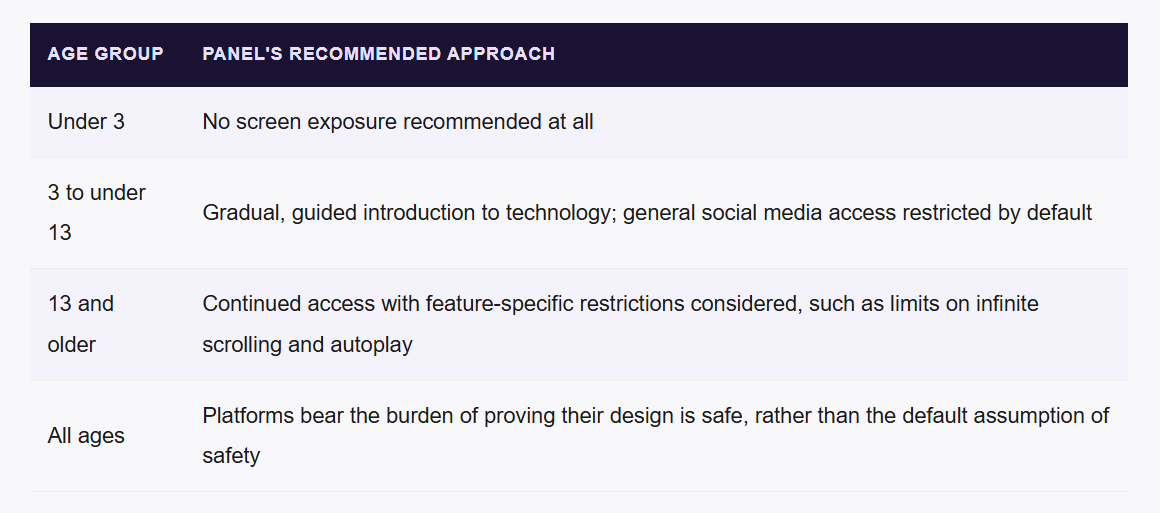
Von der Leyen herself described the panel's staged model as "very convincing" during the July press conference, while stopping short of committing to a specific minimum age in the eventual legislative proposal, which the Commission has said it intends to draft by early autumn 2026, with member states pushing for a fully harmonised EU-wide solution in place by December.
The technical problem nobody's fully solved yet
Any age-based restriction is only as effective as the system used to verify age, and reliable, privacy-respecting age verification at the scale of hundreds of millions of EU users remains a genuinely unsolved technical challenge. Digital rights groups have specifically warned that scaling up age verification risks creating exactly the kind of mass data collection infrastructure that child safety advocates and privacy advocates alike have spent years trying to prevent, a tension the Commission's eventual proposal will need to address directly rather than assume away.

The pushback, from more than one direction
Reaction to the report split along several distinct fault lines rather than a simple for-or-against divide. Digital rights organizations, including Center for Democracy and Technology Europe, welcomed the underlying goal of protecting children but raised specific concerns about how a "harmonised EU-wide access restriction" would actually be enforced in practice, warning that unclear technical specifications could lead to a broader, more rights-limiting system than intended, with real implications for freedom of expression, privacy, and data protection.
Perhaps more striking was the pushback from within the panel's own youth consultation process. Young people who participated in shaping the recommendations were notably skeptical of blanket age bans as a stand-alone solution, arguing that removing access outright strips away genuine opportunities for connection and learning without addressing what they see as the actual root causes of online harm, engagement-driven algorithmic design, infinite scrolling, and manipulative feature design. Their preferred emphasis was on shifting responsibility onto platforms to redesign these features, paired with real investment in media literacy and safe offline spaces, rather than relying primarily on an access cutoff enforced at the door.
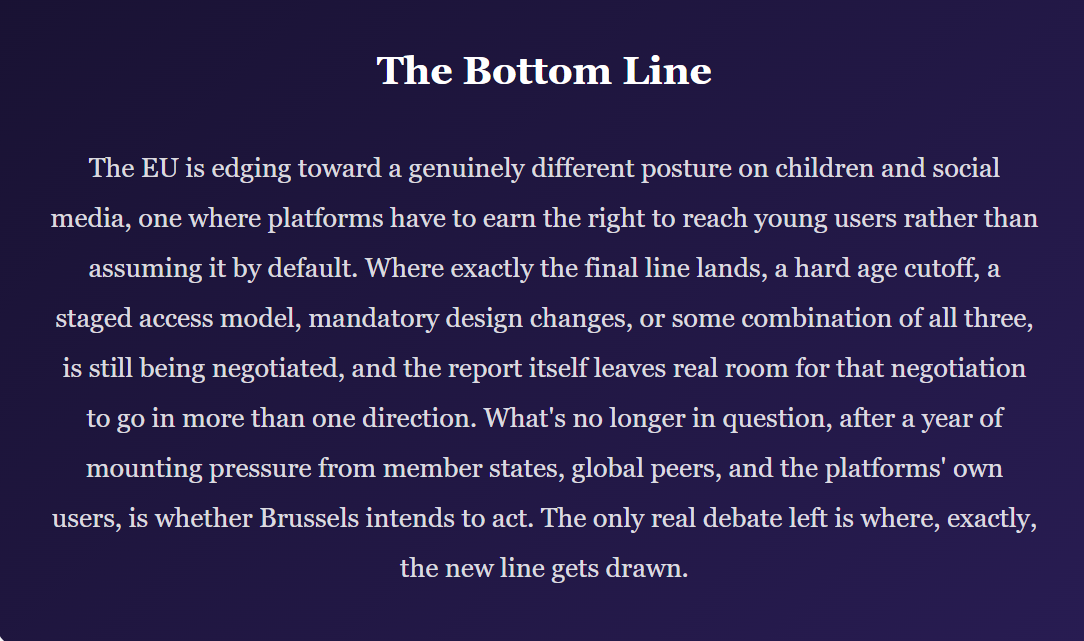
What happens between now and the Commission's autumn proposal will likely determine which version of this debate actually shapes EU law, the more restrictive, access-based approach the headline recommendation implies, or the design-focused, feature-by-feature reform the report's own youth contributors and several digital rights groups are pushing for instead. Both camps agree on the underlying diagnosis, that something about how these platforms are built isn't working for children. Where they still disagree, sharply, is on whether the fix belongs at the front door or inside the product itself.