William BensonVIEW PROFILE →
Nobody Asked for This Much AI: Inside the Growing Backlash Against Smartphone "Gimmick" Overload
Every flagship launch promises a smarter phone. A growing number of buyers are done being impressed and just want one that works.
Every flagship launch promises a smarter phone. A growing number of buyers are done being impressed and just want one that works.
Every flagship launch promises a smarter phone. A growing number of buyers are done being impressed and just want one that works.
Something shifted this year that most keynote slides never mention. For three straight product cycles, phone makers told us AI was the reason to upgrade. Then, somewhere between the price hikes and the assistant that kept mishearing "call mom," a lot of ordinary buyers quietly stopped believing it. This isn't a fringe opinion anymore — it's showing up in hard survey numbers, in satisfaction scores, and in the comments section under every AI camera demo that goes viral for the wrong reasons.
The Numbers Behind the Backlash
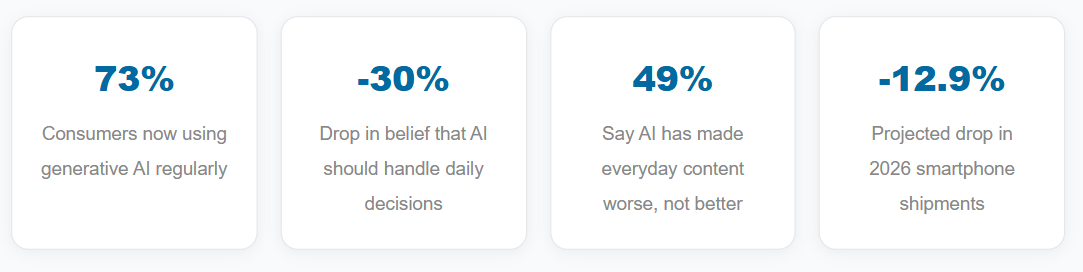
Start with the plainest evidence: a 2026 consumer report tracking generative AI sentiment found that the share of people who believe AI will become deeply woven into daily life and start handling most of their decisions has dropped by 30 percent. That's not a small dip. It's a sizeable chunk of the public looking at two years of AI marketing and concluding, on balance, that they'd rather keep the decision-making to themselves.
At the same time, actual usage is still climbing — generative AI adoption among consumers reportedly jumped from 45 percent in 2024 to 73 percent this year. Put those two numbers side by side and you get the real story: people are using AI more and trusting the hype around it less. Analysts have started describing this exact pattern as the "trough of disillusionment," the well-documented dip that follows almost every overhyped technology once the novelty wears off and the flaws become impossible to ignore.
What "AI Gimmick Overload" Actually Looks Like on Your Phone
It's one thing to talk about survey percentages. It's another to watch it play out in real time. Earlier this year, one flagship's AI-powered camera showcase turned into what tech outlets openly called one of the biggest marketing backfires of the season, after the "AI-enhanced" photos it produced looked noticeably worse than shots from cheaper phones. Rival executives piled on publicly, and the clip spread across social media faster than the actual product announcement did.
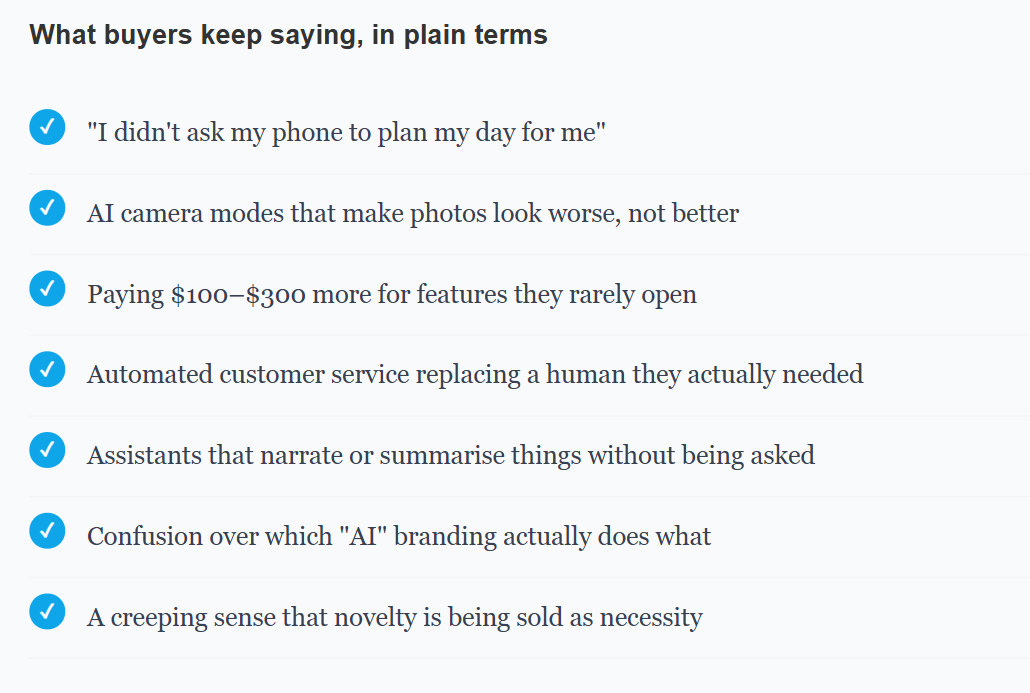
That's the pattern showing up across the industry: independent reviewers keep finding that the AI features people actually rely on — live translation, message summarising, spam filtering, smarter search — are quietly useful, while the flashy demo-stage features, the ones built to generate applause during a keynote, are exactly the features generating the most backlash. A phone that curates your gallery before you've even asked, or narrates your notifications out loud whether you wanted it to or not, sounds impressive on a slide. In daily use, plenty of buyers just find it intrusive.

The Premium Price Tag Nobody Actually Asked For
Layer a genuine affordability problem on top of the trust problem, and the frustration makes a lot more sense. Building AI into a phone requires more memory, and 2026's AI data center boom has been quietly draining the global RAM supply that used to go into consumer devices. Qualcomm's own earnings showed revenue sliding as chipmakers prioritize data-center orders over phone components, and manufacturers have had little choice but to pass the cost straight to buyers.
Samsung added a flat $100 premium to its latest Galaxy S series. Motorola did much the same with its newest Razr. Flagship prices that used to top out around $1,000 to $1,200 are now regularly landing at $1,500 or more, and that's before Apple's long-rumored folding iPhone arrives at a price reportedly hovering near $2,000. None of this is imaginary belt-tightening — IDC now projects smartphone shipments will fall by roughly 12.9 percent this year, which would make 2026 the industry's steepest decline in more than a decade.
The Human Customer Service Backlash Nobody Predicted
There's a second front to this fatigue that gets less attention than camera gimmicks: the disappearance of an actual human on the other end of a support call. As brands lean harder into AI-driven service to cut costs, a growing share of consumers are pushing back specifically against companies that use automation to eliminate human support altogether, rather than simply add an AI option alongside it. The complaint isn't that AI assistance exists — it's that, for anything remotely complicated, people still want the option of a person who can actually solve the problem.
The pattern researchers keep flagging is consistent: consumers aren't rejecting AI itself. They're rejecting AI that replaces reliability with novelty, and convenience with something that quietly costs them more control.
What People Actually Want From Phone AI
None of this means AI is dead on smartphones — far from it. It means the bar for what counts as "worth it" has quietly gotten higher. Real-time call translation that genuinely works across languages. Spam filtering that catches scam texts before a person even sees them. Search and summarisation that save real time instead of just looking clever in a demo. These are the features surviving the trough, because they solve an actual daily annoyance rather than manufacturing a new one.
What tends not to survive is anything that feels performative — AI wallpapers nobody asked to generate, proactive "nudges" that guess wrong more often than they help, or camera processing so aggressive it edits a photo into something unrecognizable. The lesson brands are slowly absorbing is an old one dressed up in new language: usefulness beats novelty, every single time, once the initial excitement fades.
Who's Actually Winning This Round
Interestingly, satisfaction data suggests the winners aren't necessarily the companies shouting loudest about AI — they're the ones whose AI features simply work reliably day to day. One major 2026 customer satisfaction survey, based on tens of thousands of real user interviews, showed one Android manufacturer edging ahead of its closest rival for the first time in years, with reviewers crediting battery life gains and dependable AI feature performance rather than flashy new capabilities. It's a small shift on paper — a single point in an index — but it says something real: in a fatigued market, "it just works" is starting to outperform "look what it can do."
A Few Honest Questions People Are Actually Asking
Should I avoid AI phone features altogether? Not necessarily. Translation, spam filtering, and search-based AI features tend to be genuinely worth using. It's the flashier, unproven features worth being skeptical of, not AI as a category.
Is the price jump on new phones actually about AI, or just inflation? Both play a role, but the memory shortage tied to AI data center demand is a documented, specific driver this year — not just general cost-of-living increases.
Will this fatigue push companies to slow down on AI features? Probably not slow down, but likely get more selective. Several 2026 industry reports predict a meaningful share of over-hyped AI projects get quietly shelved or reworked once the current disillusionment phase passes, in favor of features that actually stick.
So, Should You Actually Upgrade to an "AI Phone"?
Here's the honest, unglamorous answer: judge the phone the way you'd judge any other purchase, not by how many times "AI" appears on the spec sheet. If a specific feature — real-time translation on a trip, faster search through your own messages, more reliable spam blocking — genuinely solves something you deal with regularly, it's worth paying for. If you're being sold a feature you can't clearly picture yourself using next month, the fatigue setting in across the market is probably telling you something reasonable.
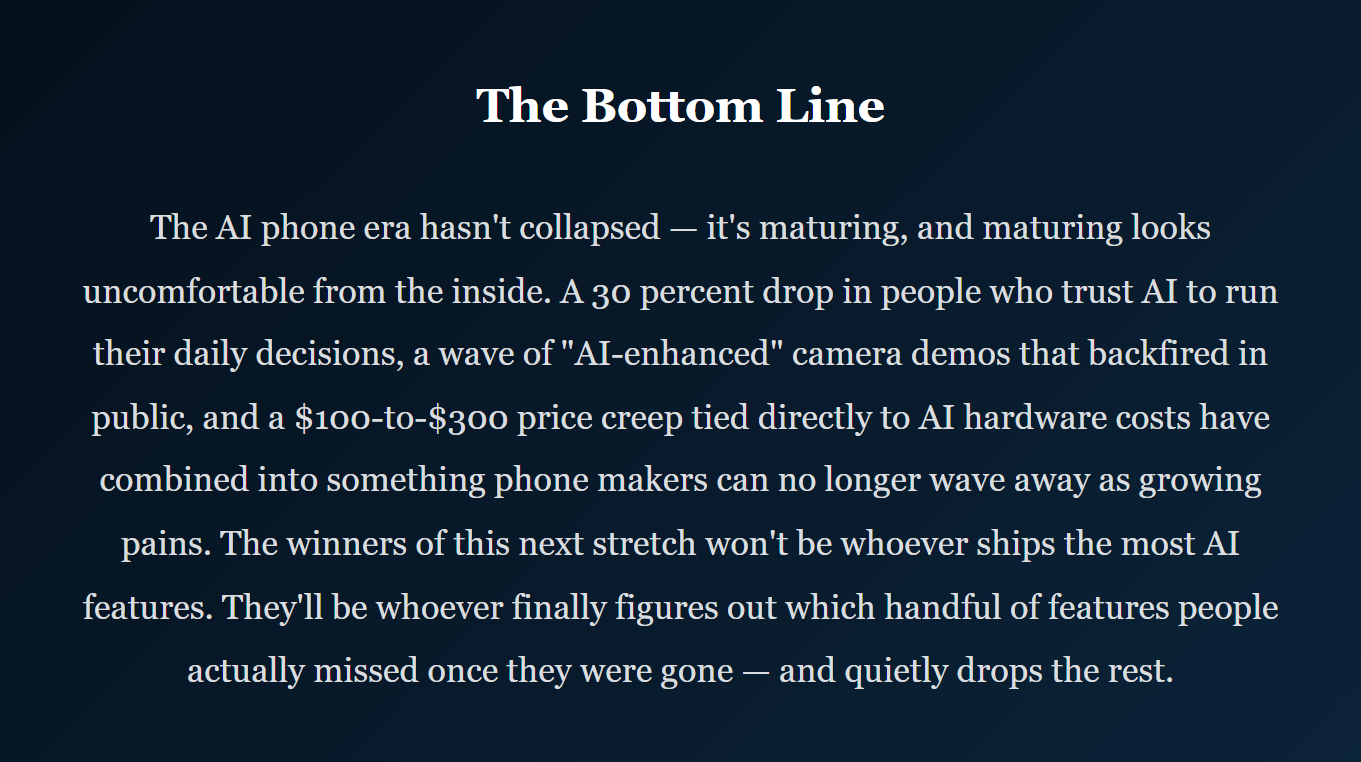
The bigger takeaway isn't really about phones at all. It's a reminder that consumers, eventually, always separate genuine utility from marketing noise — and 2026 looks like the year smartphone AI hit that reckoning first.
A note on the data
Consumer sentiment and pricing figures in this piece are drawn from multiple 2026 industry surveys and market trackers, which can vary in methodology. Treat the exact percentages as directional evidence of a real trend rather than fixed, universal numbers.