William BensonVIEW PROFILE →
Nobody's Watching, and That's the Point: How Autonomous AI Agents Learned to Pay Their Own Bills in Crypto
Software is now paying for its own cloud compute, data, and API access , no human required to click "approve."
Software is now paying for its own cloud compute, data, and API access — no human required to click "approve."
Crypto Picture an AI agent mid-task — researching a market, building a report, running a trading strategy — and it hits a wall. It needs more computing power, or a paid dataset, or access to a specialized API, and there's no human sitting nearby to pull out a credit card. A few years ago, that agent would simply stop and wait. Today, a growing number of them just pay for it themselves, in seconds, using a crypto wallet they were handed the moment they were switched on. What It Actually Means for Software to "Have" a Wallet The idea sounds almost mundane once you say it out loud, and that's exactly why it's spreading so quickly. An AI agent with a wallet isn't holding a debit card or logging into a bank account the way a person would. It's holding a set of cryptographic keys that let it sign transactions directly — sending stablecoins, paying invoices, settling with other software, all without a human in the loop for each individual payment. Give an agent that kind of financial autonomy, and it stops being a tool that only reads and recommends. It becomes something that can actually commit resources and get things done on its own. That shift matters more than it might seem. A purely advisory AI agent can tell you what to buy or which server to rent, but someone still has to execute the purchase. An agent with its own wallet skips that step entirely. It can rent the compute, buy the dataset, or pay for the API call in the same motion it decides it needs to — and it can do that hundreds of times a minute if the task calls for it, which is a pace no human approval queue could ever keep up with.

Meet x402: The Protocol Quietly Rebuilding How Machines Pay Each Other
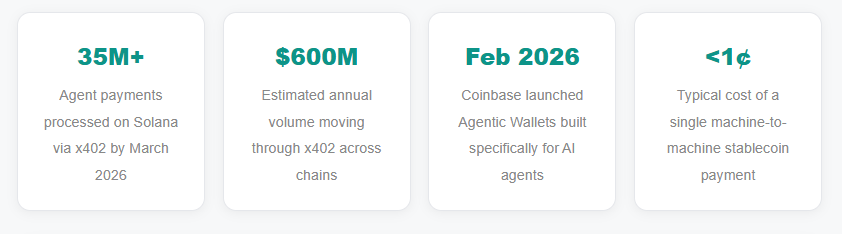
Most of the plumbing behind this new bot economy runs through a protocol called x402, built by Coinbase and named after an old, mostly forgotten piece of the internet's architecture: HTTP status code 402, "Payment Required." That code has technically existed in the web's core specification since the 1990s, sitting there unused for decades because nobody had built the infrastructure to actually act on it. x402 finally puts it to work. When an AI agent requests something from a paid API or data service, the server can now respond with that 402 status along with payment instructions, and the agent settles the bill in stablecoins right inside the same web request — no separate checkout page, no stored credit card, no account creation.
The appeal for developers building these services is straightforward: instead of managing subscription billing, API keys, and invoicing for an audience that includes both humans and increasingly autonomous software, they can simply price access per request and let payment happen automatically at the moment of use. For an AI agent calling a dozen different APIs in the course of finishing one task, that turns what used to be a tangle of accounts and credentials into something closer to inserting coins into a vending machine — quick, anonymous to the service, and done the instant the transaction clears.
An AI agent purchasing cloud compute needs settlement measured in seconds, not the days that traditional business payment systems were built around — and that mismatch, more than anything else, is what's pulling machine commerce toward crypto rails instead of the banking system.
Why the Old Payment System Was Never Built for This
It's worth pausing on why traditional finance struggles here, because the answer isn't really about crypto being trendy — it's about a genuine mismatch in design assumptions. Card networks, bank transfers, and most fintech infrastructure were built around human-scale transactions: a coffee, a flight booking, a monthly subscription. They assume a human identity behind every payer, they settle over hours or days rather than seconds, and their fees make sense for a $40 purchase but become absurd for a payment worth a tenth of a cent.
An autonomous agent breaks nearly every one of those assumptions at once. It isn't a legal person and can't easily open a bank account. It might need to make thousands of tiny payments in a single session, each one worth fractions of a cent, in a way that would get instantly flagged or throttled by conventional fraud systems built around human spending patterns. Stablecoins on fast, cheap blockchain networks solve the practical side of that problem: settlement in seconds, transaction costs low enough that even sub-cent payments make economic sense, and no requirement that the payer prove it's a human being before it's allowed to transact.

Where Agents Are Actually Spending Money Right Now
This isn't purely theoretical anymore. By early 2026, a handful of concrete categories had emerged where AI agents were genuinely transacting on-chain in production, not just in demos.
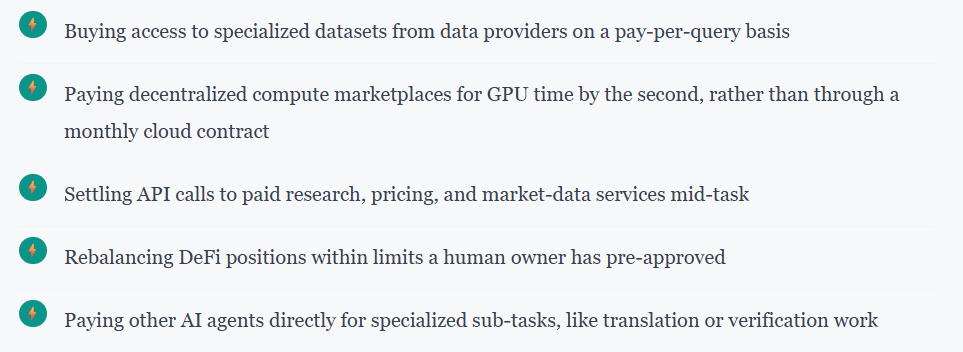
The data-and-compute category has ended up the biggest of the bunch, and it's not hard to see why. Decentralized compute networks, in particular, have benefited heavily from agent-driven payment volume, because they're built around exactly the pay-per-use pattern that suits a piece of software that only wants to rent a GPU for the ninety seconds it actually needs one, rather than commit to a subscription plan built for human customers.
Identity for software that isn't human
One quieter but genuinely important development underpins all of this: agents now increasingly carry an on-chain identity of their own, separate from any human's identity. A standard known as ERC-8004, deployed in early 2026, gives AI agents a persistent, cryptographically verifiable record they can carry across services — something closer to a reputation and credit history than a simple login. That matters enormously for agent-to-agent commerce specifically. If one AI agent is going to pay another for a sub-task, or extend it something like short-term credit, both sides need a way to judge whether the other is reliable, and a protocol-level identity system does that far more robustly than any single platform's internal reputation score ever could.
Keeping the Machines on a Leash
Handing autonomous software the ability to move real money obviously raises an immediate question: what stops an agent from spending recklessly, or worse, getting hijacked and drained by an attacker? The infrastructure that's emerged treats this as a first-order design problem rather than an afterthought.
The most common safeguard is scoped, temporary permissions rather than full account access. A technical standard called EIP-7702 lets a human owner grant an agent narrow, session-based authority — permission to spend up to a certain amount, within a certain protocol, for a limited window of time — while the owner's actual master keys stay locked away in cold storage the entire time. In practice, that looks like a person setting a daily cap on how much an agent can spend on data APIs, allowing it to rebalance funds only within one specific, pre-approved protocol, and requiring a human's explicit sign-off before anything moves across a bridge to a different blockchain entirely. It's a meaningfully different model from just handing a piece of software your wallet password and hoping for the best.
Enterprise-focused agent wallet products have leaned even further into this, building in daily and weekly spending caps, per-transaction limits, and dynamic risk scoring that can automatically tighten an agent's permissions if its behavior starts to look unusual. The overall philosophy is less "trust the AI completely" and more "give it exactly enough rope to do its job, and no more."
The Risks Nobody's Fully Solved Yet
None of this comes without genuine downsides, and it would be misleading to pretend otherwise. The same instant, irreversible settlement that makes crypto attractive for machine payments also means mistakes are far less forgiving than a disputed credit card charge — there's no chargeback if an agent gets tricked into paying the wrong address. Security researchers have also flagged that agents optimized purely to chase yield or efficiency can end up engaging in behavior that looks a lot like financial exploitation of the very systems they're plugged into, from front-running trades to gaming reward mechanisms, if they aren't constrained carefully.
There's also a broader fraud angle worth taking seriously. The same AI tools making legitimate agent commerce possible are being used by scammers to build far more convincing phishing sites, fake customer support bots, and impersonation schemes, and 2025 alone saw a record amount stolen through crypto scams and fraud industry-wide. None of that is a reason the agent economy won't keep growing — but it's a fair reason for both builders and everyday users to stay cautious rather than treat autonomous wallets as a solved, risk-free category.
A Few Straightforward Questions
Is this only relevant to crypto-native companies? Not anymore. Mainstream payment infrastructure providers, including players with no prior crypto focus, have been building agent payment products specifically because they've concluded existing systems weren't designed for non-human customers at all.
Do I need to personally hold crypto for an AI agent to use it on my behalf? In most current setups, yes — a human typically completes identity verification once and funds an agent's wallet with stablecoins, after which the agent operates within limits the human has set, rather than needing constant top-ups or approvals.
Is this actually widely used yet, or mostly hype? It's real but still early. Production deployments exist and are processing meaningful transaction volume, particularly around compute and data access, but it remains modest next to the broader stablecoin payments market as a whole — this is very much a category in its early growth phase rather than a fully mature market.
What happens if an agent's wallet gets compromised? This is precisely why scoped permissions and spending limits matter so much. A well-configured agent wallet limits the potential damage to whatever cap has been set, rather than exposing an owner's entire balance, though the underlying risk of any internet-connected system being targeted never fully disappears.
Worth keeping in mind
This is a genuinely fast-moving corner of both AI and crypto, with new protocols, standards, and products launching on a near-monthly basis throughout 2026. Treat any specific dollar figures or product names here as a snapshot of where things stood recently rather than a permanent state of the industry.