 William BensonVIEW PROFILE →
One Country, One Veto, One Exemption: How Greece Reshaped the EU's 21st Round of Russia Sanctions
Every EU sanctions package against Russia since the war began has needed all 27 member states to say yes at once. That single rule is also the quiet reason the bloc's newest, toughest round of measures nearly didn't happen at all.
Every EU sanctions package against Russia since the war began has needed all 27 member states to say yes at once. That single rule is also the quiet reason the bloc's newest, toughest round of measures nearly didn't happen at all.
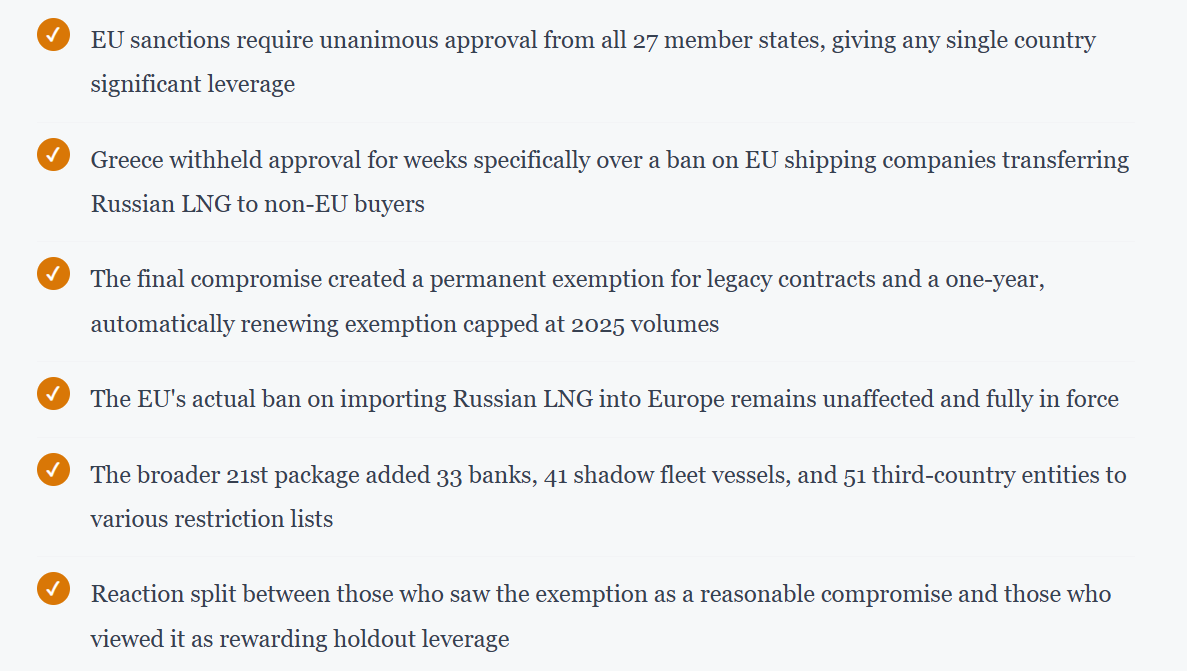
By late July, negotiators in Brussels had spent weeks assembling what was shaping up to be one of the most sweeping sanctions packages the European Union had put together since Russia's full-scale invasion of Ukraine began, new banking restrictions, dozens more vessels blacklisted from its shadow fleet, tighter export controls, and a long-anticipated tightening of the bloc's ban on Russian liquefied natural gas. Every other piece of the package had cleared the diplomatic hurdles it needed to. One country, though, was refusing to sign off, and under EU rules, refusing to sign off meant nothing else in the package could move forward either. That country was Greece, and its objection had nothing to do with disagreeing over the overall goal of squeezing Russia's war economy. Athens' concern was narrower and, from its perspective, existential for a specific slice of its own economy: a provision that would have stopped European shipping companies from transferring Russian LNG cargoes to buyers outside the EU, a business Greek shipowners, who control a significant share of the world's LNG carrier fleet, had built real revenue around. What followed was a genuinely tense standoff that ended, as these EU disputes so often do, not with Greece backing down or the rest of the bloc overruling it, but with a carefully worded exemption. Why one country can hold up sanctions on all of them EU sanctions packages require unanimous agreement among all member states to be adopted, a rule originally intended to ensure any measure this consequential carries the full, united weight of the bloc rather than a simple majority's preference. In practice, that same rule hands enormous leverage to any single government willing to withhold its vote, since a package with 26 countries in favor and one holding out is, legally speaking, exactly as stuck as a package with only one country in favor. Hungary has used that same leverage repeatedly and more visibly over the course of the war. This time, it was Greece's turn, and its objection centered on a genuinely specific commercial interest rather than a broader disagreement over sanctions policy itself.
The package was formally adopted by EU envoys on 23 July 2026 and entered into force the following day, ending weeks of negotiation that, according to diplomats close to the talks, came close to derailing the entire round of measures over this single sticking point.

What Greece was actually afraid of losing
The distinction Athens fought hardest to preserve is a subtle one that got lost in a lot of the early coverage: the EU's ban targets Russian LNG entering the EU itself, a measure that took effect earlier in 2026 and that Greece never contested. What Greece objected to was a separate, additional restriction that would have stopped EU-based shipping companies from transporting Russian LNG cargoes between non-EU buyers, business that never touches European soil or European consumers at all, but that generates real revenue for European, and disproportionately Greek, shipping firms.
The argument that ultimately won the exemption
Greek officials argued, consistently, that banning this specific transfer business wouldn't meaningfully reduce Russia's actual gas revenue, since buyers outside the EU would simply route those same cargoes through non-European shipping companies instead. The practical effect, in Athens' telling, would be European shipowners losing a substantial share of the business while Russian export volumes continued largely unaffected, a lose-lose outcome the Greek government was unwilling to accept without a fight.
We are hitting Putin where it hurts most.
— EU foreign policy chief Kaja Kallas, on the 21st sanctions package, July 2026

The compromise, in the actual legal detail
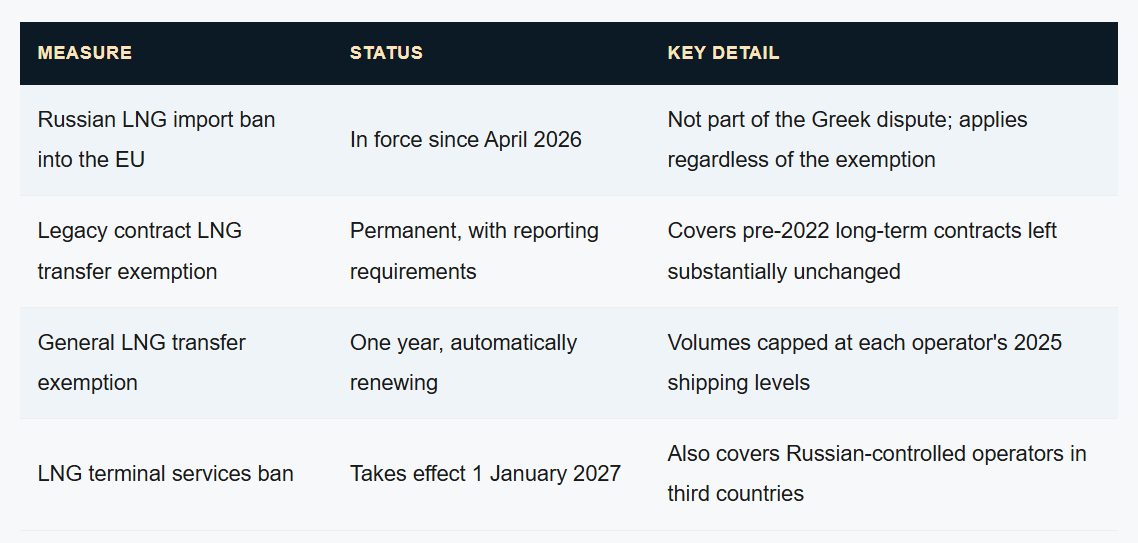
The final text grants two separate carve-outs rather than a single blanket exemption. Transfers of Russian-origin LNG made under long-term contracts signed before Russia's full invasion in February 2022, and left substantially unamended since, remain permanently exempt from the transfer ban, provided operators report their volumes and shipment data to national authorities. A second, temporary exemption covers other transfers, capped at each operator's 2025 shipping volumes, giving Greek and other European shippers a defined, if limited, path to keep participating in that trade without an open-ended commitment.
Import ban versus transfer exemption: the distinction that matters
It's easy to read headlines about a Greek "LNG exemption" and assume Russian gas can now flow into Europe again. It can't. The exemption applies narrowly to European shipping companies moving Russian LNG between other countries, cargo that never enters the EU market at all. The actual EU import ban on Russian LNG remains fully in effect, unaffected by the compromise Greece secured.
What else made it into the toughest package yet
The LNG dispute dominated headlines, but the rest of the 21st package covers considerably more ground. Thirty-three additional Russian financial institutions were added to the EU's transaction ban, extending restrictions to the use of certain financial messaging services as well. Forty-one more vessels linked to Russia's so-called shadow fleet, ships used to circumvent the existing oil price cap, were added to the sanctions list, alongside expanded criteria that now allow the EU to sanction support vessels like bunkering ships that service already-listed tankers. Fifty-one additional entities, including firms based in China, Turkey, India, and several other third countries, were added to export control lists for allegedly helping Russia work around existing restrictions, and the package suspended automatic adjustments to the oil price cap for a full year, a response to market disruption tied to tensions around the Strait of Hormuz.

The criticism from both directions
Reaction to the compromise split along fairly predictable lines. Supporters of a harder line on Russia, including some member states and Ukraine-aligned commentators, argued the exemption sets an uncomfortable precedent, rewarding a holdout government with a carve-out rather than requiring unanimous, unconditional agreement on measures the rest of the bloc considered necessary. Greece's defenders countered that protecting a legitimate national economic interest through negotiation, rather than simply blocking sanctions outright the way some other holdout states have done in the past, was a reasonable and ultimately cooperative use of its veto leverage, one that still allowed a genuinely tougher overall package to pass. One EU diplomat, describing the mood after the deal was struck, suggested other member states extended Greece the same solidarity they'd expect to receive themselves in a future dispute, a framing that acknowledges just how routinely this exact negotiating dynamic recurs.
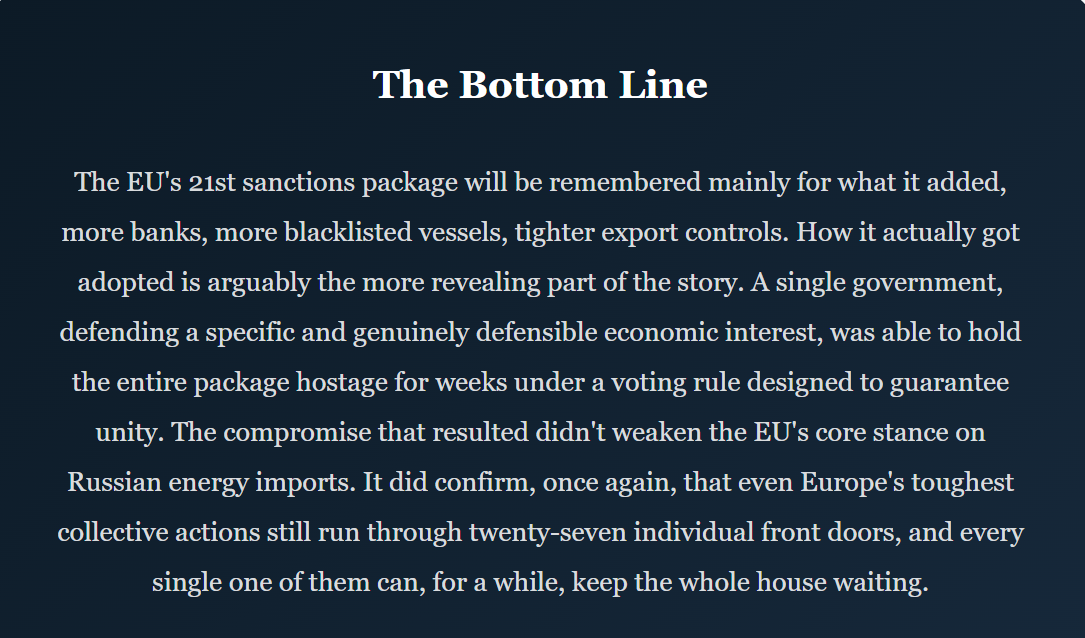
None of this is likely to be the last time this exact dynamic plays out. The EU's unanimity requirement has produced this same basic pattern, a holdout government, a tense multi-week standoff, and an eventual narrowly tailored exemption, across multiple previous sanctions rounds, and there's little structural reason to expect the 22nd package, whenever it comes, to unfold any differently. What Greece's stand this time actually demonstrates is less about Russia policy specifically than about how the EU's own decision-making architecture continues to shape, and occasionally soften, even its most urgent collective actions.