 William BensonVIEW PROFILE →
One Night, 140 Millimetres: How Accra Drowned Again in June 2026
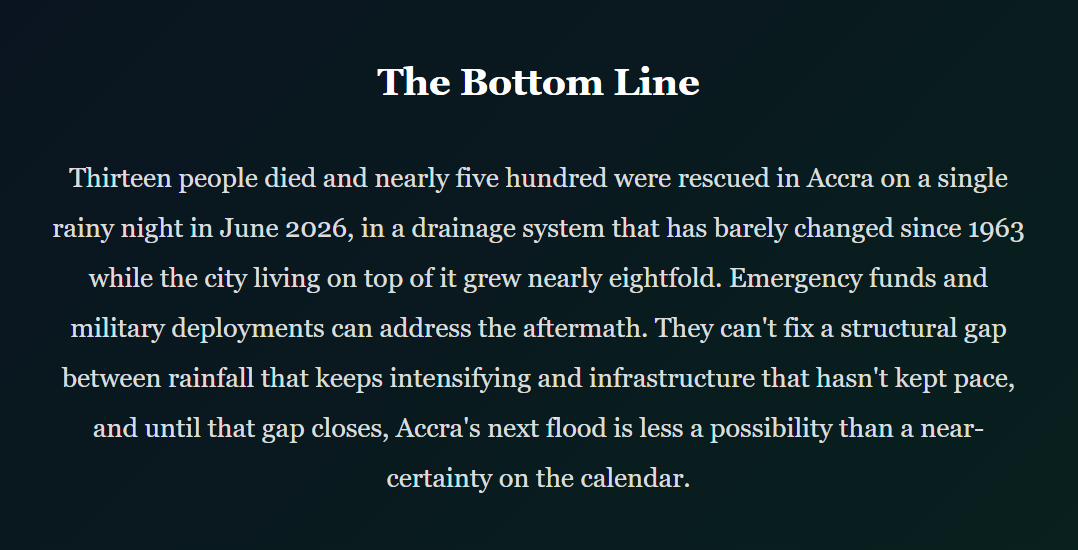
Thirteen people dead, nearly 500 rescued in a single night , and a drainage system built in 1963 for a city that has grown eightfold since.
Thirteen people dead, nearly 500 rescued in a single night — and a drainage system built in 1963 for a city that has grown eightfold since.
Monday night in Accra started the way heavy rain always starts here — inconvenient, then alarming, then, within a few hours, life-threatening. By sunrise, thirteen people were dead, nearly five hundred had been pulled from rising water, and a city of more than four million was once again asking why this keeps happening to the exact same streets. Ghana's capital doesn't flood because of one bad storm. It floods because it has been having the same argument with its own drainage system for more than sixty years, and on June 29, 2026, that argument came to a head in the worst way possible.
The Night the Drains Gave Up
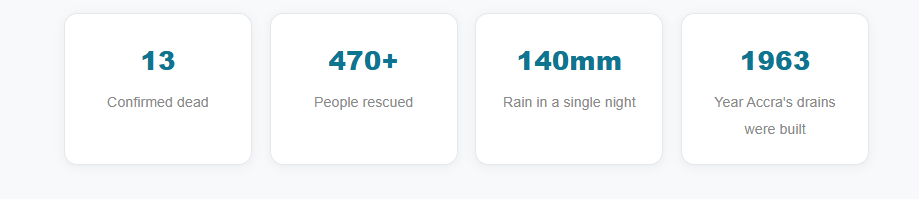
The rain began building on the evening of June 29 and, by the time most of Accra had gone to bed, had turned into one of the heaviest single-night downpours the city had recorded in years — roughly 140 millimetres, according to the Ghana Meteorological Agency, nearly triple the highest daily total logged the year before. In neighbourhoods like Kaneshie, Odawna, Adabraka, and the area around Kwame Nkrumah Circle, roads that carry tens of thousands of commuters every morning turned into fast-moving rivers within a matter of hours.
The Ghana National Fire Service, which led the emergency response, confirmed a death toll of at least thirteen, cautioning that the number could still rise as search teams worked through areas that remained difficult to reach. Fire officials in the Greater Accra region said crews had rescued more than 400 people overnight, pumping water out of flooded homes and pulling stranded residents from vehicles and rooftops. By the following day, that rescue count had climbed past 470.
A Drainage System Older Than Independence's Second Generation
The uncomfortable truth at the centre of this story isn't the rainfall itself — it's the infrastructure trying, and failing, to handle it. Accra's core drainage network dates back to 1963, designed for a population of roughly half a million people. Today, more than four million people live in the city, and the drains carrying their stormwater have not been meaningfully redesigned to match that growth.
President John Dramani Mahama, who conducted an aerial survey of the damage in the days that followed, pointed directly at two compounding factors: climate change intensifying rainfall events, and decades of illegal construction directly on top of waterways and drainage channels. It's a combination officials and researchers in Accra have been describing for years — a city whose rivers, including the Odaw and Onyasia, are meant to carry rainwater from the northern Akwapim Ridge down to the coast, but whose natural retention basins have been steadily built over by unchecked urban expansion.
Ghana's meteorological data tells its own story: June rainfall totals in Accra climbed from roughly 85 millimetres in 2024 to 172 millimetres in 2025, and then to 333 millimetres in 2026 — a pattern of intensifying rainy seasons that Accra's drainage infrastructure was never built to absorb.
This Has Happened Before, and Officials Know It
Accra's relationship with catastrophic flooding stretches back further than most of its current residents realise. Archival footage from July 1968 shows an almost identical scene — military helicopters lifting people from rooftops, submerged roads, families displaced by a few inches of relentless rain. In 2015, flooding combined with a fire at a fuel station killed more than 150 people in a single disaster that briefly forced the country to confront its drainage crisis head-on. It happened again in 2023, when weeks of flooding displaced tens of thousands of people across the wider region.
The government's response this time followed a familiar shape: emergency funds released, the military and police deployed to support relief work, and a public acknowledgment, this time from the government itself, that its initial response had fallen short. Authorities also warned that the danger wasn't fully over — with the ground already saturated, any further heavy rain in the days ahead carried a real risk of renewed flooding even without a storm as severe as the one that had just passed.
The Questions People Keep Asking
Why does Accra flood so badly compared to other coastal cities? Geography plays a real role — Accra sits on a natural incline between the Akwapim Ridge and the Gulf of Guinea, meaning rainwater from the northern hills naturally rushes downward through the city toward the sea. That geography isn't unusual on its own; what makes it dangerous is that the city's natural floodplains and retention areas have been steadily built over, leaving rainwater nowhere to go except through people's homes.
Is anything actually being done to fix the drainage system long-term? Successive governments have invested in dredging and clearing waterways ahead of each rainy season, and officials have repeatedly called for stricter enforcement against illegal construction on drainage channels. Researchers and urban planners have argued this reactive approach, clearing silt and debris each year, treats the symptoms rather than the underlying infrastructure gap between a 1960s drainage system and a 21st-century population.
Was this the deadliest Accra flood in recent memory? No. The 2015 flood-and-fire disaster killed over 150 people, making it far deadlier in terms of lives lost. What made the June 2026 event notable was less the death toll on its own and more the intensity of rainfall recorded in a single night, and how clearly it fit an accelerating multi-year trend in the data.
What This Flood Actually Represents
It would be easy to read this as an isolated tragedy, thirteen deaths, a bad night, a government response, and move on until the next storm. But the numbers tell a more specific story: rainfall intensity in Accra has nearly quadrupled over three consecutive years, according to the country's own meteorological data, while the physical capacity of the city's drains to carry that water away hasn't changed in any meaningful way since before most of the city's current population was born.
That gap, between how much rain is now falling and how much water the city's infrastructure can actually move, is the real subject of this story. Rescue crews can be as fast and as well-equipped as any city in the world, and the outcome will still depend on whether the water has somewhere to go once it hits the ground. In Accra, right now, it mostly doesn't.
A note on this reporting
Figures in this piece reflect statements from the Ghana National Fire Service, government officials, and international and regional wire reporting on the June 29-30, 2026 Accra floods. Death tolls in the immediate aftermath of flooding disasters are often provisional and can shift as search operations continue.