 William BensonVIEW PROFILE →
Osun Governor Won Re-Election. His Party Says Dozens of Its Members Are Still in Detention.
A governorship race that Adeleke's camp called a triumph for democracy has left an uncomfortable question hanging over it: what happens to the people arrested along the way.
A governorship race that Adeleke's camp called a triumph for democracy has left an uncomfortable question hanging over it: what happens to the people arrested along the way.
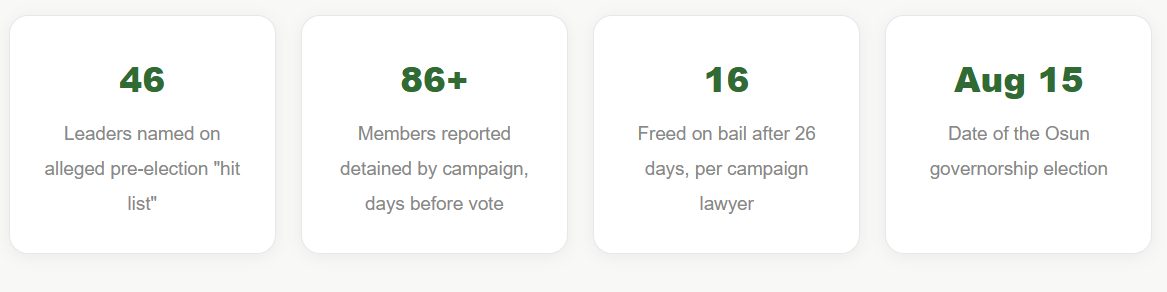
Victory speeches tend to follow a familiar script, gratitude to voters, promises for the term ahead, a nod to the opposition for a hard-fought contest. When Governor Ademola Adeleke's campaign marked his re-election win in Osun State on August 15, the tone was different. Alongside the celebration came a demand, repeated by his party's national leadership within days of the result being announced: release the dozens of Accord Party members still sitting in detention facilities in Abuja and Nasarawa State, some of whom had been there since before voters even cast a ballot. It's an unusual position for a winning campaign to find itself in, celebrating a mandate while simultaneously arguing that the process that produced it was compromised by the arrest of its own people. Understanding how Osun State arrived at this moment requires going back several weeks, before the actual vote, to a series of allegations that Adeleke's camp says were only the beginning. The warning that came before the vote Roughly two weeks before the August 15 election, the Ademola Adeleke Campaign Council, known as the Imole Campaign Council, went public with a specific and dramatic claim: that it had obtained what it described as a "hit list" naming 46 Accord Party leaders allegedly marked for arrest on what the council called trumped-up charges, with plans to transfer them to Abuja during the election period. Deputy Director-General Kolapo Alimi told reporters in Osogbo that the council would not "sit idly by while our democracy is dismantled by desperate politicians using public security forces," and called on Inspector-General of Police Kayode Egbetokun to direct state and federal police units to halt what he described as arbitrary arrests and harassment of opposition members. Days later, Governor Adeleke escalated the claim personally at an emergency press briefing, alleging that a police signal had reached Osun State directing the immediate arrest of Accord Party leaders, with instructions that those detained be transferred to Abuja and held until after the vote. He said he had raised the matter directly with the Inspector-General. "Arresting Accord Party leaders on the eve of an election amounts to the police helping and assisting the APC to rig the election."
How the numbers grew as election day approached
What followed was a steady stream of updated, and escalating, figures from Adeleke's campaign organization. By the time the campaign petitioned Nigeria's National Human Rights Commission in Abuja, it was citing more than 62 detained party leaders. Days later, campaign spokesperson Pelumi Olajengbesi told reporters that over 86 members had been arrested "for no reason" in the span of two to three days, with 36 transferred to the Nigerian Correctional Service facility in Keffi, Nasarawa State, and 14 others moved to the Kuje Custodial Centre in the Federal Capital Territory.
Olajengbesi was direct about what he believed those transfers signified. "These people have been taken from Osun to Abuja by road and detained unnecessarily," he told journalists after visiting the headquarters of the Intelligence Response Team in Abuja on behalf of the detainees. "There is no single charge against them, no allegation and no explanation." When contacted directly, Osun State Commissioner of Police Ibrahim Gotan offered a brief, noncommittal response. "I am not aware," he said. "Let me check and get back to you." According to reporting from Political Economist, he did not follow up.

Two accounts that don't line up
As with many disputes of this kind, the two sides describe fundamentally different realities. Adeleke's campaign has been unambiguous in framing the arrests as a coordinated, politically motivated operation designed to weaken Accord Party organization in the days when campaign logistics and voter mobilization matter most. Police officials contacted by journalists have, at various points, either declined to confirm the scale of the detentions or offered no substantive response at all.
That gap between a detailed, repeatedly escalating account from one side and a largely unaddressed set of questions from the other is, in itself, one of the more striking features of this story. It's difficult to independently verify a "hit list" or a specific police signal without access to internal police communications, but the underlying fact that a significant number of people were arrested and moved to out-of-state detention facilities has been corroborated across multiple independent Nigerian news outlets, and, more consequentially, by a court.
Where the courts have weighed in
Nigeria's judiciary has not stayed entirely on the sidelines. According to Olajengbesi, a court granted unconditional bail to at least 16 of the detained Accord members, including Alaba Popoola, the party's House of Representatives candidate for the Ijesa South Federal Constituency, who spent 26 days in detention before being released. The detainees, Olajengbesi said, had been arrested "simply for canvassing votes for Governor Ademola Adeleke in Osun State during the just-concluded election."
Why the court's involvement matters
A judge granting unconditional bail, rather than bail tied to specific charges or conditions, often signals that a court found little or no substantive case justifying continued detention in the first place. It doesn't resolve the broader dispute over motive, but it does lend independent weight to claims that at least some of the detentions lacked a clear legal basis.
Adeleke's win, and the demand that followed it
Despite the turbulence surrounding the campaign period, Adeleke went on to win the August 15 election. Accord Party National Chairman Maxwell Ngbudem described the result as "a major triumph for democracy and a demonstration of the people's resolve to freely choose their leaders." But Ngbudem's statement didn't stop there. He immediately followed the celebration with a demand for the release of Accord leaders, candidates, members, and supporters still held in Osun, Abuja, and Nasarawa, calling their continued detention after the election "unnecessary" and a violation of their fundamental rights under Nigeria's 1999 Constitution.
"It is in the interest of justice and equity to release them immediately. The election is over, there is no need for their detention."
— Maxwell Ngbudem, National Chairman, Accord Party
That framing, that whatever justification may have existed for the arrests, if any, evaporated the moment the election concluded, has become the party's central argument in the days since the vote. The Imole Campaign Council reiterated the point in a statement issued by Bamidele Sallam, chairman of its Media and Publicity Sub-Committee, describing the arrests as illegal and calling once more for the immediate release of those still held, citing the Inspector-General's own directive for a free and fair election and a presidential directive on the same subject as grounds the police should already be honoring.

A pattern that extends beyond one campaign
Adeleke's allegations weren't limited to police conduct alone. During the same period, he publicly called for the arrest of Senator Fadahunsi, accusing him of incitement against the people of Ijesaland and Osun State, in remarks that underscore just how adversarial the pre-election atmosphere had become on multiple fronts simultaneously. He also demanded an end to what he called "illegal operations" by the Intelligence Response Team, a federal police unit, alleging its officers had been arresting Accord Party leaders across local government areas without justification.
Election-season tension between incumbent state governments and federal security agencies is not a new phenomenon in Nigerian politics, particularly in states where the governing party at the state level differs from the party controlling the federal government. What makes this case notable is the specificity and volume of individual, named detentions being alleged, and the fact that a sitting governor was willing to make these accusations publicly and repeatedly, rather than through quieter diplomatic channels, in the days immediately before his own re-election vote.
This article reflects statements made by the Adeleke campaign, Accord Party officials, and Osun State's police commissioner as reported by Premium Times, Vanguard, Tribune Online, and other Nigerian outlets. Nigeria's police leadership has not issued a detailed public response to the specific allegations described here, and the claims made by the campaign remain, in large part, independently unverified beyond the court proceedings noted above.
What remains unresolved
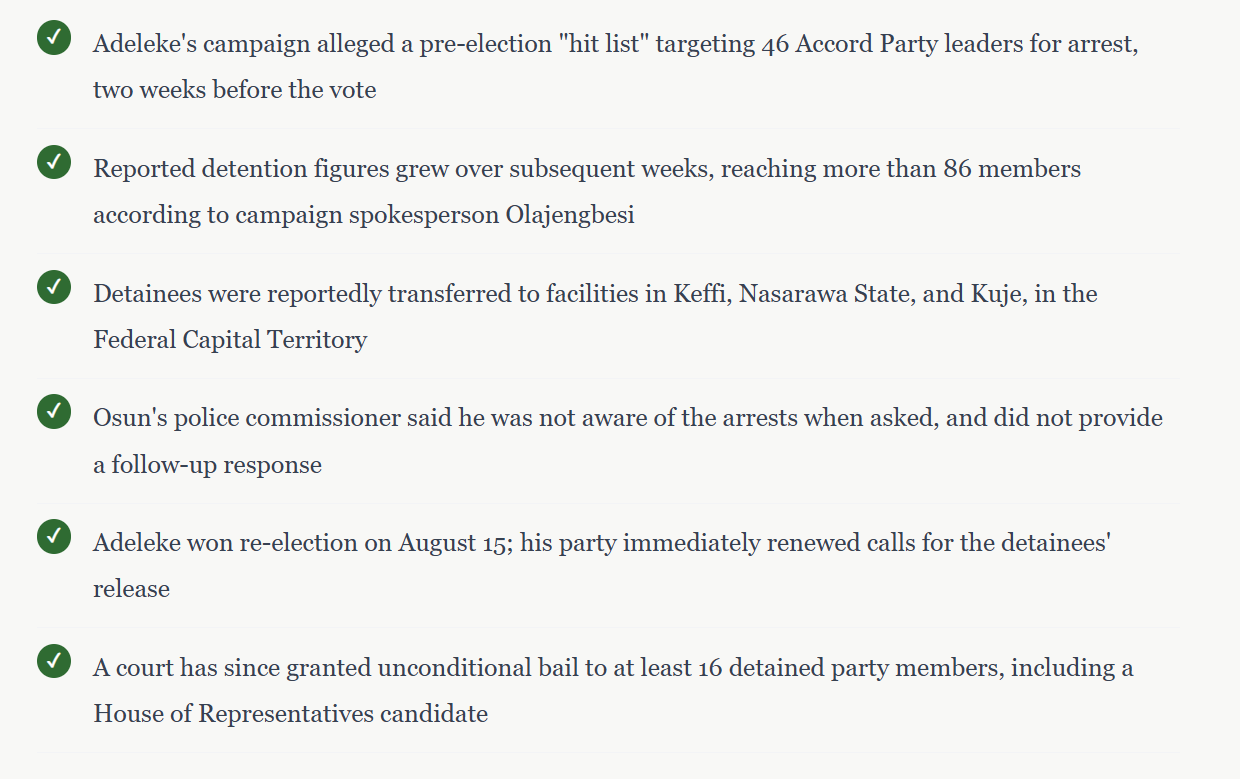
With the election over and the results standing, the practical question now is a narrower one than the sweeping allegations that dominated the campaign period: how many Accord Party members remain in detention, on what legal basis, and whether the courts will continue to intervene the way they did for the 16 members already granted bail. Accord Party's national leadership has made clear it considers this an open, ongoing issue rather than a footnote to a concluded election, and the language coming from party officials in the days since the vote, invoking constitutional rights rather than campaign grievances, suggests the party intends to keep pressing the matter through legal and public channels rather than letting it fade once the immediate electoral stakes have passed.
For Nigeria's broader political landscape, the episode adds to an ongoing conversation about the role of federal security agencies during state-level elections, and about how much independence police commissioners in individual states genuinely exercise when directives, alleged or confirmed, arrive from federal channels during politically sensitive periods. Whether this specific case prompts any formal investigation into the conduct described by Adeleke's campaign remains, for now, an open question.