 William BensonVIEW PROFILE →
Powering the Machine: How Artificial Intelligence Is Forcing Big Tech to Resurrect Nuclear Energy
Your next chatbot answer might come from a reactor that was scheduled for the scrapyard a decade ago. Here's how AI turned nuclear power from a relic into the hottest asset in tech.
Your next chatbot answer might come from a reactor that was scheduled for the scrapyard a decade ago. Here's how AI turned nuclear power from a relic into the hottest asset in tech.
Your next chatbot answer might come from a reactor that was scheduled for the scrapyard a decade ago. Here's how AI turned nuclear power from a relic into the hottest asset in tech.
Somewhere in Pennsylvania, workers are racing to restart a reactor that once symbolized nuclear power's worst decade. It's not being revived to light up homes or run factories. It's being revived to answer chatbot queries. That single detail says more about where the AI industry actually stands in 2026 than any keynote slide — the bottleneck was never really the chips. It's the electricity to run them.
The Energy Crisis Nobody Saw Coming
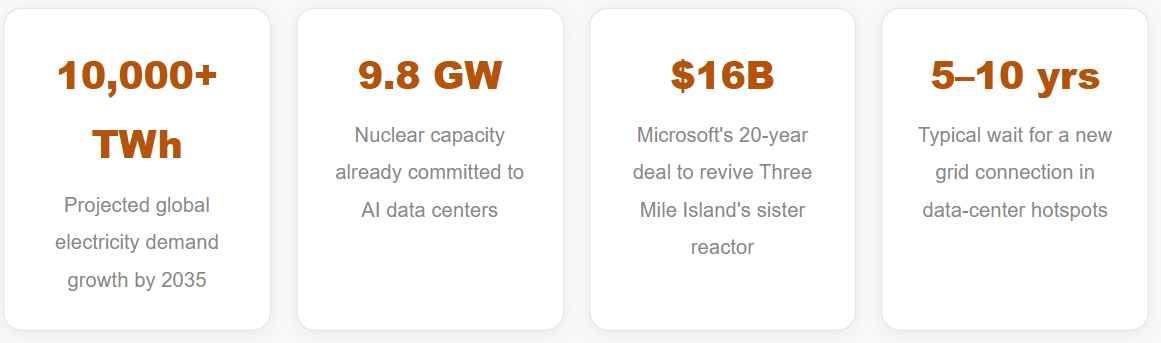
Every large AI model runs on a data center, and every data center runs on power — an obvious fact the industry mostly ignored until very recently. That changed fast once the numbers started rolling in. US AI data centers consumed over 10 percent of the country's total electricity in the first quarter of 2026, up from roughly 4 percent just three years earlier. Global electricity demand is projected to grow by more than 10,000 terawatt-hours by 2035, an amount equivalent to re-adding the entire current electricity consumption of every advanced economy on Earth, with data centers responsible for over a fifth of that growth.
The scale of a single facility makes the problem concrete. A large-scale AI data center running tens of thousands of high-end chips continuously draws somewhere between 150 and 200 megawatts — roughly the same as powering 150,000 average American homes, all day, every day, without pause. Multiply that by the dozens of new facilities hyperscalers are racing to build, and the math stops working for a power grid that was never designed for this kind of concentrated, always-on demand.
Why Nuclear, Specifically
Solar and wind are cheaper to build and faster to deploy, but they share one disqualifying flaw for this particular use case: they don't run at night, or on a still, cloudy day. AI data centers can't simply power down when the sun sets — the chips inside need constant, uninterrupted electricity, 24 hours a day, or the workloads running on them fail. That single requirement, engineers call it "baseload power," rules out most renewable sources on their own and points straight back to nuclear, which is one of the only carbon-free energy sources capable of running flat-out around the clock for years without stopping.
There's also a density argument. A nuclear plant produces an enormous amount of continuous power from a relatively small physical footprint compared to the sprawling acreage solar or wind farms would need to match it — a meaningful advantage when speed and land availability near existing transmission lines are both in short supply.
The Deals Actually Reshaping the Industry
This isn't abstract policy talk — it's real money changing hands, fast. Microsoft signed a 20-year, $16 billion agreement to buy every watt of power from what used to be Three Mile Island's Unit 1 reactor, now renamed the Crane Clean Energy Center, expected back online in late 2027. Amazon has taken a different approach, combining a direct investment in small modular reactor developer X-energy with a 1.9-gigawatt, multi-decade power purchase agreement from the Susquehanna nuclear plant in Pennsylvania, part of a broader $20 billion buildout of its Pennsylvania data center footprint.
Google and Amazon both separately announced investments in small modular reactor startups within two days of each other in a previous cycle, betting on next-generation reactor designs that are smaller, faster to build, and easier to place near existing transmission infrastructure than a traditional plant. Meta, meanwhile, has taken the broadest swing of all four companies — a request for proposals targeting between 1 and 4 gigawatts of entirely new nuclear generation, on top of an existing agreement to buy power from a working Illinois nuclear plant.
The Global Impact: Old Atomic Plants Suddenly Have a Second Life
For nearly forty years, building a new nuclear plant in the US was considered close to financially impossible — construction costs routinely spiraled, timelines stretched past a decade, and utilities simply stopped trying. What's changed isn't the underlying economics of building a reactor from scratch; it's that a handful of companies with practically unlimited capital and an urgent need for guaranteed power are now willing to fund exactly the kind of long-term, capital-intensive project that scared off traditional utilities for decades.
The shift is being described by people inside the industry as nuclear power becoming "bankable" again — not because public opinion changed, but because a small group of buyers showed up with the willingness to sign twenty-year contracts and cover the upfront cost themselves.
That shift is also reshaping the broader climate and energy conversation in ways few predicted. Plants once treated as expensive relics, awaiting eventual decommissioning, are now strategic assets. Communities near existing reactors are seeing direct tech investment flow into local infrastructure and energy pricing. It's also stirring real controversy — data centers in regions like Northern Virginia have already triggered grid capacity warnings, and new connection requests in data-center-heavy areas are now backed up five to ten years, raising uncomfortable questions about who gets priority access to a country's power supply: nearby residents, or the data center down the road.
Could Tech Companies Actually End Up Owning Their Own Power Grids?
It sounds like science fiction, but the direction of travel is genuinely pointing that way. Some of these deals already go beyond simply buying electricity from an existing grid — Microsoft's arrangement effectively earmarks an entire reactor's output for its own use, sidestepping the public grid almost entirely. Wholesale power prices near hyperscale data center clusters have reportedly surged as much as 267 percent, and rather than compete with everyone else for scarce grid capacity, several companies are now exploring direct, private transmission lines connecting a power source straight to a data center — a setup energy analysts call "behind-the-meter" power, essentially building a private grid one contract at a time.
Nobody is describing this as tech companies becoming utilities outright — regulatory and safety oversight for nuclear power remains firmly with government bodies regardless of who's buying the electricity. But the practical effect, a handful of corporations controlling dedicated, guaranteed access to gigawatts of carbon-free power that ordinary households and businesses can't touch, is already closer to reality than theory.
A Few Honest Questions People Are Actually Asking
Will this make my own electricity bill go up? It's a legitimate concern in regions near these deals — wholesale prices have already climbed sharply in some data-center-dense areas, though most of these contracts are structured so the tech company, not local ratepayers, covers the reactor's costs directly.
Is nuclear power actually safe enough to scale this fast? Existing reactor restarts, like Microsoft's Three Mile Island deal, use proven, decades-old technology under the same regulatory oversight as any nuclear plant. The newer small modular reactor designs are less proven at commercial scale and remain at least several years from widespread operation in the US.
Does this mean AI is actually good for the climate? That's genuinely contested. Nuclear power itself is carbon-free, which is a real climate positive compared to the natural gas plants some data centers still rely on. But it doesn't address the broader question of whether the energy cost of AI's growth is worth what it delivers — a debate very much still unresolved.
What This Actually Means Going Forward
The headline "tech giants buying nuclear plants" sounds like a stunt until you look at the underlying numbers, and then it looks more like the only realistic option left. Traditional grid expansion simply can't move fast enough to match AI's growth curve, and no other carbon-free power source can currently match nuclear's ability to run nonstop at scale. What started as a handful of experimental deals two years ago has become, in 2026, one of the largest corporate reshapings of the US energy landscape in decades — driven not by policy, but by a handful of companies that decided the fastest path to more computing power ran straight through a reactor.
A note on the numbers
Nuclear capacity commitments and pricing figures are drawn from multiple 2026 industry trackers and vary by source as new deals are announced regularly. Treat the totals in this piece as a snapshot of where things stood in August 2026, not a final tally.