 William BensonVIEW PROFILE →
Retail Traders Got Burned Chasing Dog Coins. Now Wall Street Is Quietly Buying the Boring Stuff , On-Chain
While joke coins bled billions in value, a much quieter corner of crypto , Treasuries, bonds, and real estate on a blockchain , quietly tripled.
While joke coins bled billions in value, a much quieter corner of crypto — Treasuries, bonds, and real estate on a blockchain — quietly tripled.
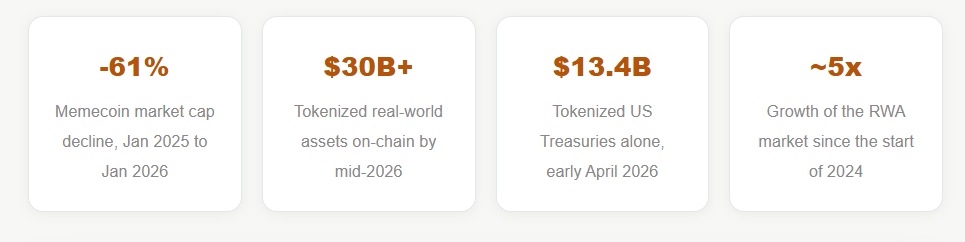
There was a moment, not that long ago, when it felt like every corner of crypto Twitter was talking about the same thing: a coin with a cartoon dog on it, or a frog, or some inside joke that had somehow turned into an eight-figure market cap overnight. That moment has largely passed. What's replaced it is far less exciting to talk about at a party, and far more interesting to anyone actually trying to build wealth: US Treasury bills, corporate credit, and real estate, minted as tokens and settled on the same blockchains that used to be memecoin playgrounds. The Numbers Tell the Story Before Anyone Has to Say a Word Start with what happened to memecoins, because the collapse is genuinely dramatic. Total memecoin market capitalization fell from roughly $93 billion in January 2025 to around $36 billion by January 2026 — a decline of about 61 percent in a single year. Trading volume told an even starker story, sliding from a mid-2025 peak near $20 billion down to under $3 billion by December. Even the on-ramps for new speculation dried up: daily new wallet sign-ups on Solana's popular memecoin launchpad pump.fun fell by roughly two-thirds over the same stretch, from nearly 186,000 a day at the peak to around 30,000 by year's end. Meanwhile, in a part of the crypto market that rarely trends on social media, something close to the opposite was happening. Tokenized real-world assets — meaning traditional financial instruments like government bonds, money market funds, private credit, and property, represented as tokens on a blockchain — grew from around $6 billion in early 2025 to more than $30 billion by mid-2026. That's not modest growth. It's the kind of trajectory that gets institutional risk committees paying attention, even when the underlying asset is something as unglamorous as a 90-day Treasury bill.

What Actually Counts as a "Real-World Asset" On-Chain
The term sounds abstract until you break down what's actually happening under the hood. Tokenizing a real-world asset generally means placing the underlying instrument — a Treasury bill, a slice of a private credit fund, a share of a commercial building — into a legal wrapper, typically a trust or a special-purpose vehicle, and then issuing blockchain tokens that represent proportional ownership of that wrapper. Smart contracts handle the operational side: distributing income to token holders, enforcing who's allowed to hold the token based on regulatory requirements, and managing transfers.
The result is something that behaves almost identically to the traditional version of the asset in terms of risk and return, but gains a handful of very practical advantages from living on a blockchain: near-instant settlement instead of the multi-day process typical of traditional securities, the ability to trade around the clock rather than only during market hours, and much easier access for investors who wouldn't otherwise have an easy path into, say, institutional-grade private credit.
Why This Is an Institutional Story First, and a Retail Story Second
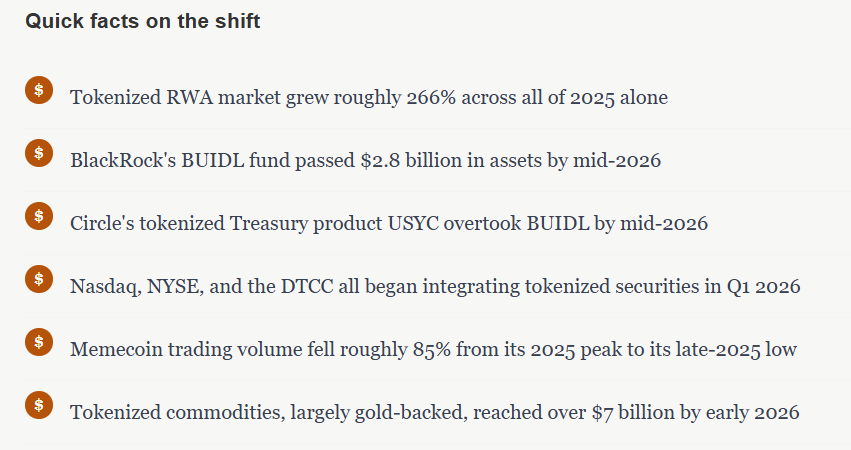
It would be easy to assume this shift is being driven by disillusioned memecoin traders looking for something safer, but that's not really where the money is coming from. The growth in tokenized RWAs has been overwhelmingly institutional. Nasdaq, the NYSE, and the Depository Trust and Clearing Corporation — the organization that quietly handles settlement for a huge share of US securities trading — have all been moving in the same direction: integrating tokenized securities into the existing architecture of regulated markets, rather than treating them as some experimental side project.
Asset managers have followed the same path. BlackRock's tokenized Treasury-backed fund, known as BUIDL, had grown past $2.8 billion in assets by mid-2026. Franklin Templeton, Apollo, Hamilton Lane, and WisdomTree all have live tokenized products in the market as well, and data provider RWA.xyz tracks their combined assets in close to real time — a level of institutional transparency that simply didn't exist around this category even two years earlier.
When rates feel uncertain and traditional distribution channels feel clunky and slow, on-chain yield instruments stop looking like a novelty and start looking a lot more like infrastructure — which is precisely the argument several major asset managers have been making internally as they've built out tokenized products.
Where the yield actually comes from
It's worth being precise here, because "crypto yield" has a reputation problem after years of unsustainable token-emission schemes. Tokenized Treasuries don't generate yield the way a typical DeFi protocol does, by printing new tokens to reward depositors. The yield comes directly from the underlying government securities, generally in the 4 to 5 percent range annually as of mid-2026, delivered programmatically through smart contracts rather than through a quarterly brokerage statement. That backing by the US government, rather than by a protocol's own token, is exactly why institutional risk teams have been comfortable getting involved in a way they never were with earlier DeFi lending products.
Tokenized Real Estate: Still Small, But No Longer Theoretical
Real estate tokenization has had a rockier history than Treasuries. Early attempts back in 2018 and 2019 to fractionalize property ownership through blockchain tokens mostly failed to gain real traction, largely because the legal frameworks around ownership rights were ambiguous, custody arrangements were uncertain, and there wasn't yet an institutional distribution network willing to put its name behind the products.
That's begun to change, even if property remains one of the smaller categories within the broader RWA market compared to Treasuries and private credit. The core appeal hasn't changed: real estate has always been a genuinely attractive asset class for long-term investors, but it's traditionally been locked behind large minimum investments, slow closing processes, and geographic limitations. A tokenized structure, in principle, lets an investor hold a fractional, liquid claim on a property or a real estate fund without needing six or seven figures upfront or waiting weeks for a transaction to clear.

The Concentration Problem Nobody's Fully Solved
None of this means the tokenized asset market is evenly diversified or risk-free, and it's worth being honest about that rather than only telling the flattering version of the story. As of mid-2026, roughly 80 percent of the total tokenized RWA market's value sits in just one category: US Treasury and cash-equivalent products. That concentration matters for two reasons. First, it means the sector's growth is still fundamentally a story about government-backed yield rather than a genuinely diversified alternative asset class. Second, a market that leans this heavily on one instrument type is more exposed to a single regulatory or macroeconomic shift than a more evenly spread market would be.
There's also a structural point worth flagging: much of the settlement infrastructure underlying tokenized RWAs currently runs on a relatively small number of blockchain networks. That's a normal feature of an early-stage market finding its footing, but it's a meaningfully different risk profile than a fully mature, diversified financial market, and it's the kind of detail that gets glossed over in headline growth numbers.
What This Actually Means for Everyday US Investors
For someone weighing where to put money in 2026, the practical takeaway isn't that tokenized Treasuries are guaranteed to outperform anything, or that memecoins are permanently finished — speculative crypto has cycled back from supposed "death" before, and probably will again. The more useful takeaway is about what kind of exposure each category actually offers. A memecoin's value is driven almost entirely by attention, sentiment, and momentum, with essentially nothing backing it beyond community enthusiasm. A tokenized Treasury's value is backed by an actual US government obligation, and its yield is set by the same interest-rate environment that determines yield on a conventional bond — meaning the two categories aren't really substitutes for each other so much as they're answers to completely different questions about what an investor wants from an asset.
What's changed is that, for the first time, investors have a genuinely liquid, blockchain-native way to access that boring, government-backed yield without going through a traditional brokerage account — and that optionality, more than any single price chart, is probably the real story behind the shift in where crypto-native capital has been flowing throughout 2026.
A Few Straightforward Questions
Are tokenized Treasuries actually as safe as regular Treasuries? The underlying asset carries the same government backing either way. The additional risk with a tokenized version relates to the legal wrapper, the custodian, and the smart contract infrastructure itself, rather than to the creditworthiness of the US government.
Do I need to be a crypto expert to buy into this? Not particularly, though you do generally need a compatible digital wallet and, in most cases, to complete identity verification with the issuing platform, similar to opening a brokerage account.
Is this only available to wealthy or institutional investors? Some products still carry minimums or accreditation requirements depending on the specific fund and its regulatory structure, but the broader trend has been toward lower minimums and wider retail access compared to traditional versions of the same instruments.
Could memecoins make another comeback? It's happened before — the category has swung between "dead" and roaring back to life more than once in recent years, and speculative appetite in crypto tends to be cyclical rather than permanently extinguished. The RWA shift reflects where a lot of institutional and risk-averse capital has moved, not a claim that speculative trading has disappeared entirely.
Worth keeping in mind
Tokenized RWA market figures move quickly and vary somewhat between data providers like RWA.xyz and DeFiLlama depending on methodology. Treat specific dollar figures here as a snapshot of a fast-growing category rather than a fixed, permanent number, and check current data before making any investment decision — this isn't financial advice, and it's worth speaking with a licensed financial advisor about how any of this fits your own situation.