 William BensonVIEW PROFILE →
São Paulo Driver Kills Two Armed Robbers Minutes After Being Held Up , Police Call It Self-Defense
He wasn't arrested. But the legal and moral debate his case has reopened is far from settled.
It was just before seven in the
morning when a young man in São Paulo's Capão Redondo neighborhood walked out
to his car and, in the space of a few minutes, found himself living through two
entirely different kinds of violence. First, as the victim of an armed robbery.
Then, a short time later, as the person responsible for two deaths that
Brazilian police would go on to classify as a lawful act of self-defense.
The case, which unfolded on Friday, August 21, has done what
these stories tend to do in cities with high rates of street crime: split
public reaction cleanly down the middle, between people calling the driver a
symbol of justified self-protection and others warning, with real urgency, that
what happened next could have gone catastrophically wrong for him, or for a
stranger who had nothing to do with any of it.
What
happened, in the order it happened
According to Brazilian broadcaster Record News, the driver, a
20-year-old identified in multiple outlets' reporting, was leaving his home in
Capão Redondo, a district in the southern zone of São Paulo, at around 6:55 in
the morning when two men approached him on a motorcycle. The pair reportedly
posed as delivery riders to get close, a tactic Brazilian police have flagged
repeatedly in recent years as a common setup for street robberies in urban
areas. At least one of the two men was armed.
The driver handed over his belongings without resistance, and
the two men fled the scene on their motorcycle. That, in the vast majority of
similar cases, is where the story would end: a robbery reported, a police
report filed, and a slow, often unsuccessful search for suspects who've long
since disappeared into the city.
This
time, it didn't. According to multiple Brazilian news outlets, the driver got
into his vehicle after the robbery and, rather than simply reporting the crime,
drove through the surrounding streets and spotted the same two men again a
short time later. What followed was a pursuit rather than a passive report: the
driver followed the motorcycle and ultimately drove his car directly into it,
pinning both men between the vehicle, a utility pole, and the wall of a nearby
home. Both suspects died at the scene.

The force of the collision was significant enough to destroy the gate of a nearby residence, according to local reporting, and the street where it happened was cordoned off for much of the day while forensic investigators processed the scene. A resident whose property was damaged in the crash declined to be identified publicly.
Why the driver wasn't arrested
São Paulo police classified the driver's actions as self-defense, and under that classification, he was not taken into custody. That outcome surprises people unfamiliar with how Brazilian criminal law actually treats cases like this one, so it's worth explaining the legal mechanics rather than just reporting the outcome.
What Brazilian law actually says
Article 25 of Brazil's Criminal Code defines legítima defesa, legal self-defense, as acting with moderate and necessary means to repel an unjust, present, or imminent aggression against oneself or another person. If an investigation confirms those conditions were met, the act is not legally classified as a crime at all, which is why an initial police classification of self-defense can mean no arrest is made, even in a case involving two deaths.
Crucially, that initial classification isn't the end of the legal process, even if it may feel that way from the outside. According to legal analysis from CNN Brasil, the case has been registered under several classifications simultaneously, including robbery, self-defense, and homicide, and investigators continue working to establish additional facts, including the origin of items found with the two suspects. Brazil's Code of Criminal Procedure allows a judge to decline pretrial detention specifically when evidence supports a self-defense classification, but the broader investigation and any eventual judicial review of the case remain ongoing rather than closed.
"The classification of 'legítima defesa' in the police record is an indication that the driver may be protected under the law, not a final determination that ends the case."
The debate this has reignited
Cases like this one tend to surface a real and unresolved tension in cities with high rates of violent street crime: the instinct to treat a person who fights back against an armed robber as unambiguously justified, versus the sober, repeated warning from security professionals that pursuing criminals after a robbery has already ended is a decision that rarely turns out well, for anyone involved.
Security specialists interviewed in the wake of similar incidents have been consistent on this point for years: the standard, safety-focused guidance after any robbery is to never pursue or confront the people responsible, and to prioritize personal safety over recovering stolen property or seeking any form of retribution. In this specific case, the driver had already surrendered his belongings and was, in the strict legal sense, safe from further threat at the moment the robbers fled. Choosing to search for and then strike them with his vehicle introduced a new and entirely voluntary risk, both to himself and to anyone else who happened to be on that street at that moment.
Why security experts warn against this, specifically
A driver pursuing armed suspects through residential streets faces real risks that have nothing to do with the original robbery: a crash involving bystanders or other vehicles, retaliation from the suspects' associates, or an armed confrontation that escalates well beyond what happened here. Most reactions to robbery attempts, according to security researchers, do not end with the reacting party unharmed and legally protected. This case is, by most professional assessments, an outlier rather than a template.

A pattern that shows up in other cases, too
This isn't the first time a Brazilian self-defense case involving a driver has drawn national attention, and it likely won't be the last. Brazilian courts have handled a steady stream of similar cases over the years, ranging from armed citizens to on-duty police officers, each turning on the same core legal question: whether the force used was proportionate to a genuine, ongoing threat, or whether it crossed into retaliation once the original danger had already passed. That distinction, moderate force against an active threat versus force applied after the fact, is precisely where legal outcomes in these cases tend to diverge, and it's the central fact that investigators in this case are still working to establish with full certainty.
The broader context: street robbery in São Paulo
None of this unfolds in a vacuum. São Paulo, like many large Latin American cities, continues to grapple with persistent street-level crime, including the specific tactic reportedly used in this case, robbers posing as delivery riders to approach victims at close range without raising early suspicion. That method has become common enough that it's now a recognized pattern in local crime reporting, one that residents in many neighborhoods have learned to treat with particular caution.
That backdrop matters for understanding why this case resonated so strongly and so quickly. For many residents living with a genuine, ongoing sense of vulnerability to street robbery, a case like this one taps directly into an underlying frustration with how rarely robbery suspects are caught, let alone held accountable, through the ordinary channels of policing and prosecution. That frustration is real and understandable. It doesn't, according to the safety professionals who study this exact scenario, make pursuit and confrontation a good or reliable strategy for anyone else who finds themselves in a similar situation.
This article reflects information reported by Record News, Band, TMC, and legal analysis from CNN Brasil as of the time of writing. The driver has not been charged, and the investigation into the full circumstances of the incident remains open. Brazilian authorities have not released the identities of the two men who died.
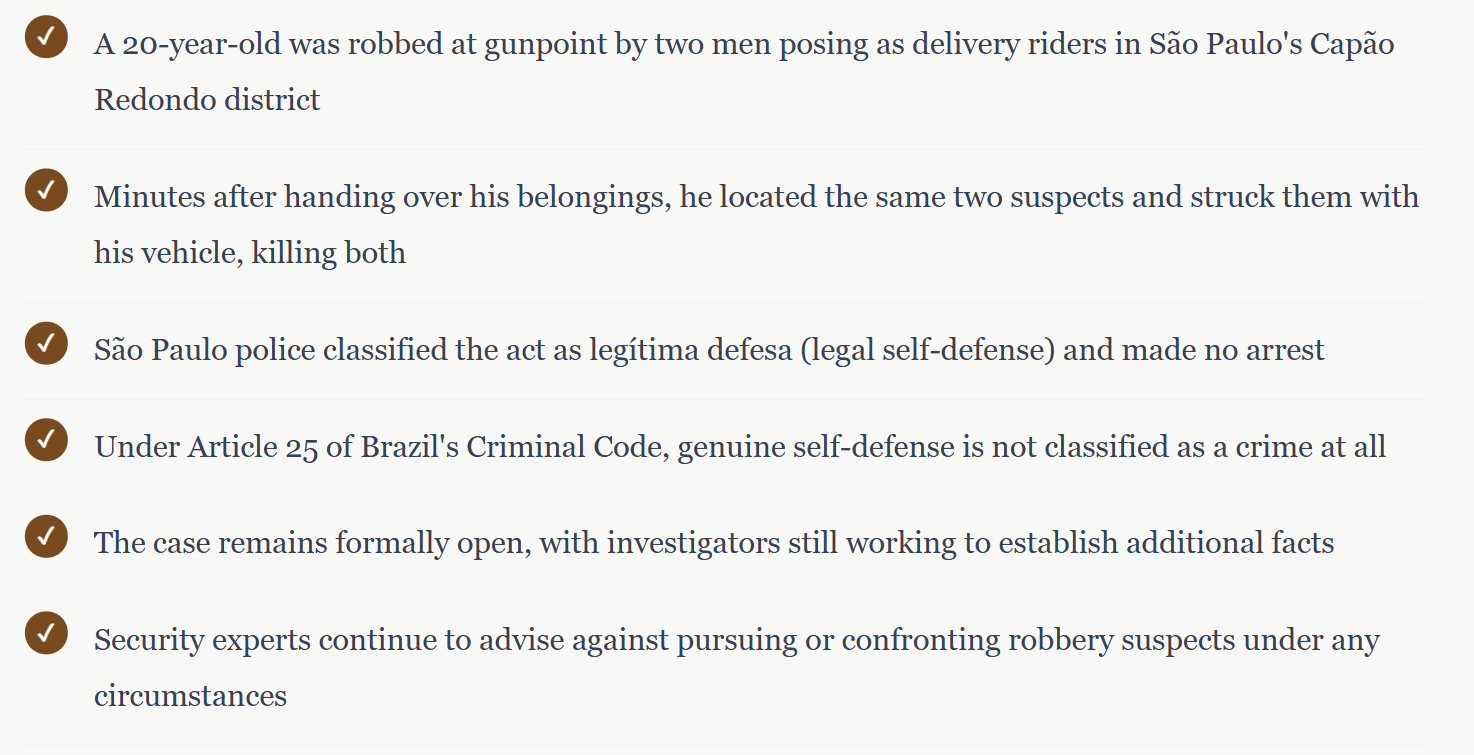
In practical terms, the absence of an arrest doesn't mean this case is finished. Investigators are continuing to work through the physical evidence from the scene, and the classification of the driver's actions could, in principle, still be revisited if new information emerges that complicates the self-defense determination. For now, though, the driver remains free, and the two men who died in the encounter have not been publicly identified by authorities, an ongoing part of the investigation that will likely shape whether any further legal questions arise about their identities or possible criminal history.
For a broader audience following this story less because of its legal specifics and more because of what it represents, the case is likely to keep generating exactly the kind of split reaction it has already produced: real sympathy for a young man who did not start this encounter, alongside real, professionally grounded concern about what could have happened, to him or to someone else entirely, had those same few minutes gone even slightly differently.