 William BensonVIEW PROFILE →
Seaplane Crash Caught on Camera: How Ten Americans Escaped a Sinking Aircraft in North Bimini
A routine morning flight out of North Bimini turned into a half-sunken aircraft and a scramble for survival, and every single person made it out alive.
A routine morning flight out of North Bimini turned into a half-sunken aircraft and a scramble for survival, and every single person made it out alive.
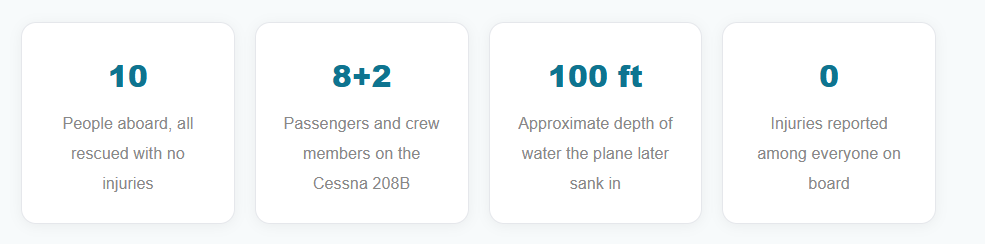
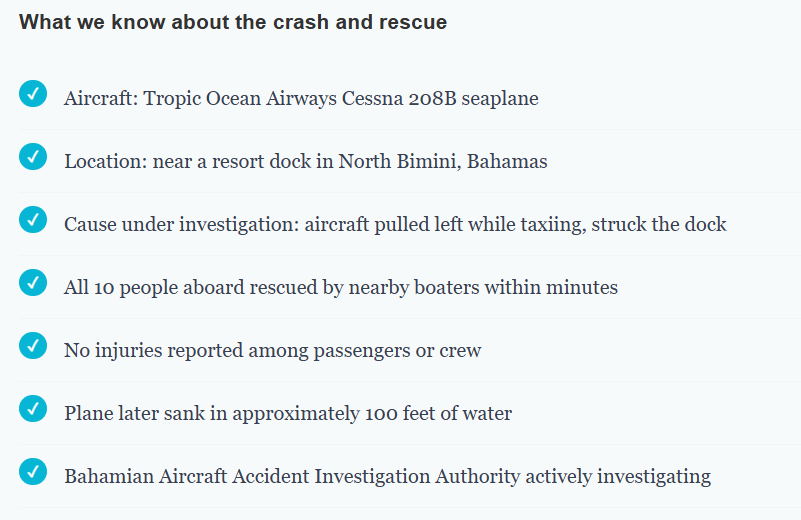
Jeanne O'Brien remembers exactly how normal it felt right up until the moment it didn't. She and nine other passengers and crew were settling in for what should have been a short, scenic hop out of North Bimini, the kind of flight that barely registers as an event on a Bahamas vacation itinerary. Then the dock started getting closer. Someone behind her asked where they were going. And then, in her words, it was simply "boom, and it hit." What happened in the seconds after that impact is a genuinely remarkable story about how fast a routine morning can turn dangerous, and how fast a handful of strangers on nearby boats can turn it back around. What Actually Happened That Saturday Morning On the morning of August 1, 2026, a Tropic Ocean Airways Cessna 208B seaplane was preparing to take off from the waters near North Bimini, carrying eight passengers and two crew members, all of them American. According to a preliminary investigation by Bahamian police, the aircraft encountered boat traffic while attempting its takeoff run. The pilot responded by turning north, searching for a clearer, safer stretch of water to get airborne. It was during that adjustment, while taxiing, that things went wrong: the seaplane began pulling to the left, and despite the pilot's attempts to correct the drift, it never straightened out. The aircraft slammed directly into a dock near a resort in North Bimini. Video captured from inside the cabin by passenger Eloidis Cantillo shows the dramatic final seconds before impact, the kind of footage that's since been replayed across national news broadcasts precisely because it captures something so few plane crash survivors ever get on tape: the exact moment everything changes. Witness Gian Jimenez, watching from nearby, described seeing the aircraft head straight toward the houses along Bimini's seawall before crashing directly into it.
The Minutes That Mattered Most
What happened immediately after impact is where this story genuinely becomes remarkable. The seaplane's nose began taking on water almost immediately, nearly submerging as passengers scrambled to get out. Nearby boaters didn't wait for official rescue crews, they moved instantly. Jack Davoudpour, who was aboard a yacht nearby when he heard the crash, recalled the scene bluntly: "The captain said there was a plane crash. Let's go." He and others grabbed a dinghy and raced toward the wreckage.
By the time Davoudpour's group reached the aircraft, passengers were already climbing out onto the wing, the plane already half-sunk beneath them. "The plane was already half sunk and people were out on the wing," he later recounted. "And so, we just went straight towards it." Boat operator Nick Pavlakis was among several nearby vessels that rushed in to help evacuate everyone still aboard, ferrying shaken but unharmed passengers away from the sinking aircraft before it eventually settled in roughly 100 feet of water.
"Where Are You Going?" — A Passenger's Account
Speaking to ABC News the day after the crash, passenger Jeanne O'Brien walked through the sequence of events from inside the cabin. The flight had felt entirely ordinary up to that point, the aircraft positioned near a fairly large marina, some distance from the dock itself, preparing for a standard takeoff out over open water. Then, without warning, the geometry of the situation shifted fast. "All of a sudden the dock started getting closer and closer," she recalled, "and one of the people in the plane behind me said, 'Where are you going?' And then it just was 'boom,' and it hit."
What separates this incident from so many aviation emergencies is the speed and coordination of the civilian response, boaters reaching a sinking aircraft and beginning evacuation before any official emergency crew had even arrived on scene.
Aviation analyst John Nance, speaking with ABC News, noted that a full investigation would need to examine several specific questions: what the captain was doing in the critical seconds before impact, how the aircraft was actually being handled during the taxi and correction attempt, and why it ultimately couldn't be kept clear of the dock. He was careful to frame the investigation's scope honestly: "You rule nothing in and you rule nothing out" at this early stage.
Tropic Ocean Airways Responds
In a statement following the crash, Tropic Ocean Airways, the Florida-based operator of the aircraft, described the incident as the seaplane being "involved in a mishap while taxiing before departure," and confirmed the company is "cooperating fully with the applicable authorities." That kind of careful, procedural language is standard for aviation incidents under active investigation, and it reflects the genuinely early stage this inquiry remains at. The Bahamas Aircraft Accident Investigation Authority, working alongside Bahamian police, is leading the formal review into what caused the aircraft to lose directional control while taxiing.
Why This Story Resonated So Widely Part of what made this crash draw such heavy national coverage in the US, beyond the dramatic in-cabin footage, is how directly it plays into a familiar and genuinely reassuring narrative: ordinary people, with no formal training or equipment beyond whatever boat they happened to be on that morning, reaching a life-threatening situation faster than any official response realistically could. Bimini's proximity to South Florida, roughly 50 miles off the coast, means it's a heavily used short-hop destination for American travelers, and seaplane service between the islands is a genuinely routine part of how people move around the region, making this crash feel unusually close to home for many who read about it. It's also worth noting what this incident wasn't. Unlike more catastrophic seaplane accidents in the region's history, this crash, while frightening and dramatic on video, ended without a single injury. That outcome owes something to circumstance, the crash happening during daylight, near an active marina, with boaters already close by, and something to the composure of both the flight crew, who reportedly ordered passengers out quickly, and the rescuers who reached them within moments. A Few Honest Questions People Are Actually Asking Is it still safe to fly seaplanes in the Bahamas? Seaplane travel remains a common and generally safe way to move between Bahamian islands, used by thousands of travelers each year. This specific incident, still under active investigation, doesn't yet point to a broader safety issue with the aircraft type or route, though the findings once released may clarify contributing factors worth knowing. What likely caused the plane to veer off course? Investigators have not yet released a formal cause. The preliminary account describes the aircraft pulling left during taxi despite correction attempts, but whether that stemmed from mechanical, environmental, or pilot-related factors remains part of the ongoing inquiry. How deep is the water where the plane sank, and will it be recovered? The aircraft came to rest in approximately 100 feet of water. Wreckage recovery for investigations at that depth typically involves specialized marine salvage teams, a process that can take weeks depending on conditions and investigative priorities. What Happens Next The formal investigation into the crash remains ongoing, led by Bahamian aviation authorities working alongside Tropic Ocean Airways' own internal review. Findings from incidents like this typically take months to finalize, particularly when they involve underwater wreckage recovery and detailed analysis of taxi and takeoff procedures. For now, what's confirmed is the outcome that matters most: ten people who boarded a routine flight that Saturday morning all made it home safely, thanks in large part to a handful of strangers who didn't hesitate to act. A note on this reporting Details in this piece reflect accounts from ABC News, NBC affiliates, and WSVN 7News as of August 2026, including statements from passengers, witnesses, and Tropic Ocean Airways. The official cause of the crash has not yet been determined and remains under active investigation by Bahamian authorities.