William BensonVIEW PROFILE →
Skimpflation: The Ingredient Swap Happening in Your Pantry That No Price Tag Will Ever Warn You About
You already learned to check if the cereal box got smaller. The next thing worth checking is quieter, and it's hiding in plain sight on the back of the packaging, in a paragraph of ingredients most people have never actually read.
You already learned to check if the cereal box got smaller. The next thing worth checking is quieter, and it's hiding in plain sight on the back of the packaging, in a paragraph of ingredients most people have never actually read.
Somewhere in the last few years, a specific kind of consumer suspicion became mainstream: the instinct to pick up a familiar snack and wonder, mid-bite, whether it always tasted like this. Not spoiled, not expired, just subtly, unmistakably different in a way that's hard to pin down. For a lot of people that instinct turned out to be exactly right, and it usually has nothing to do with a smaller box or a higher price sticker. It has to do with what's actually inside the packaging, which has been quietly rewritten while the packaging itself stayed exactly the same. Shrinkflation, the practice of shrinking a product while holding the price steady, got its own viral moment a few years back, once shoppers started noticing suspiciously large air pockets in chip bags and cereal boxes that felt lighter than they used to. Its lesser-known relative is proving far harder to catch. Economists and consumer advocates have taken to calling it skimpflation: swapping a higher-quality ingredient for a cheaper one, reformulating a recipe to use less of the expensive stuff, all while the price on the shelf, and often the packaging itself, stays exactly where it was. The product looks the same. It isn't the same. Why this is so much harder to notice than a smaller bag A shrunken package is something your hands can feel before your brain has consciously registered why. A reformulated recipe offers no such physical cue. The box weighs what it always weighed. The price on the shelf tag hasn't budged. The only place the change is disclosed at all is the ingredient list on the back, printed in small type, in an order almost nobody reads closely unless they're specifically looking for something, and phrased in language, "vegetable oil blend," "chocolatey coating," that's technically accurate and practically invisible to a shopper moving quickly through a grocery aisle.
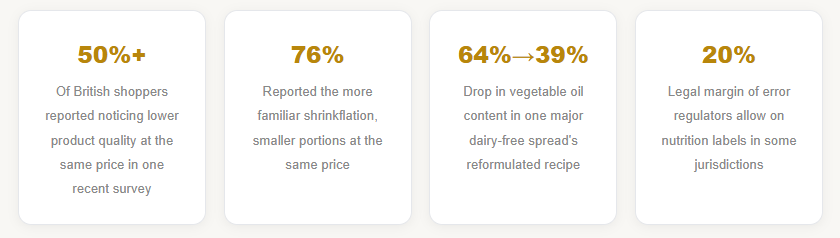
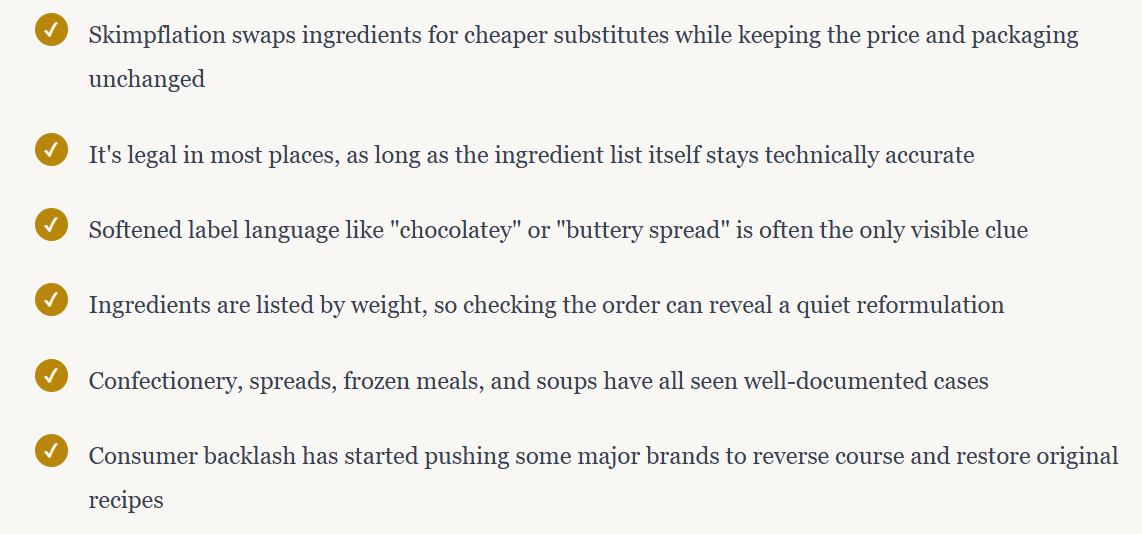
That last figure is the quiet engine behind most of this. Recipe changes are, in almost every case, entirely legal. Manufacturers are generally permitted to reformulate a product without advance notice to consumers, as long as the ingredient list on the label is technically accurate. There's real regulatory room to work within, which is exactly why this trend has been able to spread across categories, chocolate, spreads, snack bars, frozen meals, so quietly for so long.
The swap that started the whole conversation
One case in particular did more to put this trend on the map than any economic report could. A well-known dairy-free buttery spread quietly cut its vegetable oil content from roughly 64% down to about 39% of the formula, replacing it with a mix of water and other fillers, while keeping the same tub, the same branding, and the same price. Shoppers noticed the texture and taste had changed before they ever thought to check the ingredient panel, and the backlash was sharp enough that the manufacturer eventually reversed the reformulation and returned to something closer to the original recipe.
The chocolate that stopped being chocolate
A similarly telling case involved a popular chocolate-coated snack bar. A longtime customer noticed the bar tasted noticeably different, almost stale, compared to what he remembered. It hadn't expired. Comparing the current box against an older one, he found the milk chocolate coating, previously made with real cocoa butter, had quietly been replaced with what the label now called a "chocolatey coating," made using palm oil instead, a cheaper fat that behaves differently on the tongue and doesn't legally qualify as chocolate at all. The word "chocolatey" isn't a marketing accident. It's doing real legal work, letting the product avoid claiming to be something it no longer technically is.
Skimpflation is a sneaky way to give shoppers less for their money, and it's far harder to catch than a smaller box, because the packaging and the price both stay exactly the same.
— A pattern consumer advocates have tracked closely since 2022
Where else this is showing up on shelves
Confectionery is far from the only category affected. Industry reporting through 2026 has tracked similar substitutions across frozen meals, where the ratio of protein to filler ingredients like rice or breading quietly shifts without any change to the stated weight on the box, and across soups, sauces, and pie fillings, where water is added to stretch a formula further while trimming the amount of the actual named ingredient. None of these changes are individually dramatic. That's rather the point, each one is small enough to avoid triggering the kind of consumer backlash a visibly smaller box invites.
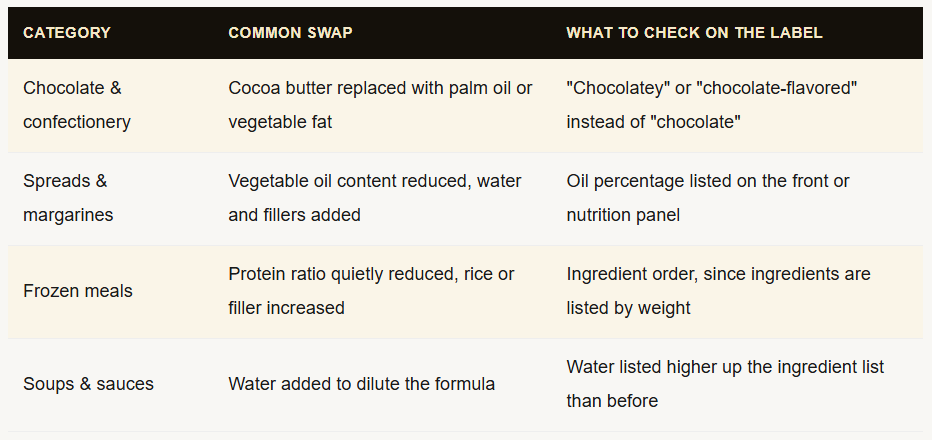
That ingredient-order detail matters more than most shoppers realize. Regulations in most countries require ingredients to be listed in descending order by weight, which means comparing an old ingredient list against a current one, if you happen to have kept a photo or simply remember the order, is one of the few reliable ways to catch a reformulation before it shows up in the taste.
How to actually catch it while you're shopping
Look for softened language rather than direct claims, "chocolatey," "buttery spread," "meat-flavored." Check whether a percentage is listed on the front of the pack and compare it against what you remember. And if a favorite product suddenly tastes slightly off, check the ingredient list before assuming it's just you. It usually isn't.
The tide may finally be turning
There's a reasonably hopeful postscript to this story. Industry reporting through 2026 suggests some major manufacturers are starting to walk skimpflation back, not out of goodwill, but because consumers who felt fooled once have gotten noticeably better at noticing it a second time, and at saying so publicly. One of the world's best-known chocolate makers has reportedly signaled plans to return to more traditional recipes, and a major global cocoa supplier has acknowledged that full demand recovery for real cocoa butter will still take years, but that the direction of travel is now clearer than it's been since the trend began. The economics that started this in the first place, volatile commodity prices, squeezed margins, price-sensitive shoppers, haven't disappeared. What's changed is that quietly cutting corners has started to carry a real reputational cost of its own.
None of this requires becoming a full-time label detective. It just means treating a familiar product's ingredient panel the way you'd treat a price tag, worth a quick glance now and then, especially the moment something you've eaten a hundred times suddenly tastes like a slightly worse version of itself. The box rarely tells you anything changed. The ingredient list, if you actually read it, usually does.