 William BensonVIEW PROFILE →
The $8.8 Trillion Question: What DOL's New 401(k) Rule Actually Means for Crypto
Most headlines said Bitcoin just got added to America's retirement accounts. That's not quite what happened , here's the version that actually matters.
Most headlines said Bitcoin just got added to America's retirement accounts. That's not quite what happened — here's the version that actually matters.
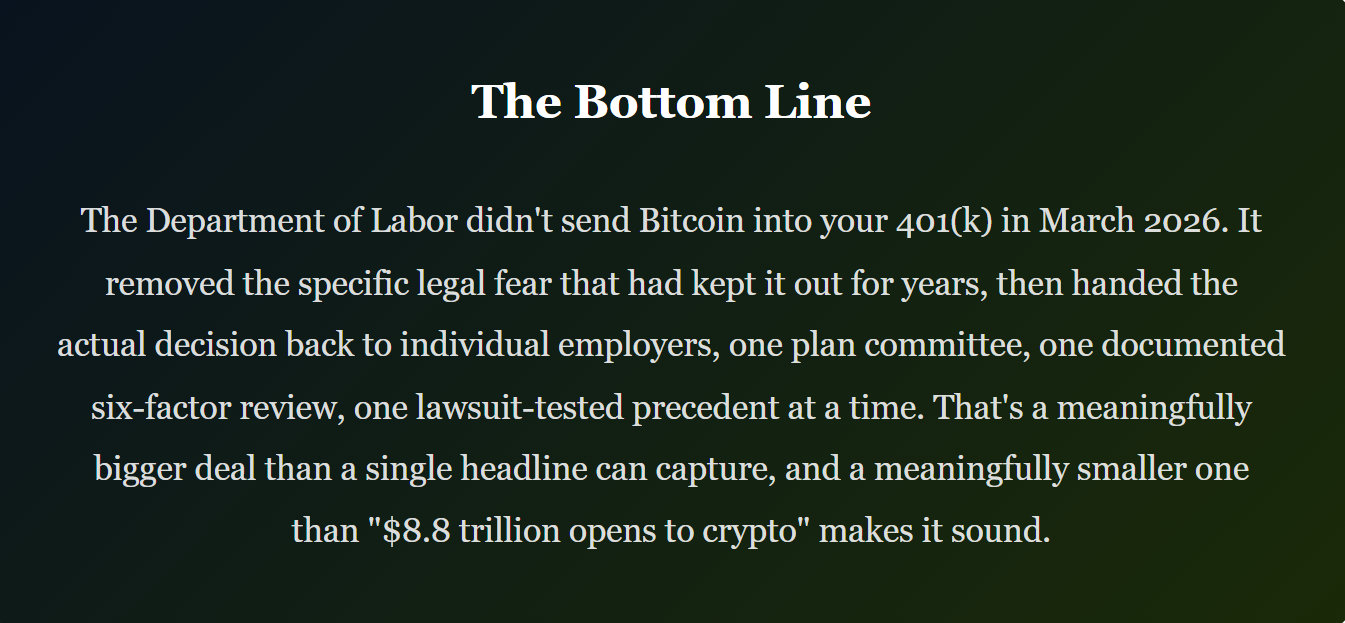
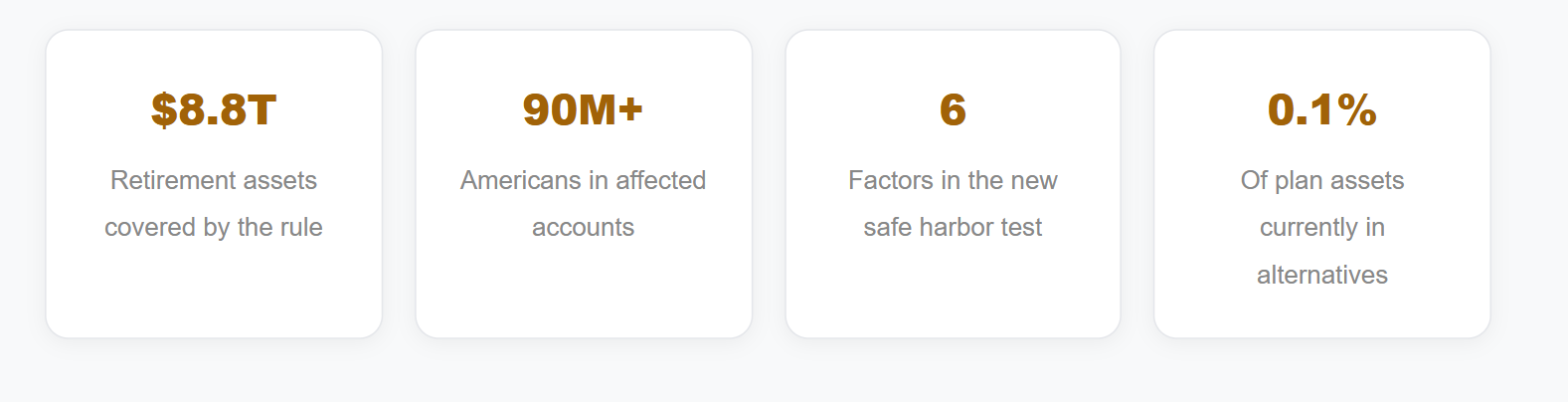
Somewhere between the headline and the fine print, this story keeps losing its most important detail. On March 30, 2026, the U.S. Department of Labor proposed a rule that touched, by its own estimate, $8.8 trillion in retirement savings across more than 700,000 plans. It did not put Bitcoin into a single 401(k). What it did was quietly remove the main reason employers were scared to. That distinction, between opening a door and walking someone through it, is the entire story here. And it's the part almost every crypto headline from that week skipped straight past.
Why Fiduciaries Have Avoided Crypto for Years
To understand why this rule matters, you first have to understand what's actually been stopping employers from offering crypto in workplace retirement plans, and it was never really a law that said "no." Plan fiduciaries, the people and committees legally responsible for choosing what goes into a 401(k) menu, operate under the Employee Retirement Income Security Act, or ERISA, which holds them personally liable if they fail to act prudently with participants' money.
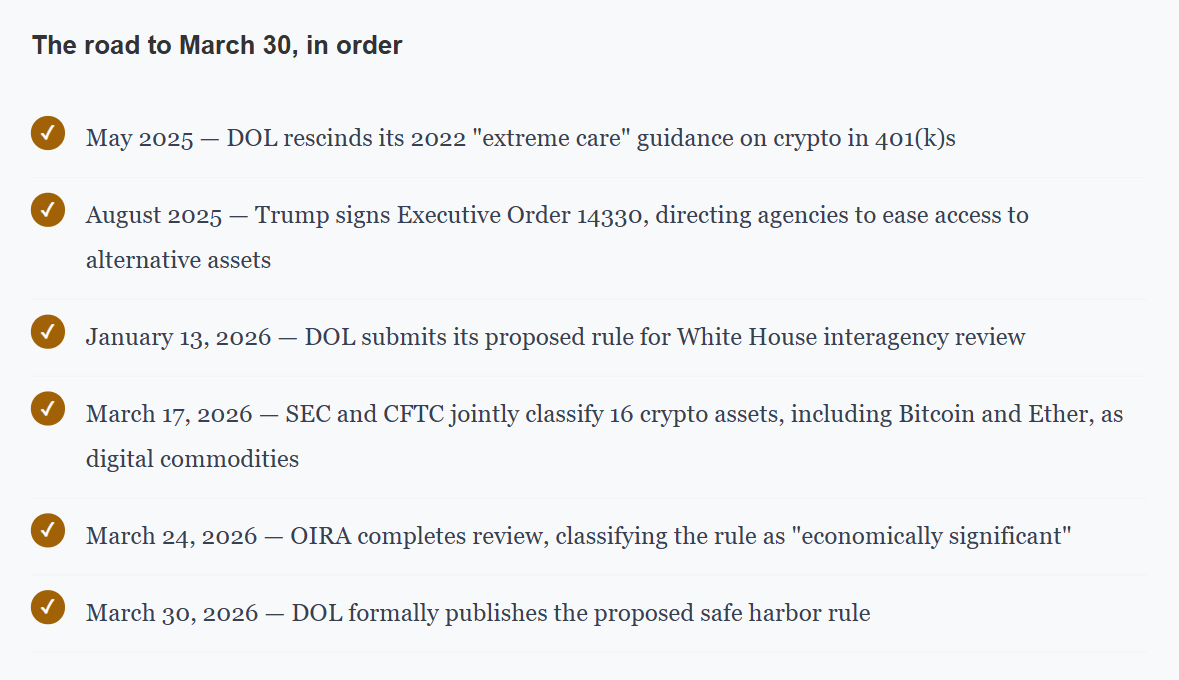
Back in 2022, the Labor Department issued guidance urging those fiduciaries to exercise "extreme care" before adding cryptocurrency to any 401(k) menu. It wasn't a ban. But it functioned like one, because no benefits committee wants to be the test case in an ERISA lawsuit. That guidance got rescinded in May 2025, returning the agency to a neutral stance, and three months later, in August 2025, President Trump signed an executive order directing federal regulators to reduce the litigation and regulatory barriers standing between 401(k) plans and alternative assets like crypto, private equity, and real estate.
What the Safe Harbor Actually Does
The proposal, formally titled "Fiduciary Duties in Selecting Designated Investment Alternatives," creates what's called a process-based safe harbor. In plain terms: if a fiduciary documents an "objective, thorough, and analytical" review of an investment, including crypto, against six specific factors, their decision is presumed reasonable and given significant deference by courts.
The six factors fiduciaries must document under the proposed safe harbor are: performance history relative to comparable alternatives, fees and total cost transparency, liquidity adequate for both plan-level and participant-level needs, valuation methodology, benchmarking against appropriate reference points, and a candid assessment of complexity, whether participants can reasonably understand what they're investing in.
Critically, the rule doesn't tell any plan to add crypto, and it doesn't say crypto is a good investment. A fiduciary who works through all six factors and concludes crypto isn't right for their participants has satisfied the standard just as completely as one who decides to add it. What changes isn't the outcome, it's the legal ground fiduciaries stand on while making that call.
The Part Nobody's Guaranteeing Here's where the more careful coverage of this story earns its keep. Jaret Seiberg, a financial services policy analyst at TD Cowen, put it about as plainly as it can be put: fiduciaries are unlikely to actually add alternatives to 401(k) plans until courts have confirmed the safe harbor language provides the protection it promises. A proposed rule isn't case law. Nobody wants to be the first employer sued under it. Benefits attorneys have echoed the same caution. Karen Brandon, a shareholder at Ogletree Deakins who leads the firm's fiduciary matters practice, noted that even with DOL approval, the threat of employee lawsuits over issues like fees or liquidity doesn't simply disappear. And Kevin Walsh of Groom Law Group described the DOL's challenge as trying to hit a "Goldilocks zone," offering fiduciaries enough certainty to act without writing something so prescriptive it becomes its own liability trap. Where This Connects to a Bigger Regulatory Story This rule doesn't exist in isolation. It leans directly on the SEC and CFTC's March 17, 2026 joint interpretive release, which formally classified sixteen crypto assets, including Bitcoin and Ether, as digital commodities. That classification matters because a fiduciary's "prudence review" under the new safe harbor depends on knowing what an asset legally is before evaluating whether it belongs in a retirement plan. It also connects to the still-unresolved CLARITY Act working its way through Congress, legislation that would codify those same crypto classifications into statute rather than leaving them as agency interpretation. As one financial commentator noted, roughly 40 percent of Americans currently have no exposure to markets at all, and figures like BlackRock's Larry Fink have specifically pointed to retirement systems as the mechanism through which tokenized and alternative assets could reach that group. The DOL's safe harbor is, in that sense, the regulatory machinery that starts making that argument operational, even if it's several steps removed from actually putting Bitcoin in anyone's paycheck deduction. Questions People Are Actually Asking Can I add Bitcoin to my 401(k) right now? Only if your specific employer's plan already offers it, and as of the rule's proposal, only about 4 percent of defined-contribution plans offered any alternative investments at all, with just 0.1 percent of total assets allocated to them. For most people today, an IRA or a taxable brokerage account remains the more direct route to crypto exposure, since those aren't gated by an employer's plan committee. Is the rule even final yet? No. The public comment period closed June 1, 2026, after drawing more than 20,000 submissions as of early May. The DOL must review those comments, potentially revise the rule, and complete another Office of Management and Budget review, a process that can take up to 90 days, before any final rule appears in the Federal Register with an actual effective date. Does this mean my employer has to add crypto to our plan? No, and this is the most misunderstood part of the entire story. The rule creates optional legal protection for fiduciaries who choose to evaluate alternative assets properly. It does not mandate that any plan sponsor add crypto, private equity, or anything else to their investment menu. What Actually Happens From Here If the rule is finalized roughly as proposed, the realistic timeline for crypto showing up in meaningful numbers of 401(k) plans is still measured in years, not months. Plan committees move cautiously by design, employee benefits attorneys will want to see how early adopters fare in court before advising clients to follow, and target-date funds, the default investment vehicle for most 401(k) participants, would likely be the slower, indirect route by which small alternative-asset allocations reach ordinary savers rather than a menu option most people actively choose. What the rule does accomplish, regardless of how quickly adoption follows, is real: it dismantles the specific legal excuse that's kept plan fiduciaries on the sidelines for years. Whether that translates into actual dollars flowing from America's retirement system into Bitcoin now depends less on regulation and more on courts, employer risk tolerance, and how digital assets perform during the exact window when this new protection first becomes testable. A note on this reporting Figures and quotes in this piece reflect the DOL's proposed rule as published March 30, 2026, and reporting and analysis from Sidley Austin, Bloomberg Law, HR Dive, Investing.com, FinTech Weekly, and CoinDesk current through mid-2026. The rule was not finalized as of this writing; timelines and provisions may change before any final rule is published.