 William BensonVIEW PROFILE →
The Asteroid That Kept Failing to Miss the Headlines: Inside the Two-Year Hunt to Clear 2024 YR4
A 60-meter space rock spent nearly two years on humanity's watchlist, first threatening Earth, then the Moon. Here's the full, occasionally nerve-wracking story of how the James Webb Space Telescope closed the case years ahead of schedule.
A 60-meter space rock spent nearly two years on humanity's watchlist, first threatening Earth, then the Moon. Here's the full, occasionally nerve-wracking story of how the James Webb Space Telescope closed the case years ahead of schedule.
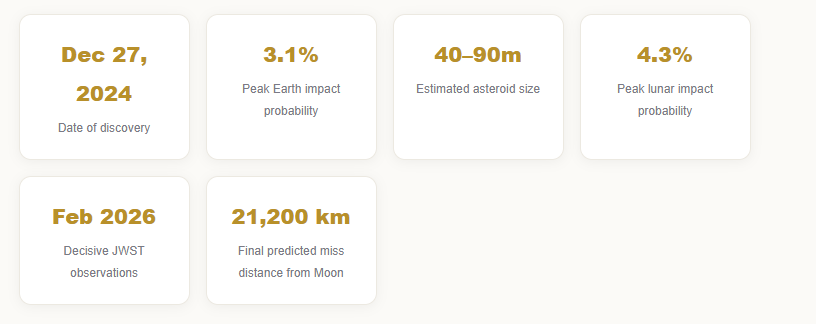
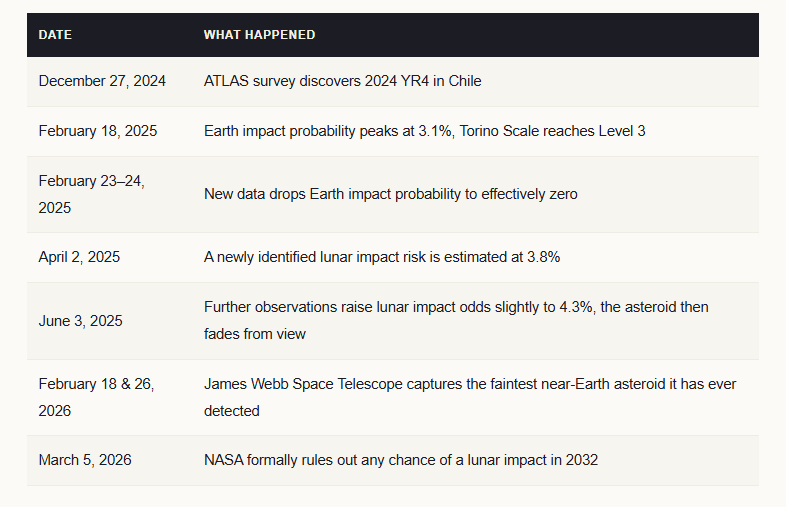
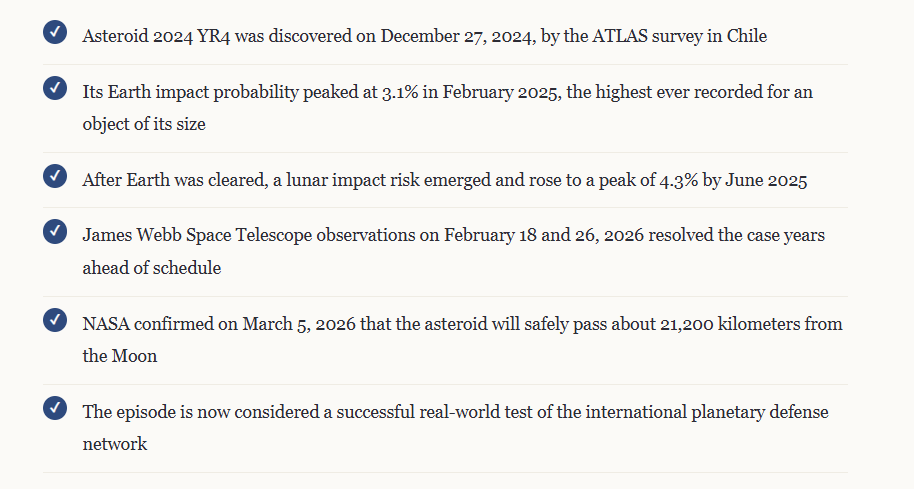
Most asteroids discovered by automated sky surveys never make the news. They're spotted, their orbits get calculated, the risk turns out to be essentially nothing, and the story ends before most people ever hear it began. Asteroid 2024 YR4 refused to cooperate with that pattern. Over roughly twenty months, it climbed to the highest impact probability ever recorded for an object of its size, threatened Earth, got cleared, then threatened the Moon instead, and finally got cleared again, this time using a telescope built to study the birth of galaxies rather than track rocks in our own cosmic backyard. A Faint Streak Over the Chilean Desert The discovery itself was almost anticlimactic. On December 27, 2024, the ATLAS survey, a NASA-funded network of telescopes designed specifically to catch objects on a possible collision course with Earth, picked up a faint point of light from its station in Río Hurtado, Chile. The object had actually made a close pass by Earth two days earlier, which is why it had become bright enough to notice in the first place. Astronomers designated it 2024 YR4 and immediately began the routine but essential work of pinning down its orbit. Early size estimates put the asteroid somewhere between 40 and 90 meters across, roughly the footprint of a large office building, based purely on how much sunlight it reflected. That's an important detail, because an asteroid's size and its calculated impact probability move together in determining how seriously astronomers need to take it. A pebble on a collision course with Earth is a non-event. A building-sized rock is a genuine reason to pay close attention, and 2024 YR4 was squarely in that second category. Within weeks of its discovery, an object smaller than a football field had climbed higher on the international risk scale than almost any asteroid astronomers had ever tracked, and for a while, nobody could be entirely sure it would stay that way. When the Odds Kept Climbing Instead of Falling Here's the part of the story that made headlines around the world. As astronomers gathered more observations through January and February 2025, the calculated chance of 2024 YR4 striking Earth on December 22, 2032 didn't shrink the way early-stage asteroid risk assessments usually do. It grew. By mid-February 2025, the probability had climbed as high as 3.1%, or roughly a one-in-32 chance, the highest impact probability ever recorded for an asteroid of this size and enough to push it to Level 3 on the ten-point Torino Impact Hazard Scale, a rating so rarely used that only a handful of objects have ever reached it since the scale was introduced in 1999. For a sense of scale, the only real historical comparison is asteroid Apophis, which briefly touched a 2.7% impact probability back in 2004 before later observations ruled out any danger entirely. The projected risk corridor for 2024 YR4 stretched across a band of the planet that included parts of South America, Africa, and South Asia, and news coverage at the time understandably leaned into just how unusual it was to see a number this high hold steady for weeks rather than immediately collapsing to zero. What the Torino Scale actually measures The Torino Scale runs from 0 to 10 and combines two things: how likely an impact is, and how much damage it would cause if it happened. A rating of 3, where 2024 YR4 briefly sat, is officially described as a close encounter meriting attention from astronomers, with at least a 1% chance of a collision capable of localized destruction. It's a genuinely rare rating. Almost every asteroid discovered eventually drops back to 0 as more data comes in, which is exactly what happened here, twice.
Enter the World's Most Powerful Telescope
By the spring of 2025, 2024 YR4 had moved far enough away from Earth that it became too faint for any ground-based telescope to track. Ordinarily, that would have meant waiting until 2028, when the asteroid's orbit would bring it back into view, before anyone could resolve the lingering lunar question. Two astronomers, Andy Rivkin of the Johns Hopkins Applied Physics Laboratory and Julien de Wit of MIT, weren't willing to wait that long. They successfully applied for a small allocation of the James Webb Space Telescope's discretionary observing time, betting that Webb's extraordinary sensitivity to infrared light might be able to pick out the asteroid against a crowded field of background stars, years ahead of when it would naturally reappear.
The gamble paid off. Using its Near-Infrared Camera, Webb detected 2024 YR4 on February 18 and again on February 26, 2026, in what NASA later described as the faintest near-Earth object the telescope has ever managed to observe. Those two data points extended the tracked arc of the asteroid's motion by roughly eight months and cut the uncertainty in its 2032 position by more than a factor of thirty, turning a fuzzy, unresolved four percent worry into a precise, confident answer.
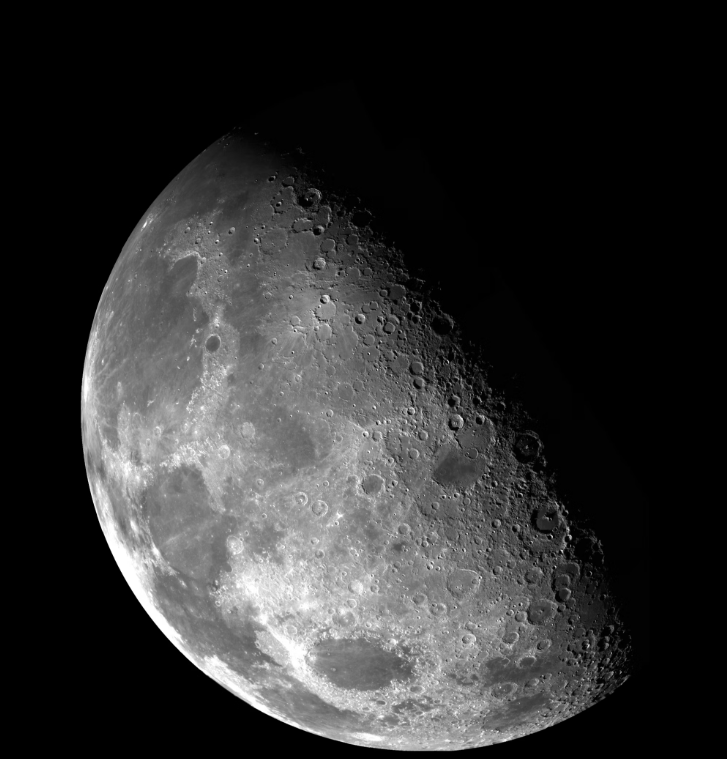
On March 5, 2026, NASA's Center for Near-Earth Object Studies announced the result: 2024 YR4 will pass roughly 21,200 kilometers from the Moon's surface on December 22, 2032, comfortably clearing it with no realistic chance of impact. It's worth being precise about what changed here. The asteroid's actual path through space never shifted. What changed was how confidently astronomers could describe that path, thanks to two extra data points gathered by a telescope that was never designed with asteroid-hunting as its primary job.
Why a Building-Sized Rock Commands This Much Attention
It's fair to ask why an object this small generated so much sustained coverage. Part of the answer is comparative. The meteor that exploded over Chelyabinsk, Russia in 2013, injuring more than a thousand people through shattered glass and shockwave damage, was only about 20 meters across, smaller than the low end of 2024 YR4's size estimate. An object several times larger, striking a populated area, would represent a meaningfully different scale of regional disaster, even if it fell well short of the civilization-threatening impacts associated with much larger asteroids.
The other part of the answer is that 2024 YR4 arrived at a moment when planetary defense as a discipline had real momentum behind it. NASA's DART mission successfully altered the orbit of a small asteroid moon in 2022, the first time humanity had deliberately changed the trajectory of a celestial object. Asteroid Apophis, once considered a genuine threat, is now set for a spectacular, entirely safe flyby on April 13, 2029, when it will pass within about 32,000 kilometers of Earth's surface, closer than many geostationary satellites, and be visible to the naked eye across much of Europe, Africa, and Asia. Against that backdrop, 2024 YR4 became a live, real-time test of whether the detection and tracking side of planetary defense actually works the way it's supposed to.
The system worked exactly as intended
Strip away the drama, and 2024 YR4's story is actually a reassuring one. An automated survey caught the object almost immediately after its closest approach. International monitoring systems flagged the risk and issued formal notifications once the probability crossed the 1% threshold. Independent teams at NASA, ESA, and other observatories cross-checked each other's calculations. And when ground-based telescopes ran out of runway, astronomers found a creative way to use one of the most oversubscribed scientific instruments on Earth to close the loop years early. That's not luck. That's a planetary defense network functioning the way it was designed to, under conditions that were realistic rather than a controlled drill.
What happens next
2024 YR4 itself is now essentially a closed case, though it will swing back within range of ground-based telescopes around 2028, giving astronomers another opportunity to refine its orbit purely out of scientific interest rather than concern. The more important legacy is methodological. NASA and the European Space Agency have both said the technique used here, pulling a nearly invisible object out of a dense star field using Webb's infrared sensitivity, has effectively been validated for future planetary defense work, meaning the next asteroid that raises this kind of alarm may not need to wait years for a definitive answer.