 William BensonVIEW PROFILE →
The Billionaire Playbook Nobody Talks About: Buying Sports Teams as an AI-Proof Fortune
Tech stocks lurch on every AI headline. Sports franchises just keep breaking price records. That's not a coincidence anymore, it's a strategy.
Tech stocks lurch on every AI headline. Sports franchises just keep breaking price records. That's not a coincidence anymore, it's a strategy.
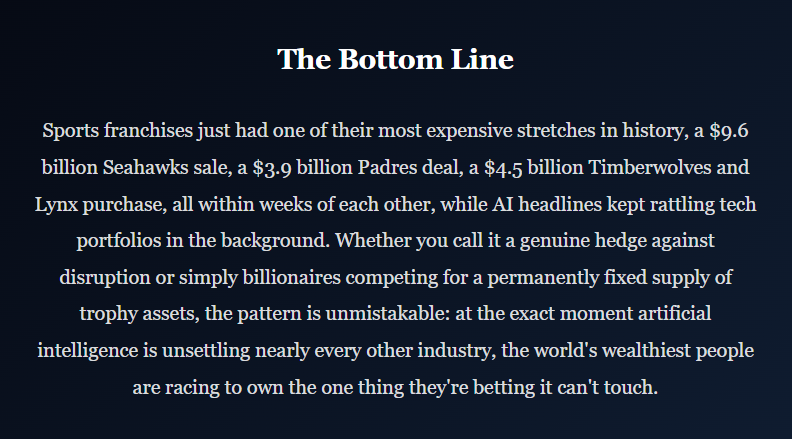
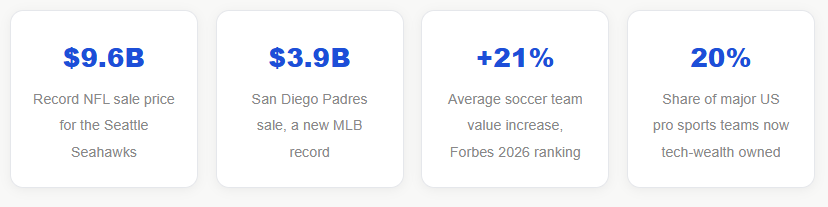
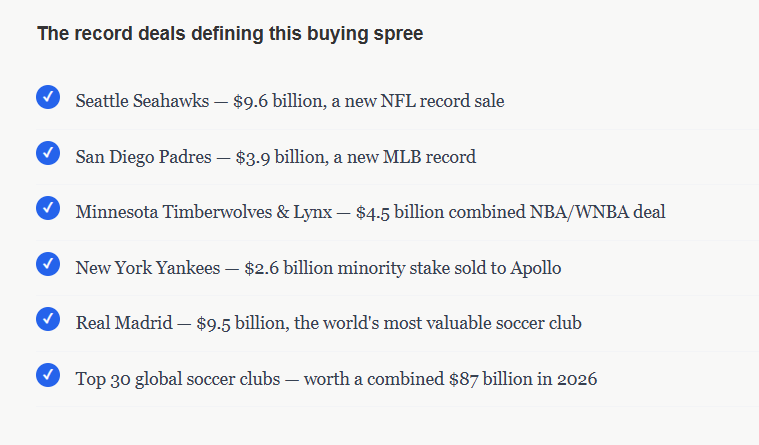
Right now, in the same week that AI headlines keep sending tech portfolios lurching up and down, a very different kind of asset is quietly setting record after record: the American sports franchise. If you've noticed team sales getting more frequent and more expensive lately, that's not your imagination, and it's not just rich people chasing a hobby. Some of the sharpest minds in finance are describing it as something closer to a hedge, a bet that whatever artificial intelligence disrupts next, it probably won't be the Yankees. The Sales Spree Breaking Records Right Now The pace of this is genuinely startling once you line the deals up. Major League Baseball recently approved the $3.9 billion sale of the San Diego Padres to a private equity billionaire and his wife, comfortably eclipsing the $2.4 billion Steve Cohen paid for the New York Mets back in 2020. Around the same time, the NFL moved toward approving a record $9.6 billion sale of the Super Bowl champion Seattle Seahawks. The NBA's Minnesota Timberwolves, bundled together with the WNBA's Lynx, changed hands in a deal valued at $4.5 billion. And baseball's most valuable franchise, the Yankees, agreed to a $2.6 billion minority investment from private equity giant Apollo Global Management. None of these are isolated events. They're happening within weeks of each other, a pace that longtime industry dealmakers say they've genuinely never seen before. Sal Galatioto, an investment banker who has spent three decades negotiating sports team sales, put the underlying confidence in fairly blunt terms: he'd bet on the Yankees still existing in a hundred years with better odds than he'd bet on a company like IBM being around that long.
The "AI-Proof" Theory, Explained Plainly
Here's the argument financiers are actually making, stripped of the jargon. A software company, no matter how dominant today, can be genuinely disrupted by the next model release, the next chip breakthrough, or a competitor nobody saw coming. A professional sports franchise faces essentially none of that risk. Nobody is building an AI that replaces the emotional pull of watching your city's team play live, and the scarcity is structural, there are only 32 NFL teams, only 30 MLB teams, ever, with no risk of a tech disruptor suddenly manufacturing more supply.
Mary Callahan Erdoes, who heads JPMorgan Chase's asset and wealth management division, called sports the "antithesis of AI" at this year's Forbes Iconoclast Summit, arguing that rising AI adoption is actually pushing valuations higher rather than threatening them, because AI is boosting the broader live-events industry around sports even as it unsettles other sectors entirely. It's a genuinely counterintuitive pitch: the same technology spooking investors elsewhere is, in this telling, part of what's making stadiums more valuable.

Why Tech Billionaires Specifically Are Piling In
The buyer profile behind this boom has shifted noticeably. Steve Ballmer's $2 billion purchase of the LA Clippers back in 2014 looked, at the time, like an outlier, a tech executive paying roughly double the previous NBA record for a franchise. It doesn't look like an outlier anymore. By 2022, tech-sector wealth controlled roughly 6 percent of major US sports franchise ownership, according to JPMorgan estimates. That figure had climbed to 20 percent by 2025, as more tech fortunes diversified into teams alongside real estate and art, the traditional hard-asset playbook for preserving wealth across market cycles.
What's changed in 2026 specifically isn't the trend itself, it's how fast it's accelerating. Three forces are converging at once: private equity ownership rules loosening across major leagues, media rights deals resetting at unprecedented valuations, and a newer generation of tech operators treating team ownership as a strategic asset rather than a passive trophy purchase. Sports finance analysts have started calling the resulting environment "overdrive," more deals, happening faster, with valuations climbing in ways that specifically favor cash-rich tech buyers over traditional ownership groups.
Private Equity Joins the Party
It isn't just individual billionaires driving this. Private equity firms, which spent years mostly on the sidelines of major sports ownership due to strict league rules, have increasingly recognized the same opportunity. Irwin Kirshner, who heads the sports law group at law firm Herrick Feinstein, put the shift simply: valuations keep climbing every year, and private equity has caught on to exactly why that opportunity exists. Once leagues began loosening restrictions on institutional ownership, that recognition turned into real capital flowing in fast, competing directly with individual buyers and helping push prices even higher.
Demand keeps rising, supply stays fixed by design, there will never be a 33rd NFL franchise, and a widening pool of billionaires and institutions now see sports specifically as insulated from the disruption reshaping nearly every other industry.

There's a Tax Story Behind This Too
Valuations this high don't happen purely on emotional appeal, tax policy has played a real supporting role. A provision in a major 2025 tax bill nearly gutted a longstanding depreciation benefit that makes sports ownership financially attractive, prompting some of the country's most powerful team owners to lobby directly to preserve it. That benefit survived, and it continues to make franchise ownership meaningfully more appealing on an after-tax basis than it would otherwise be, a detail rarely mentioned in the breathless headlines about record sale prices, but a real part of why the math works so well for wealthy buyers specifically.
A Few Honest Questions People Are Actually Asking
Are these franchises actually profitable, or just expensive? It varies significantly by league and team. Some franchises, including several WNBA teams, have posted real losses even as their valuations climbed sharply, over 180 percent in some cases, a reminder that these purchases are often bets on long-term asset appreciation and media rights growth rather than current-year profit.
Could sports team values actually crash the way tech stocks sometimes do? It's not impossible, but the structural scarcity, a fixed, tiny number of franchises that will ever exist, makes a sudden crash far less likely than in sectors where a competitor can simply out-innovate an incumbent overnight.
Is this good or bad for regular fans? That's genuinely contested. Some argue deep-pocketed, patient ownership brings stability and investment. Others worry rising valuations translate directly into higher ticket prices and a widening gap between what franchises are worth and what everyday fans can actually afford to attend.
Bubble, or a Genuine Shift in How Wealth Gets Parked?
It's worth asking the skeptical question directly: is this just billionaires bidding each other up in a frothy market, the way art and rare watches sometimes get, or is there something structurally different happening? The honest answer is probably both. The AI-proof argument is genuinely sound as far as it goes, live sports really is a uniquely hard thing to disrupt with software. But scarcity plus an ever-growing pool of billionaires competing for a fixed number of assets would push prices up regardless of what AI is doing to other industries. The AI narrative may be less the root cause and more the story wealthy buyers are telling themselves, and each other, to justify paying record prices in a moment when nearly every other asset class feels genuinely uncertain.
Whatever the precise mix of motivations, the practical effect is the same either way: a smaller and smaller circle of the world's wealthiest people and institutions are locking up ownership of professional sports, treating a stadium full of fans as one of the few things left that AI, for now, simply can't touch.
A note on the numbers
Sale prices and valuation figures in this piece reflect deals reported and approved as of late August 2026. Sports franchise sales often involve confidential terms and pending league approvals, so final figures can shift slightly as deals officially close.