 William BensonVIEW PROFILE →
The Death of App Overload: Why AI Agents Are Making Your Smartphone Screen Obsolete
The average phone has more than 80 installed apps and uses a fraction of them regularly. Agentic AI is betting that the whole model, one app per task, is about to become the exception rather than the rule.
The average phone has more than 80 installed apps and uses a fraction of them regularly. Agentic AI is betting that the whole model, one app per task, is about to become the exception rather than the rule.
There's a specific kind of fatigue that comes from planning a weekend trip on a phone: open the airline app to check fares, switch to a hotel app to compare rooms, open a rideshare app to see what the airport transfer will cost, then a separate app to book the restaurant, and a fifth to split the bill with whoever's coming. Nothing about that sequence is hard exactly, it's just relentless, a small tax paid in taps and app-switches on every single plan you try to make. For years that tax felt like the permanent cost of doing anything on a smartphone. It's starting to look optional. What's changing isn't a new app that does everything better. It's the idea of the app itself becoming less central to how these tasks get done. A new generation of AI agents, built into ChatGPT, Gemini, and a widening list of AI-native travel and shopping tools, can now search, compare, and in a growing number of cases actually complete a booking or purchase, without a person tapping through five separate interfaces to make it happen. The screen doesn't disappear. What disappears is the requirement to personally operate a dozen different pieces of software to get one afternoon's worth of errands done. From answering questions to actually doing the task For the past few years, AI chatbots were genuinely useful but fundamentally passive. Ask ChatGPT for flight options and it would hand back a helpful list of prices and airlines, then leave the actual booking, the form-filling, the payment, the confirmation email, entirely up to the person holding the phone. Agent mode changes that division of labor. Described plainly by people who've tested it, asking an AI agent to book a flight to Tokyo under a set budget now means the agent opens a browser itself, searches multiple travel sites, compares prices, filters by preference, and completes the booking, while the person does something else entirely.
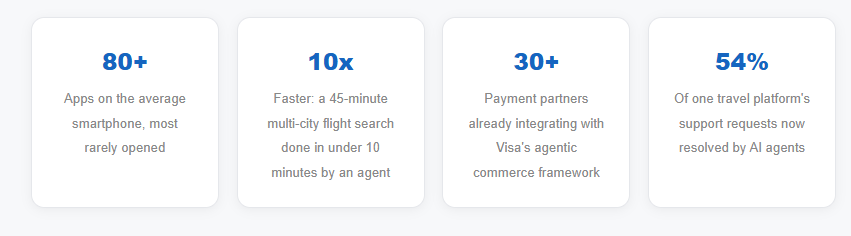
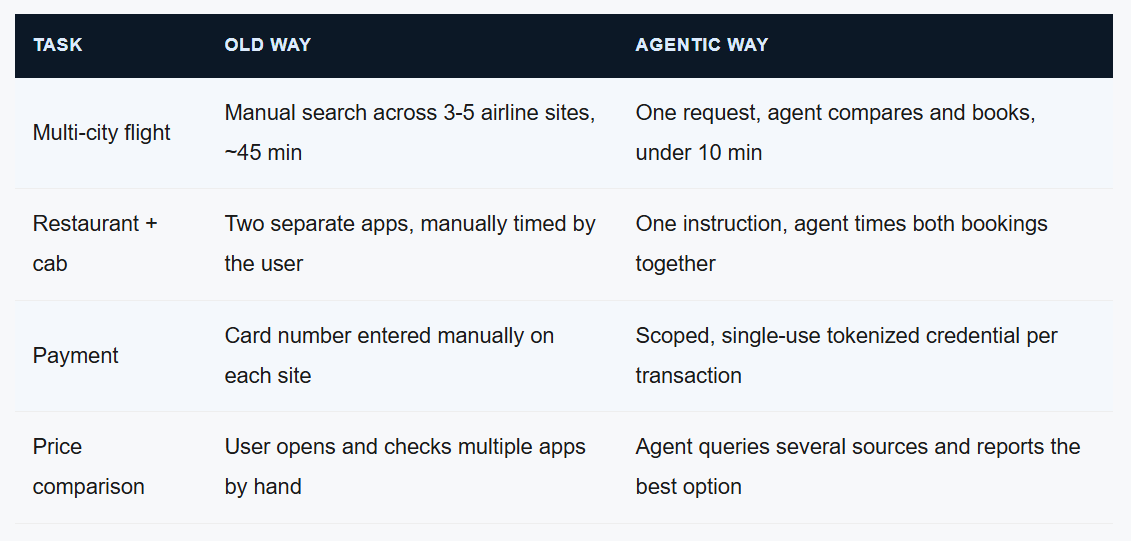
The shift shows up most clearly in travel, which has always been one of the most app-fragmented parts of daily life. Booking a genuinely optimized multi-city flight the traditional way, checking prices across airlines, comparing layovers, filling out passenger details on each site, can eat up the better part of an hour. AI agents handling the same task are already cutting that down dramatically, treating what used to be a tedious research project as a single instruction to carry out in the background.

The missing piece was never intelligence, it was payment
An AI agent being smart enough to find the best flight was never really the hard part. The genuine bottleneck has been trust: how does a piece of software prove it's acting on a real person's behalf, with that person's actual consent, when it reaches the checkout page and needs to hand over a credit card. That problem has quietly been getting solved throughout 2026, not by the AI labs, but by the payment networks themselves.
How the money actually moves
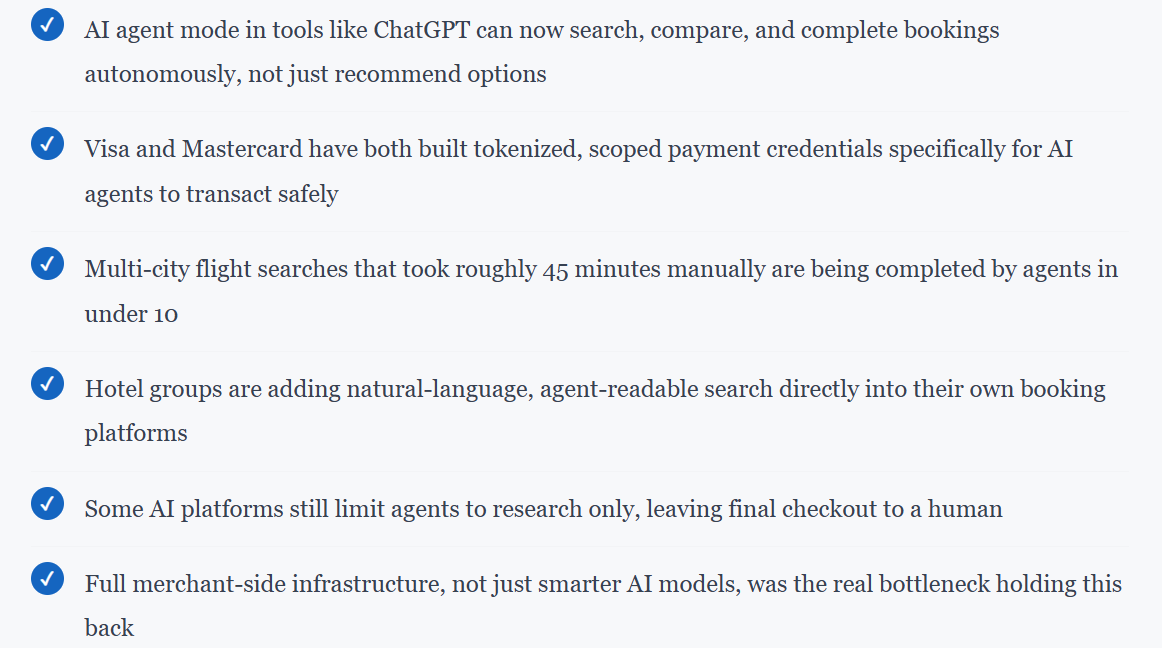
Visa's Intelligent Commerce framework issues scoped, tokenized credentials to AI agents, meaning an agent booking a flight receives a token that only works for that specific airline and that specific trip window, not a blank check to spend freely elsewhere. Mastercard's parallel system, Agent Pay, does something similar through what it calls Agentic Tokens, binding a card credential to one specific agent, one specific merchant, and one specific consent policy, so a model like ChatGPT can complete a purchase without ever actually holding the raw card number. Both companies have already run and completed hundreds of real, agent-initiated transactions as proof the infrastructure works at scale.
This holiday season marks the end of an era. In 2026, AI agents won't just assist your shopping, they will complete your purchases.
— Rubail Birwadker, SVP of Growth Products and Partnerships, Visa
The practical result is that an agent isn't operating with your card number sitting exposed in its memory somewhere. It's operating with a permission slip, cryptographically scoped to exactly what you asked it to do, expiring the moment the task is complete. That distinction is what's finally let major merchants and payment processors get comfortable letting software transact on a person's behalf.

What the everyday version of this actually looks like
Strip away the infrastructure talk and the day-to-day experience is fairly simple to picture. Instead of opening a rideshare app, checking prices, opening a food delivery app, checking a restaurant's wait time, and opening a calendar app to see if the timing even works, a person tells their AI agent the outcome they want, dinner reservation at 7, a car booked to arrive at 6:40, and the agent works out the sequence of bookings needed to make it happen, checking each one against real availability rather than guessing.
Hotel groups have started building directly for this shift rather than reacting to it after the fact. Some major chains are rolling out natural-language search inside their own booking platforms this year, and industry infrastructure like the Model Context Protocol is becoming the standard way an AI assistant actually queries a hotel's live inventory and completes a reservation, rather than just describing what it found in a search.
Worth knowing before you rely on this
Not every agent has equal booking authority yet. Some platforms currently limit AI agents to research and comparison, leaving the final purchase step to a human, while others have moved to full autonomous checkout. It's worth checking which mode you're actually in before assuming a booking has gone through.
Why this doesn't mean apps disappear entirely
It's tempting to read all of this as the end of the app icon altogether, but that's overstating where things actually stand. Airlines, hotels, and retailers still very much want their own branded apps and websites to exist, both for customer relationships and for the transactions agents haven't fully taken over yet. There's also been a genuine pullback in parts of the industry: reporting from earlier this year noted one major AI lab appearing to step back from native in-chat checkout, shifting purchases back toward merchant-controlled apps and websites rather than completing them entirely inside the chat window.

What to actually watch for next
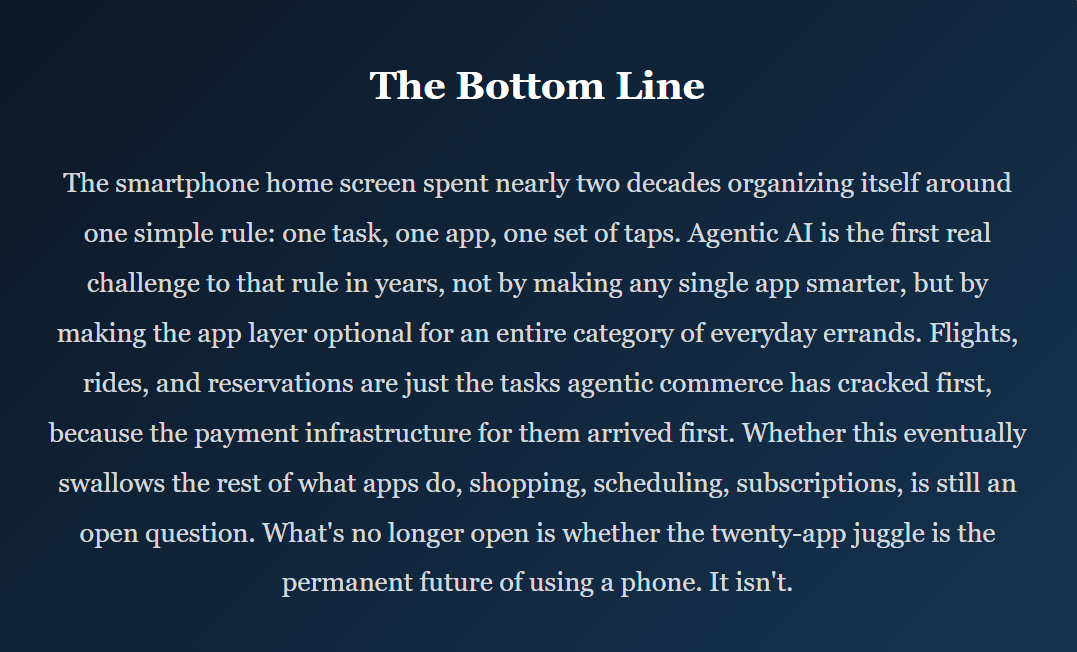
The realistic near-term picture isn't a single dominant super-app replacing everything overnight. It's a gradual redistribution of where the interface actually lives, moving away from twenty separate icons and toward one conversational layer that reaches into all of them on a person's behalf. Card rails are expected to keep handling most retail and travel purchases directly, while newer settlement methods take on more of the machine-to-machine and cross-border transaction volume behind the scenes, largely invisible to the person who just wanted a flight booked.
For now, the honest caveat is that this is still early. Coverage varies enormously by airline, retailer, and region, some merchants have deep agentic integration already, plenty of others have none yet. But the direction is no longer really in question. The App Store icon that used to be the only way to buy a plane ticket is turning into just one of several paths to the same outcome, and increasingly, not the fastest one.