 William BensonVIEW PROFILE →
The Ecosystem Tim Cook Built Is So Effective That Even His Own Exit Won't Slow It Down
Fifteen years, a market cap that grew from $350 billion to $5 trillion, and 2.5 billion active devices later, Cook is walking away from the most tightly engineered ecosystem in consumer technology.
Fifteen years, a market cap that grew from $350 billion to $5 trillion, and 2.5 billion active devices later, Cook is walking away from the most tightly engineered ecosystem in consumer technology.
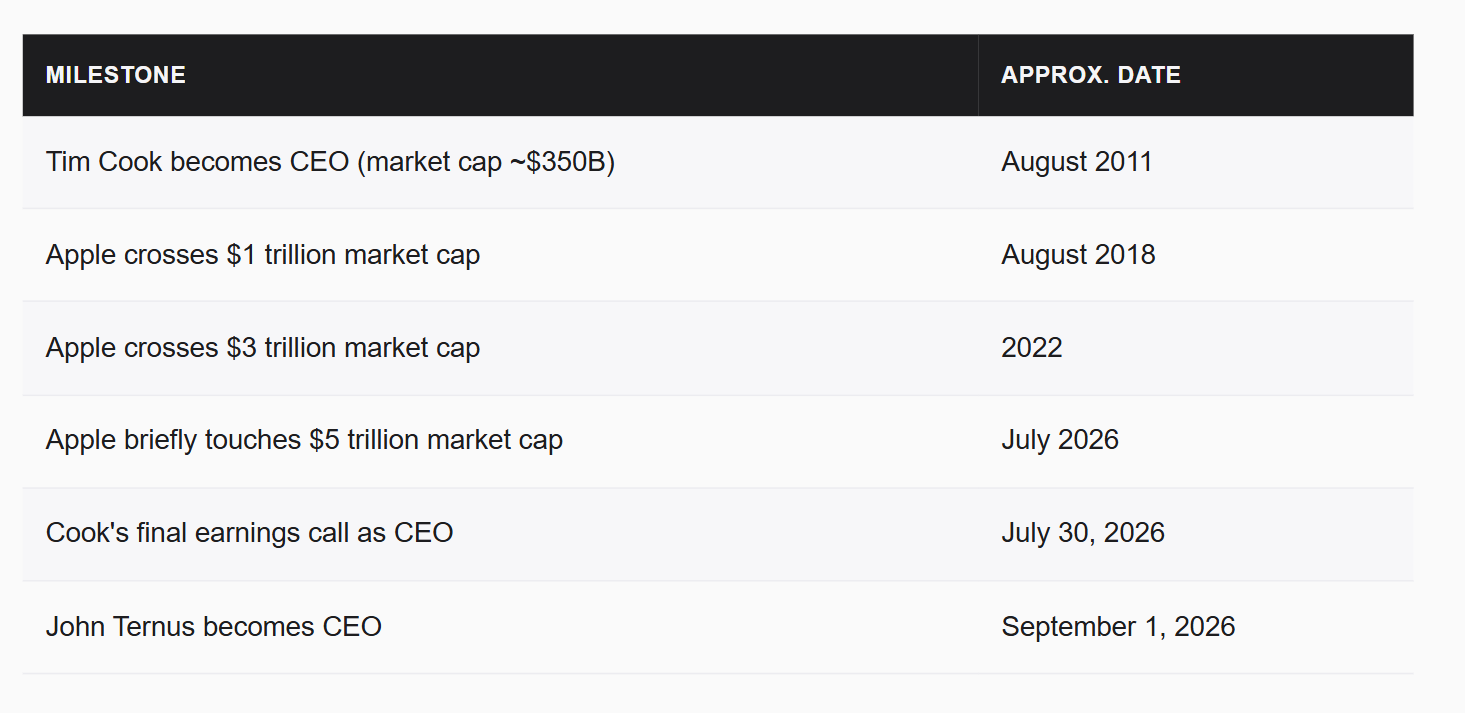
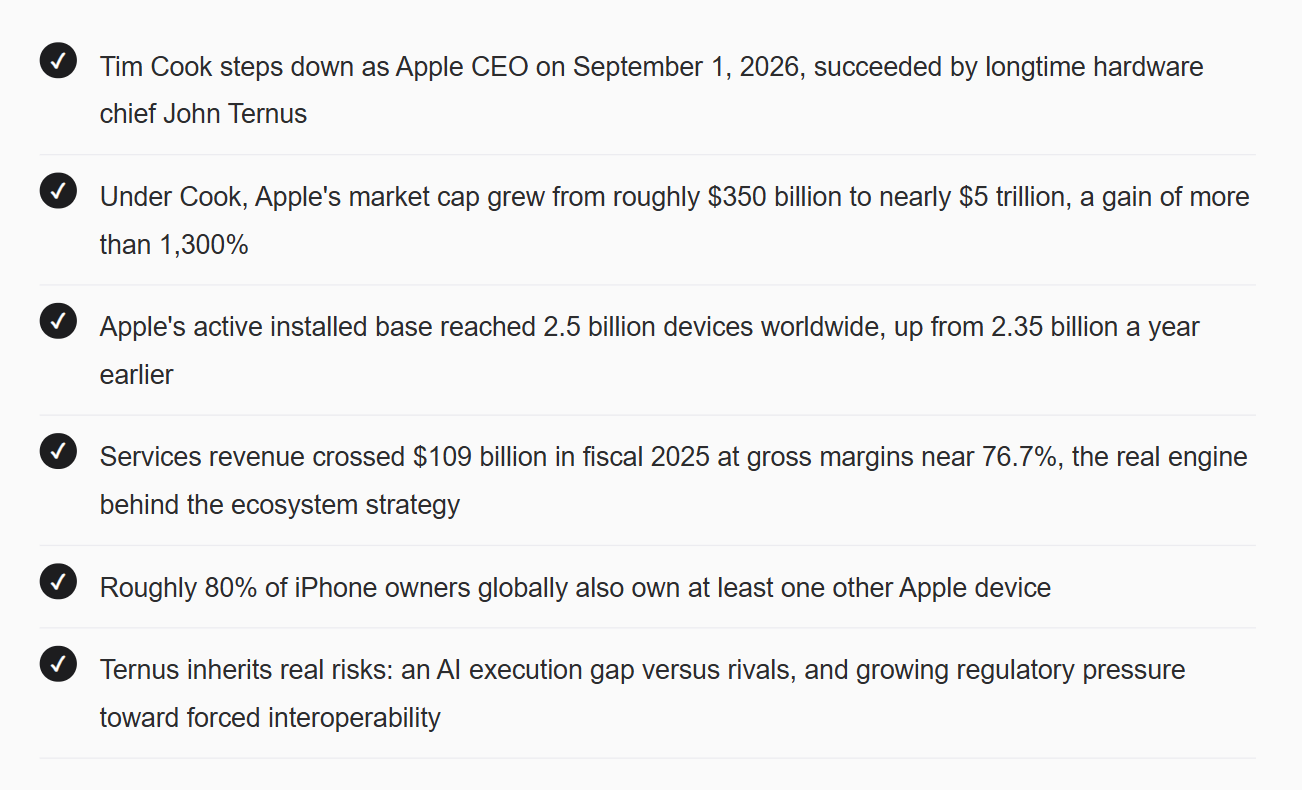
Tim Cook's final earnings call as Apple's CEO landed in the same week the company briefly touched a $5 trillion market capitalization, a fittingly enormous number to close out a 15-year run that started at roughly $350 billion. On September 1, 2026, longtime hardware chief John Ternus takes over as CEO, inheriting a company so structurally embedded in its customers' daily lives that analysts openly describe leaving it as less of a preference and more of a project. That's not an accident. It's the specific thing Cook spent a decade and a half engineering, and it's worth understanding exactly how it works before asking whether anyone, even a capable successor, could actually break it. The End of an Era Nobody Expected This Soon Cook's departure caught even close Apple watchers off guard. Analyst Gene Munster, managing partner at Deepwater, told CNBC the timing was roughly two years earlier than he'd anticipated. Cook, 65, is handing the role to Ternus, a longtime Apple hardware executive who had been quietly profiled for months as a likely successor, including a New York Times feature in January headlined "The Man Who Could Be Apple's Next C.E.O." When asked what advice he'd give his successor during the transition call, Cook offered a characteristically understated line: never forget the company's North Star. The numbers underpinning that farewell are difficult to overstate. Under Cook's leadership, Apple's market capitalization grew more than 1,300%, from roughly $350 billion when he took over in August 2011 to nearly $5 trillion just before his final earnings report. Apple became the first U.S. company to cross $1 trillion, then $2 trillion, then $3 trillion in market value, each milestone arriving faster than the last. Revenue over his tenure grew 331% on a trailing basis, while net income rose approximately 397%, translating to compound annual growth above 10% for revenue and above 11% for profit, sustained over a decade and a half at a company already operating at massive scale when he started. Tim Cook turned Apple into a $4 trillion-plus juggernaut by deliberately not trying to be Steve Jobs, leaning instead into supply-chain discipline, financial patience, and a slow, compounding expansion of the ecosystem around the iPhone rather than any single dramatic product reinvention. What Cook Actually Built Wasn't a Product, It Was a System Cook's tenure produced fewer headline-grabbing product reveals than the Jobs era, and he's been candid that this was by design. Instead, he oversaw the methodical expansion of an ecosystem: the Apple Watch in 2014, AirPods in 2016, and eventually Apple Vision Pro, each entering an already-familiar category but commanding a premium specifically because it plugged directly into a customer's existing iPhone, Mac, and iCloud setup. None of these products needed to be revolutionary on their own. They needed to make the whole system slightly more indispensable, and collectively, they did exactly that. The scale that strategy has reached by 2026 is genuinely difficult to picture. Apple's installed base of active devices passed 2.5 billion units worldwide in the most recent fiscal year, spanning more than 175 countries, up from 2.35 billion just a year earlier. Roughly 80% of iPhone owners globally own at least one other Apple device, whether an iPad, a Mac, or an Apple Watch, and U.S. households now average 2.4 Apple devices each, up from 1.8 just three years ago. Once someone owns two or three pieces of that puzzle, the company isn't really selling them individual products anymore, it's selling continuity between them.
Why Leaving the Apple Ecosystem Is a Project, Not a Decision
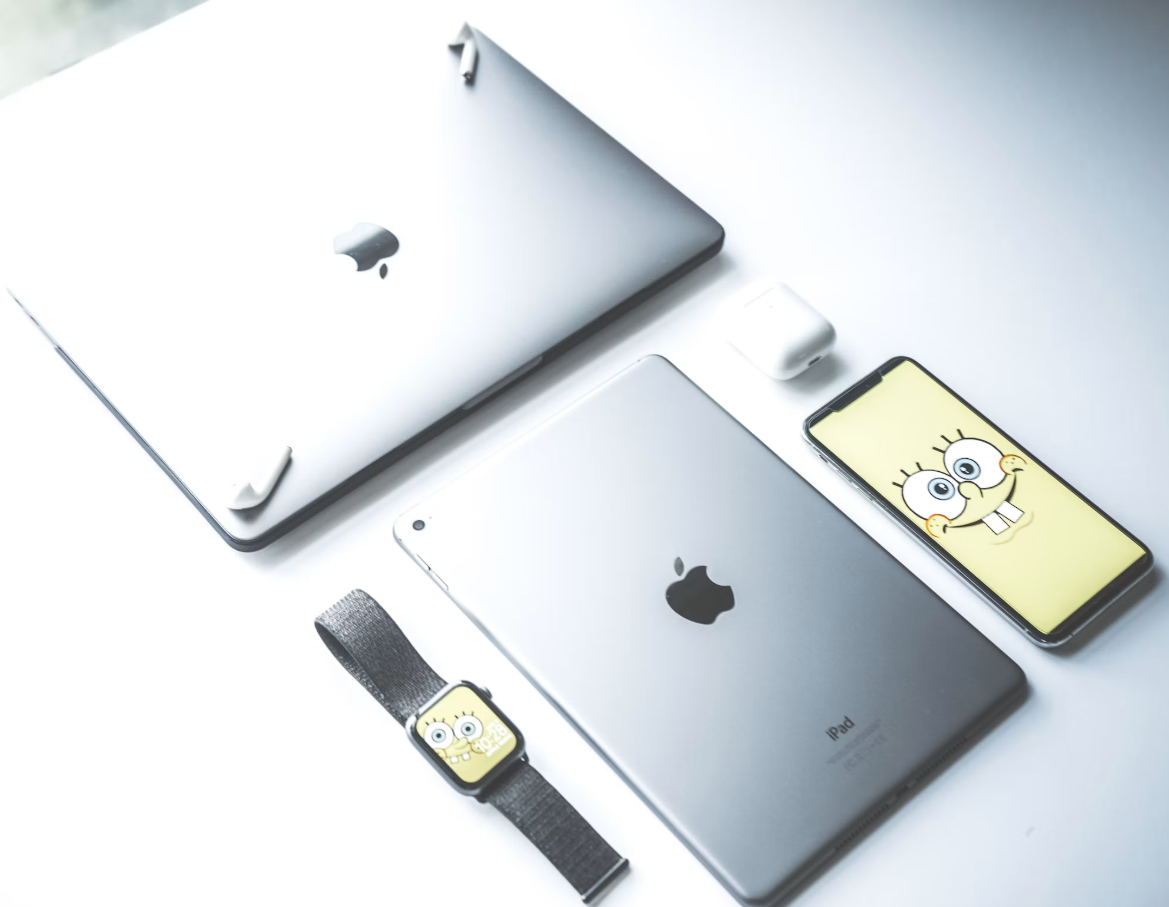
The mechanism behind that lock-in is more mundane than most people assume, it isn't any single killer feature, it's dozens of small conveniences that quietly compound. Handoff lets you start an email on your iPhone and finish it on your Mac without thinking about it. AirDrop moves files between devices instantly. iMessage and FaceTime work seamlessly across the entire product line but noticeably worse, or not at all, once a non-Apple device enters the conversation. Individually, each convenience feels minor. Together, they add up to what one industry analysis bluntly called "orchestration" rather than innovation, a system where you stop actively considering alternatives because the default path has simply become frictionless.
iCloud plays an outsized role in that dynamic. More than half of Apple users now pay for iCloud storage upgrades, with average storage per user climbing to between 50 and 200 gigabytes. Migrating years of photos, documents, and backups off that infrastructure and onto a competing platform introduces exactly the kind of tedious, error-prone friction that research estimates increases switching costs by 30% to 40%. It's rarely any single barrier stopping someone from leaving, it's the cumulative weight of a dozen small ones.
The services number that explains the whole strategy
Apple's Services segment, which includes the App Store, iCloud, Apple Music, Apple TV+, and Apple Pay, crossed $109 billion in annual revenue for the first time in fiscal 2025, up roughly 13.5% year-over-year, at gross margins reported around 76.7%, dramatically higher than hardware margins. Divided across the installed base, that works out to roughly $44 in recurring services revenue per active device, per year. That figure is the real payoff of Cook's ecosystem strategy: hardware sales fund the initial entry point, and the ecosystem itself becomes a high-margin, recurring revenue machine for years afterward.
What John Ternus Actually Inherits
Ternus takes over a company at genuinely record scale, but not without real questions hanging over it. Apple is reportedly developing a foldable phone, an AI-focused wearable pin, and smart glasses, all framed internally as ways to deepen the existing ecosystem rather than reinvent the company's product philosophy. That's consistent with Ternus's own background: a hardware executive who, according to CFO Kevan Parekh, shares Cook's emphasis on financial discipline and deliberate decision-making rather than dramatic pivots.
The risks are less about hardware execution and more about whether Apple's slower, integration-first approach still works in an AI-driven market. Some industry analysts have flagged a real "AI execution gap," the concern that if a competing assistant, whether Gemini, a future ChatGPT-native device, or something else entirely, becomes dramatically more capable than Apple Intelligence, users might start choosing devices based on AI quality rather than ecosystem familiarity, an axis where Apple has historically not led. Regulatory pressure adds a second front: European interoperability rules are already pushing toward forced openness, opening iMessage to Android, AirDrop to non-Apple devices, and easier iCloud data portability, each of which would directly chip away at the switching costs that make the ecosystem so sticky in the first place.
The North Star Cook left behind
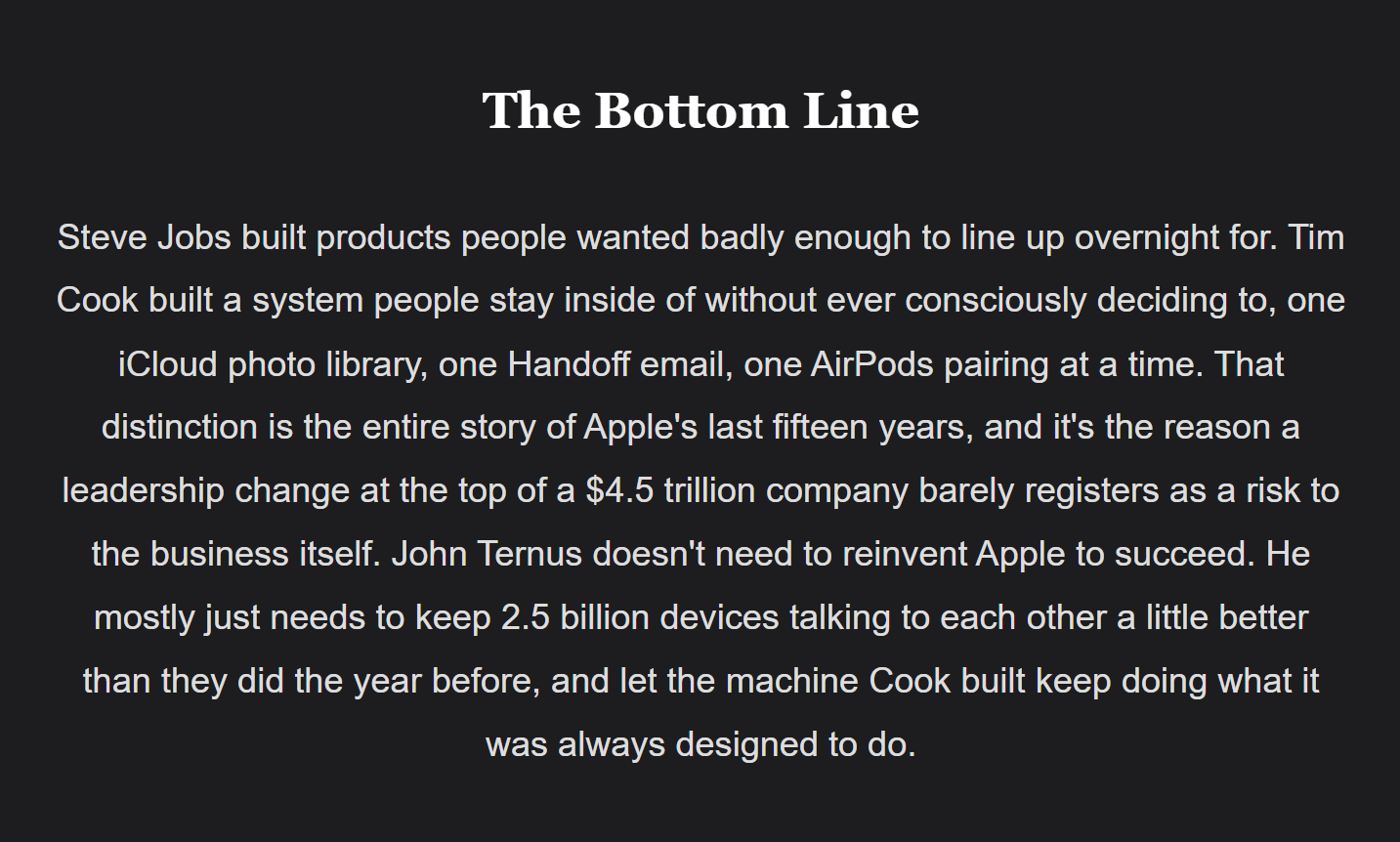
Whatever Ternus decides to build next, foldable phones, smart glasses, deeper healthcare wearables, or the "spatial computing" future Apple has been slowly building toward since Vision Pro, none of it is likely to abandon the underlying architecture Cook spent 15 years perfecting. The specific products will change. The strategy underneath them, make every new device meaningfully better because you already own the others, is the actual inheritance, and it's the part of Apple that has proven, so far, remarkably resistant to disruption from any single competitor's better idea.