 William BensonVIEW PROFILE →
The End of the Stadium Hotdog Line? Inside America's New Frictionless Sports Arenas
Face-scanners at the gate, AI-tracked concession shelves, and food that finds your seat before you do, the American ballpark is quietly turning into one of the most automated public spaces in the country.
Face-scanners at the gate, AI-tracked concession shelves, and food that finds your seat before you do, the American ballpark is quietly turning into one of the most automated public spaces in the country.
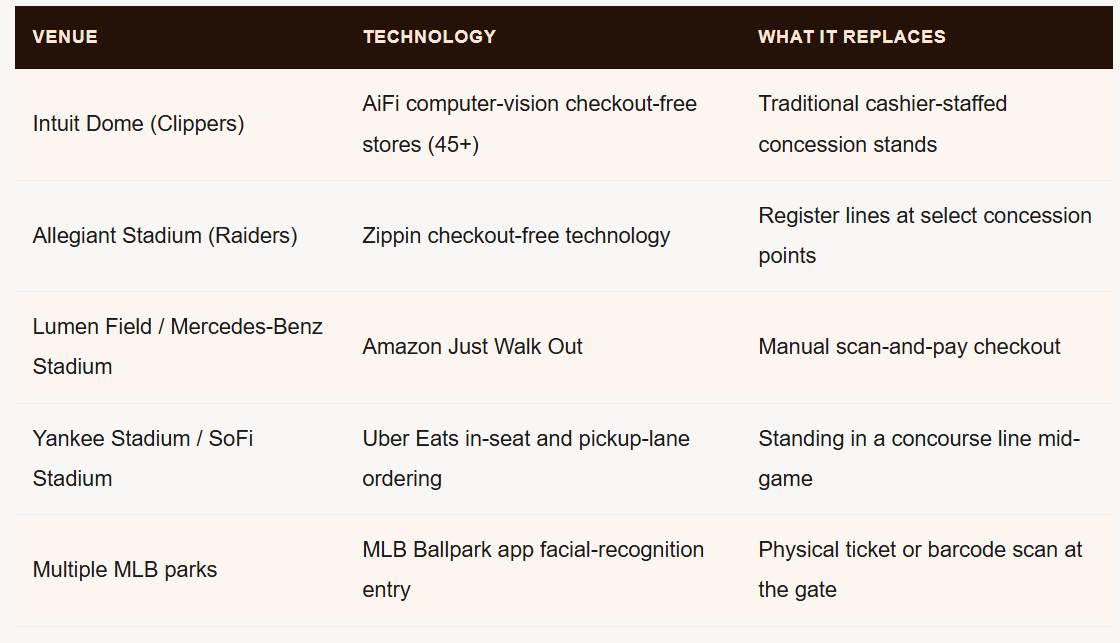
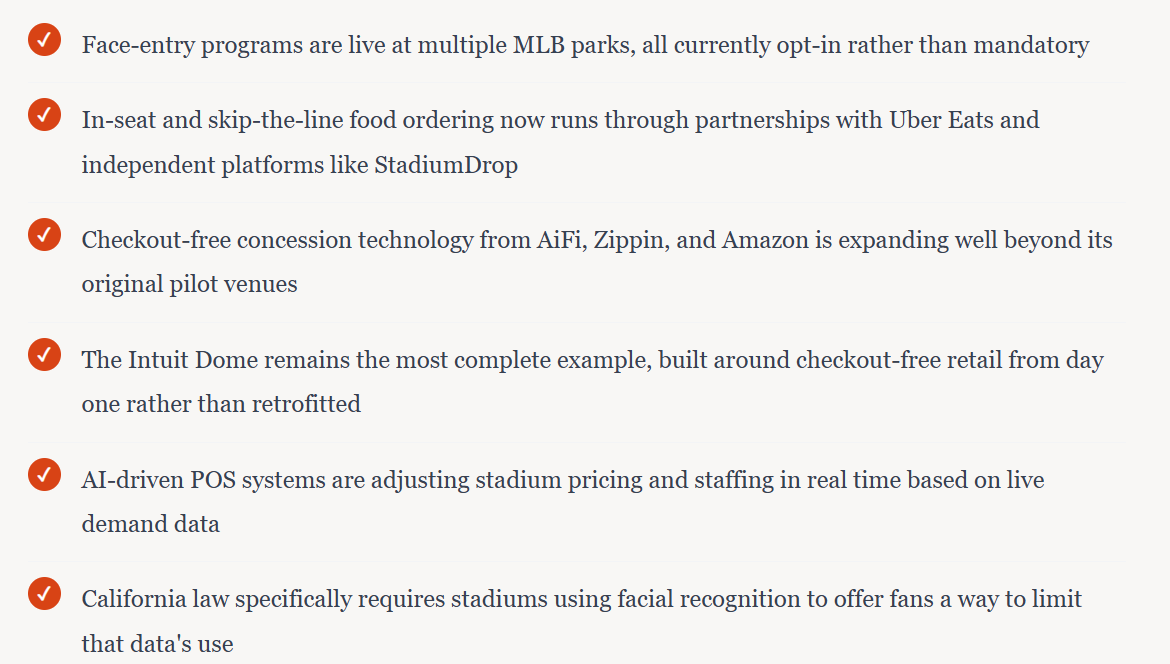
Picture the old version of a night at the ballpark: fumbling for a paper ticket at the gate, standing in a concession line so long you miss half an inning, then digging for cash or a card while the person behind you sighs audibly. That version of game day is disappearing faster than most fans have noticed. Walk into a growing number of American stadiums this season and the whole sequence looks different, your face is the ticket, your phone is the wallet, and in some buildings, nobody rings you up at all. This isn't a single flashy gadget rolled out for a press photo. It's a coordinated shift touching nearly every physical touchpoint of attending a game, entry, security, food, merchandise, and even how crowds get managed during a rain delay or a post-game exit. Some of it is genuinely delightful. Some of it raises real questions about where your face and your spending habits end up once a private company has them. Both things are true at once, and understanding the difference matters if you're the one walking through the gate. Your face is now the ticket at a growing number of MLB parks The most visible piece of this shift is happening right at the turnstile. Major League Baseball's branded face-entry program is already live at multiple parks, including Citizens Bank Park in Philadelphia, Nationals Park in Washington, Minute Maid Park in Houston, and Citi Field in New York. Fans opt in through the MLB Ballpark app, upload a selfie once, and from then on their face functions as their ticket, no phone screen to pull up, no barcode to angle just right under a scanner.
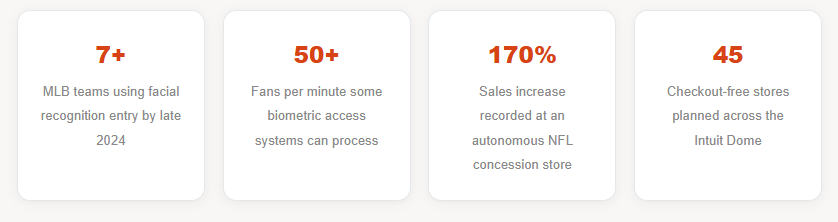
The Milwaukee Brewers rolled out a similar opt-in system at American Family Field, and team president Rick Schlesinger was candid about where he sees it heading: a test run at two gates now, with an expectation that in a few years every ballpark will offer it. The Los Angeles Clippers' Intuit Dome pushed the concept even further, building the entire fan journey around a single selfie uploaded during account setup, matched at a walk-up terminal that clears you with nothing more than a glance.
The app did the ordering before you even sat down
Entry was only the opening move. Once fans are inside, the second major shift is happening between the concourse and the seat. SoFi Stadium and Yankee Stadium both let fans order food on their phones and skip the line entirely through dedicated pickup lanes, a partnership with Uber Eats that has since expanded into full in-seat delivery at Yankee Stadium, where stadium staff prepare and physically walk the order to a fan's row. StadiumDrop, a smaller independent player in the same space, runs a comparable model across dozens of venues: order from your seat, pay digitally, tip digitally, and either grab it from a designated pickup zone or have a runner bring it directly to you.
Why venues are investing so heavily in this
The business case is blunt. A well-designed digital entry and ordering flow lowers abandoned purchases, reduces the staffing a venue needs at peak rush, and, most importantly for operators, gives fans back the minutes they used to lose standing in line, minutes that get spent buying more food, more merchandise, or simply watching more of the game they paid to see. Industry analysts tracking stadium technology in 2026 have been blunt that the entry experience specifically has become a proxy for a venue's overall approach to fan experience: a clunky gate makes everything after it feel clunky too.
It's not all about the latest flashy robots, but rather high-speed checkouts and clear inventory tracking that quietly remove the small annoyances fans once simply tolerated as part of going to a game.
— a pattern echoed across multiple 2026 stadium technology reports
Concession stands with no cashier at all
The most striking piece of this shift might be the disappearance of the register itself. Checkout-free technology, the kind pioneered in grocery retail, has moved into stadiums at real scale. Allegiant Stadium in Las Vegas runs ten checkout-free stands using Zippin's computer-vision system. Lumen Field in Seattle runs nine stores on Amazon's Just Walk Out technology. Mercedes-Benz Stadium in Atlanta uses the same Amazon system across its concessions, letting fans grab a drink and a snack and simply walk out, no scanning, no line, no register.
The Intuit Dome took the concept furthest of any venue built so far, opening with more than 40 AiFi-powered checkout-free concession stands, four autonomous merchandise stores, and one dedicated VIP space, all monitored by a network of thousands of cameras using computer vision to track what fans pick up and charge them automatically on the way out. It's the first arena designed from the ground up to make nearly every concession point in the building checkout-free rather than treating it as a novelty add-on.
The financial case for venues is easy to see: an early autonomous store at Ford Field cut transaction and queuing time by roughly half while pushing sales up 170% during the same season, numbers that make the upfront hardware and camera investment look far less risky to ownership groups weighing whether to expand the model further.

What fans actually notice, and what they don't
Strip away the sensor networks and the computer-vision jargon, and what a fan experiences is fairly simple: shorter waits, fewer physical objects to keep track of, and a game-day rhythm that feels less interrupted by errands. AI-powered point-of-sale systems now sit behind the scenes at many of these venues too, adjusting menu pricing and staffing forecasts in real time based on demand, which is part of why a packed playoff crowd doesn't create the same bottlenecks it used to a few seasons ago.
The part that doesn't make it into the press release
None of this convenience is free of cost, it's just that the cost isn't always paid at the register. Facial recognition at a stadium means a private venue, and often a third-party security vendor, is holding a biometric template of your face, not just a photo but a mathematical map of it. Madison Square Garden drew significant scrutiny, and extensive New York Times reporting, after it used facial recognition to identify and deny entry to attorneys whose law firms had active litigation against MSG-affiliated companies, including turning away people attending entirely unrelated events like a family night at Radio City Music Hall.
Worth knowing before you opt in
Facial geometry is classified as sensitive personal information under laws like California's CCPA and CPRA, meaning venues in states with these protections are required to offer a way to limit how that data gets used, even if the option isn't advertised prominently at signup.
There's also the simple question of choice. Every major program currently rolled out, MLB's Ballpark app system included, is opt-in rather than mandatory, and fans who'd rather show a physical ticket or scan a barcode can generally still do so. But the direction of travel is clear enough that industry insiders expect the newest stadiums under construction, including several new NFL venues slated to open over the next few years, to be designed with face entry as the default flow and a traditional scan as the fallback rather than the other way around.