 William BensonVIEW PROFILE →
The Garage That Swallowed the World: Inside Jeff Bezos's "Day 1" Obsession and Andy Jassy's Quiet Reinvention of Amazon
Every company that gets big enough eventually starts telling a cleaner version of its own origin story than the messy reality it actually lived through. Amazon's holds up better than most, mostly because the founder never really stopped acting like the company was still one bad quarter away from irr
Every company that gets big enough eventually starts telling a cleaner version of its own origin story than the messy reality it actually lived through. Amazon's holds up better than most, mostly because the founder never really stopped acting like the company was still one bad quarter away from irrelevance.
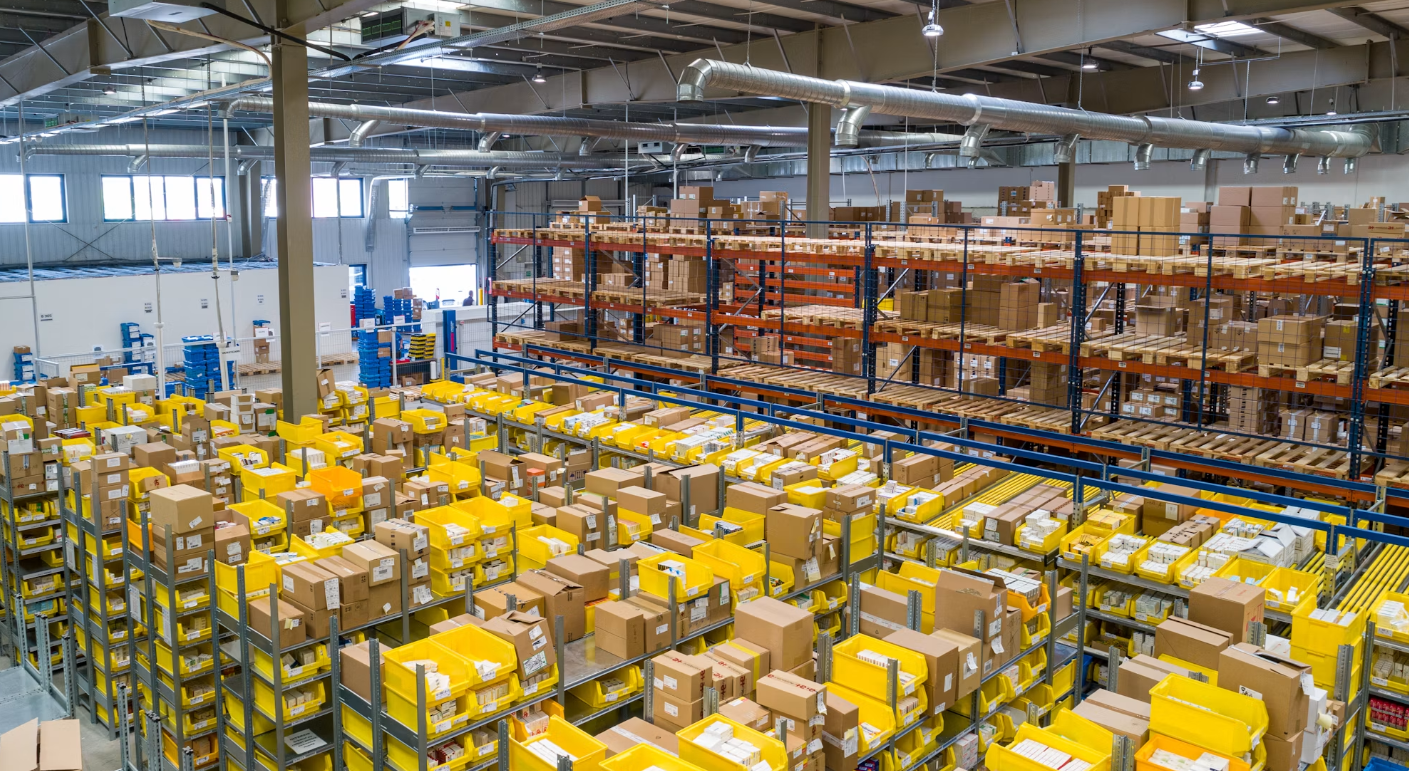
In the summer of 1994, a hedge fund analyst in his early thirties quit a comfortable Wall Street career, drove across the country, and started selling books out of a garage in Bellevue, Washington, off a folding door repurposed as a desk. Nothing about that scene predicted what the company would eventually become. Books were chosen deliberately, not out of any deep passion for publishing, but because they were one of the few product categories with a catalog large enough, and a customer base patient enough, to prove that people would actually trust a stranger on the internet with their credit card number. Everything that followed, the marketplace, the warehouses, the cloud servers, the delivery drones now buzzing over parts of Texas and Arizona, grew out of that first, oddly narrow bet. What makes the story genuinely interesting isn't the garage, every tech giant has one of those in its mythology by now. It's the specific discipline the founder built around never letting the company feel settled, a philosophy he formalized early on and referred to, over and over, in shareholder letters, as staying in "Day 1." The idea is deceptively simple: the moment a company starts believing it has arrived, decision-making slows down, customer obsession quietly curdles into internal politics, and decline becomes inevitable, just slow enough not to notice until it's too late. Whatever else changed at Amazon over three decades, that particular anxiety never really went away. From a bookstore to a flywheel nobody else could copy The early strategy looked, from the outside, almost recklessly unprofitable. Amazon spent years plowing nearly every dollar of revenue back into infrastructure, selection, and lower prices rather than reporting the kind of clean profit margins Wall Street usually wants to see, a pattern that drew real skepticism through the late 1990s and early 2000s. The underlying logic was what later became known internally as the flywheel: lower prices and wider selection attract more customers, more customers attract more third-party sellers, more sellers deepen the selection and lower costs further through scale, and the wheel picks up speed on its own once each part is reinforcing the others. It's a slow, expensive idea to prove out. It's also nearly impossible to compete against once it's actually spinning.
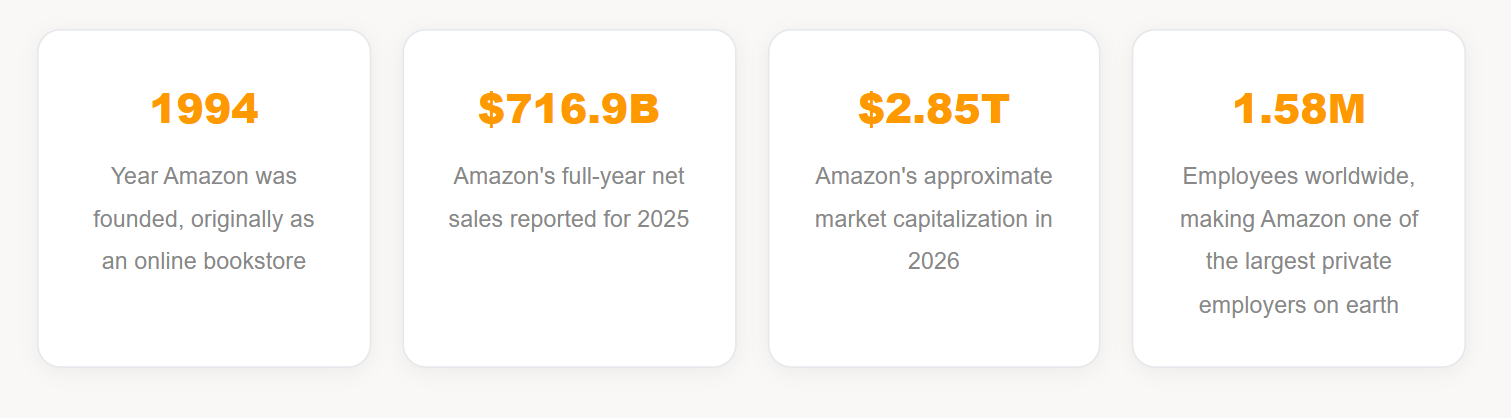
Retail alone, even at that scale, was never going to explain a valuation like that. The far bigger surprise turned out to be a division nobody outside the company took especially seriously when it launched.
The side project that ended up funding everything
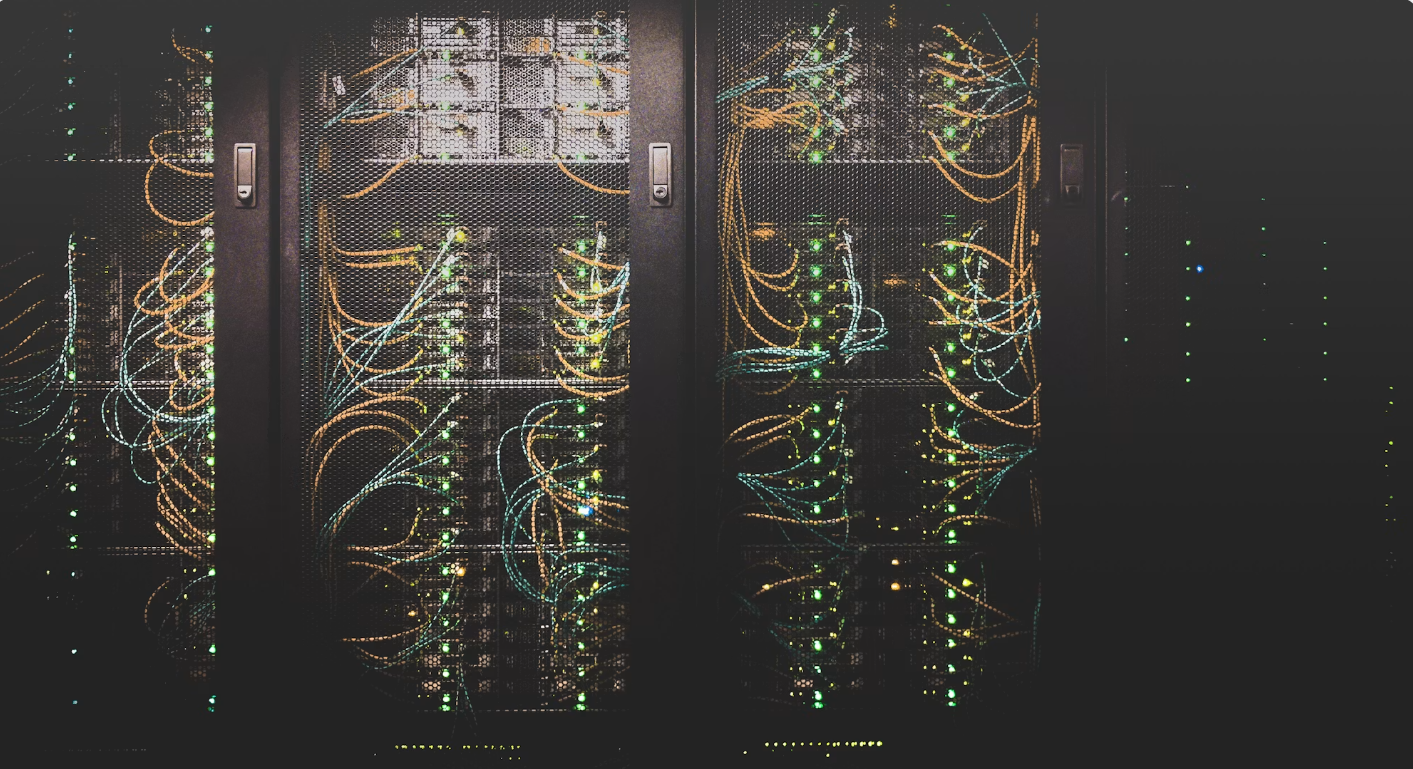
Amazon Web Services began life as an internal solution to a fairly unglamorous problem: engineering teams across the company kept independently rebuilding the same computing infrastructure for every new project, wasting time and money on undifferentiated plumbing instead of the features that actually mattered to customers. Standardizing that infrastructure into reusable internal services turned out to be valuable enough that Amazon made the unusual decision to sell access to it externally, effectively renting out the same computing power, storage, and databases it had built for its own retail business to any company willing to pay for it.
From accidental side hustle to the company's profit engine
Two decades later, that side project has become the primary reason Amazon's overall profitability looks as strong as it does. AWS generated well over $100 billion in annual revenue by 2025, and cloud growth has been accelerating sharply through 2026, driven largely by companies racing to build and run artificial intelligence workloads on rented infrastructure rather than their own data centers. AWS's operating margins consistently run well above 30%, dramatically higher than the thinner margins typical of the retail business, which is why a division that started as an internal fix for wasted engineering time now generates a majority of Amazon's total operating profit in any given quarter.
Amazon's leadership has pointed to booming demand for cloud computing infrastructure as the reason the company is committing to record capital spending, even acknowledging it still won't have enough capacity to meet everything customers want in the near term.
— Based on Amazon's 2026 quarterly earnings commentary
The handoff, and a very different kind of second act
Bezos stepped back from the CEO role in 2021, moving into the position of executive chair while handing day-to-day leadership to Andy Jassy, the longtime executive who had built and run AWS from its earliest days. The timing wasn't especially kind. Jassy inherited the company just as pandemic-driven demand was cooling, supply chains were tangled, and Amazon was digesting years of rapid, somewhat sprawling expansion that had ballooned costs faster than revenue. The next couple of years looked, by Amazon's usual standards, rough, with cost-cutting, warehouse closures, and a noticeably more disciplined tone replacing the growth-at-any-cost posture of the previous decade.
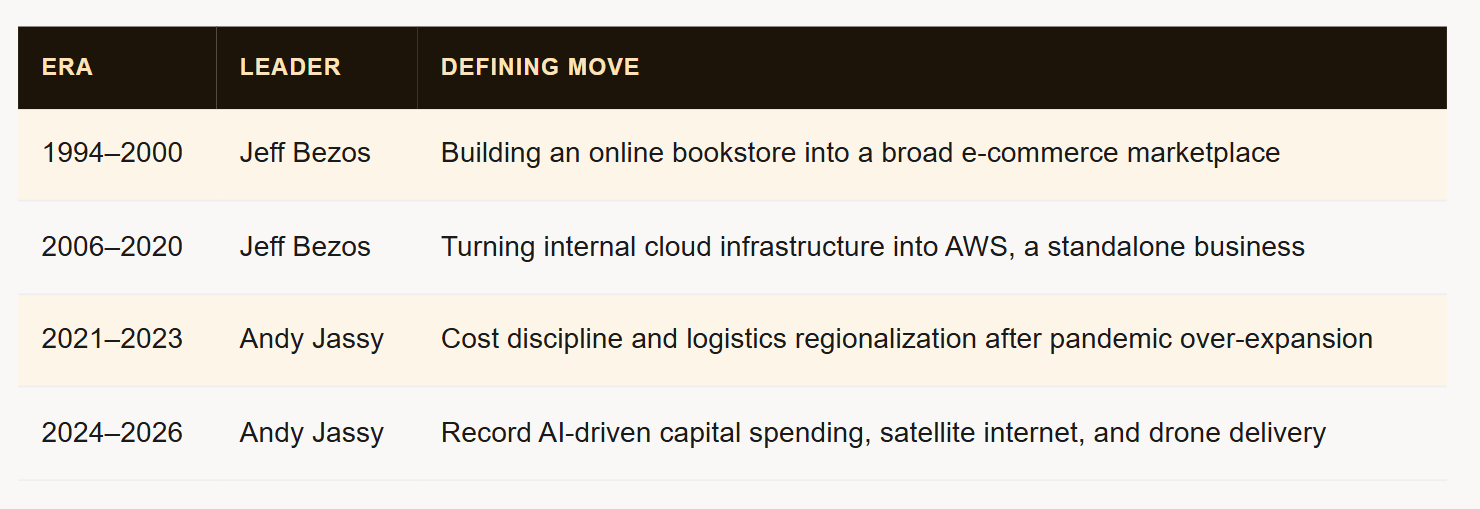
What emerged from that reset looks more disciplined than the Amazon of the 2010s. Jassy pushed a broad reorganization aimed at flattening management layers and cutting corporate bureaucracy, explicitly framed internally as an effort to recapture some of that original Day 1 urgency that can get diluted as any organization grows past a certain size. By 2025, the strategy had clearly paid off on the numbers: net income rose sharply year over year, operating margins expanded as the logistics network became more regionally efficient, and the advertising business quietly grew into a high-margin revenue stream worth tens of billions of dollars a year in its own right.
Why the AWS number matters more than the retail number
Amazon's overall revenue is dominated by retail, but its profit is dominated by AWS. Cloud computing consistently generates a large majority of the company's total operating income despite being a smaller slice of total sales, which is why nearly every major strategic bet Amazon is making right now, custom AI chips, data center expansion, satellite internet, traces back to keeping that cloud engine growing.

Betting $220 billion on what comes next
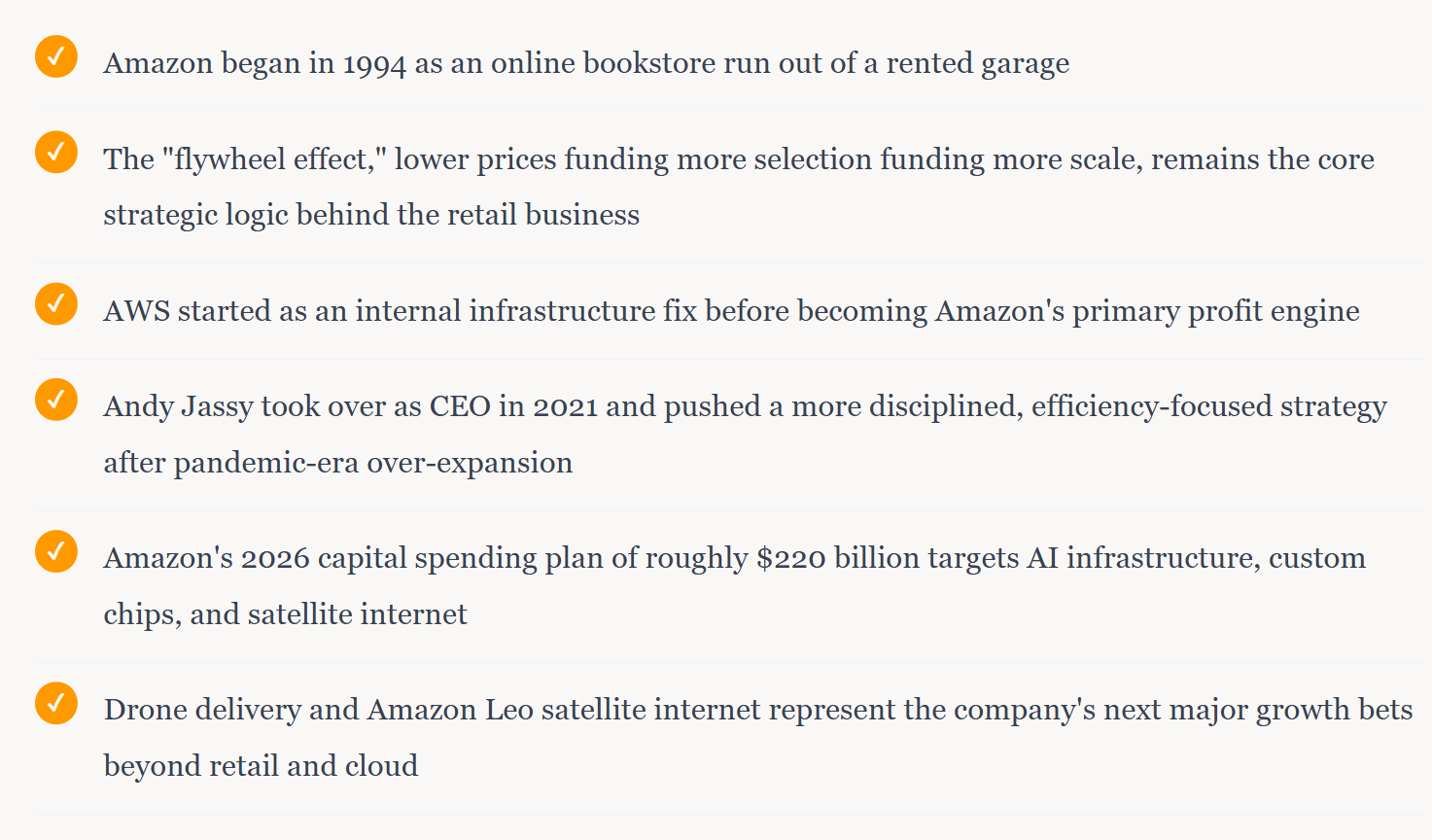
Amazon entered 2026 with a capital spending plan that would have sounded implausible a decade earlier, roughly $220 billion for the year, directed largely at AI infrastructure, custom chip production, robotics, and low-earth-orbit satellites. Leadership has been unusually blunt about the reasoning: demand for cloud and AI computing capacity is currently outpacing what Amazon can physically build, a dynamic executives expect to persist for at least another year or two. That kind of spending is a genuine bet, one that pressures short-term free cash flow in exchange for a claim on infrastructure that competitors would need years to replicate.
Three projects illustrate where that spending is actually going. The satellite internet initiative, now operating commercially under the Amazon Leo name, launched service in 2026 aimed at bringing broadband to rural and underserved regions, directly challenging existing satellite internet providers. Drone delivery, long treated as a novelty, has expanded toward roughly 500 cities as the program scales past its first million completed deliveries. And custom silicon, chips developed in-house specifically for cloud and AI workloads, is reducing Amazon's reliance on outside chipmakers while improving the margins on every dollar of cloud revenue that runs through its own data centers.
None of this guarantees the next decade goes as smoothly as the last three, a bet this large carries real risk if AI-driven cloud demand cools faster than expected, and Amazon's free cash flow has already tightened noticeably under the weight of this spending cycle. But the underlying instinct driving it, spend aggressively now on infrastructure competitors can't easily replicate, worry about the comfortable margins later, is exactly the same instinct that turned a garage bookstore into a company touching nearly every part of how the modern internet, and increasingly the physical delivery of goods, actually works.