 William BensonVIEW PROFILE →
The Glucose Obsession: Why Millions of Healthy People Are Wearing a Diabetic's Device, and What the Science Actually Says
A device built to keep insulin-dependent patients out of the emergency room has become one of the most talked-about wellness accessories of the year. The question nobody selling one seems eager to answer in full: does it actually do anything for someone whose blood sugar was never the problem to beg
A device built to keep insulin-dependent patients out of the emergency room has become one of the most talked-about wellness accessories of the year. The question nobody selling one seems eager to answer in full: does it actually do anything for someone whose blood sugar was never the problem to begin with?
Somewhere in the last two years, blood sugar went from a number your doctor mentioned once a year to a live, scrolling graph people check the way they'd check a step count. A small sensor sits on the back of an arm, quietly measuring glucose in the fluid under the skin every few minutes, and an app translates that into a chart with peaks and valleys that people have started treating like a report card. Eat white rice, watch the line climb, feel a flicker of guilt that has nothing to do with how the meal actually made you feel. It's a strange thing to have happened to a metric almost nobody outside of endocrinology used to think about at all. The tool at the center of this is the continuous glucose monitor, or CGM, a device that was, until fairly recently, prescribed almost exclusively to people managing diabetes. Since regulators cleared the first version for sale without a prescription, it has been adopted by a very different crowd: athletes chasing marginal performance gains, biohackers optimizing for longevity, and a much larger group of otherwise healthy people who simply want to understand their bodies better after watching an influencer's blood sugar spike dramatically after a bowl of cereal. The trend has real substance underneath it. It's also collected a lot of noise on top, and untangling the two is worth doing before spending money, or worse, developing anxiety, over a normal biological wobble. The number that actually justifies some of the panic The wellness industry's favorite statistic on this topic isn't exaggerated: a widely cited 2022 analysis found that only about 6.8% of American adults met every marker of optimal metabolic health, things like waist circumference, blood pressure, blood sugar, and cholesterol all sitting comfortably in a healthy range at the same time. That leaves the overwhelming majority of adults with at least one metabolic marker outside the ideal zone, which is exactly the kind of statistic that makes a real-time window into your own blood sugar sound less like a gadget and more like due diligence.
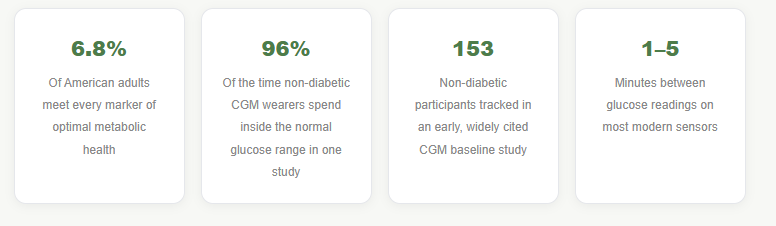
What tends to get lost in the discourse is the second half of that picture. Multiple studies looking specifically at people without diabetes have found their glucose levels sit inside the normal range the overwhelming majority of the time, spiking briefly after a meal and returning to baseline well before it becomes anything close to a medical concern. A rising line on a graph after lunch isn't a warning sign in someone with healthy insulin function, it's just digestion, visible for the first time because someone strapped a sensor to their arm.

Where the "hacks" came from, and which ones hold up
A specific vocabulary has grown up around this trend: eat your vegetables before your carbs, have a spoonful of vinegar before a starchy meal, take a ten-minute walk right after eating, never eat a sweet treat on its own. Some of this traces back to legitimate physiology. Fiber does slow the rate at which sugar enters the bloodstream, which is why a plate built around vegetables and protein tends to produce a gentler curve than the same calories eaten as juice on an empty stomach. A short walk does help muscles pull glucose out of the blood more efficiently. None of that is fringe science.
Where the evidence gets thinner
What's far less settled is whether flattening every single post-meal spike is actually something a metabolically healthy person needs to be doing. Researchers reviewing the broader trend have pointed out that there's still no agreed-upon threshold for what counts as a "concerning" spike in someone without diabetes, which means a lot of the alarm generated by these apps is being measured against a standard nobody has actually validated. A food causing a temporary rise in blood sugar doesn't automatically make it a poor choice, and treating every fluctuation as a problem to be solved is itself a pattern some clinicians are starting to flag as a genuine downside of the trend.
Constant glucose monitoring in people without a diagnosed metabolic condition can foster an unhealthy preoccupation with food, sometimes tipping into restrictive eating patterns that outweigh whatever insight the data actually provided.
— A concern raised across multiple 2026 clinical reviews of non-diabetic CGM use

What the device is actually good at, and who it's genuinely good for
None of this means CGMs are a scam. For people managing type 1 or insulin-dependent type 2 diabetes, continuous monitoring is genuinely life-changing technology, catching dangerous highs and lows in real time in a way that finger-prick testing never could. Even outside that group, there's emerging, still-developing research suggesting the simple act of seeing the data can nudge people toward better habits, more consistent meals, more walking, less late-night snacking, purely because visibility tends to change behavior. A 2026 pooled analysis of dozens of smaller studies found that non-diabetic participants who wore a CGM saw modest improvements in average blood sugar compared with those who didn't, though researchers are still working out how much of that came from the data itself versus simply paying closer attention to eating habits in general.
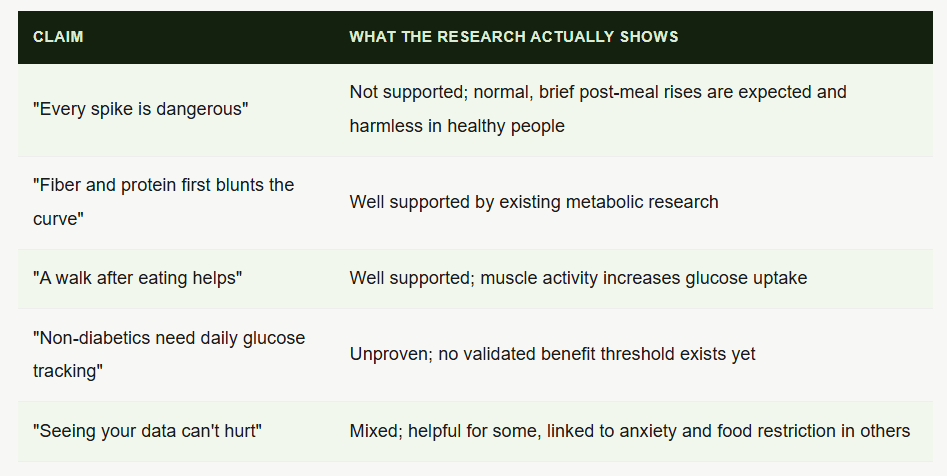
The honest middle ground, based on where the evidence currently sits, is that a CGM can be a genuinely useful short-term learning tool for a curious, health-focused adult who wants to understand how their own body responds to different meals, sleep patterns, and stress. It's a different thing entirely to wear one indefinitely, chasing a flat line that was never a realistic or necessary goal for someone whose metabolism was working fine before the sensor arrived.
Worth knowing before buying one
Manufacturers now market these devices explicitly as consumer wellness tools rather than purely medical ones, which is part of why the marketing can outrun the science. If blood sugar is a genuine concern, a conversation with a doctor or registered dietitian about an actual risk profile will tell you far more than watching a graph in isolation ever will.

Why this particular trend spread so fast
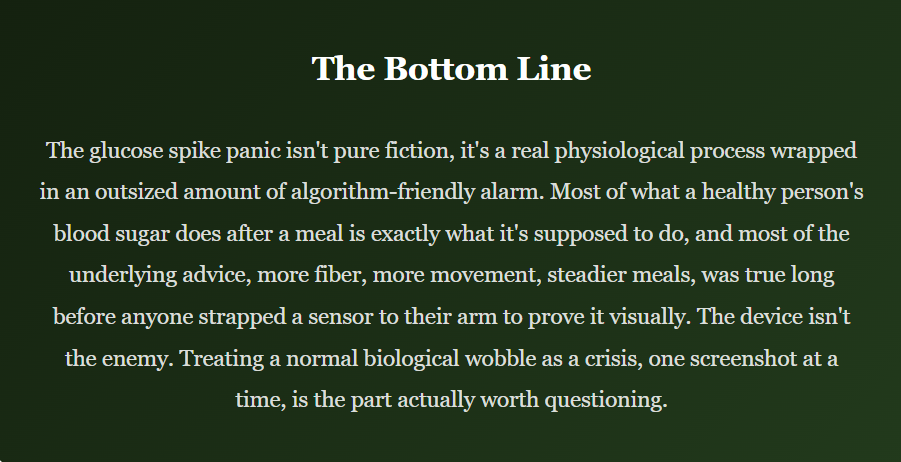
Part of what made glucose tracking so shareable is that it produces a literal graph, and graphs are inherently more persuasive on a social feed than a paragraph of nuance ever could be. A steep line after a specific food is dramatic, easy to screenshot, and easy to caption with a warning. The gentler, more accurate explanation, that a temporary rise followed by a quick return to baseline is exactly what a healthy metabolism is supposed to do, doesn't generate nearly the same reaction. That mismatch between what's visually alarming and what's medically meaningful is where most of the genuine confusion around this topic comes from.
None of this means the underlying curiosity is misplaced. Wanting to understand how your own body responds to food, sleep, and stress is a reasonable, even healthy, impulse. What the current evidence actually supports is narrower than the online version of this trend suggests: pay attention to the basics that are already well established, meals built around fiber and protein, regular movement, decent sleep, and treat a glucose graph as one data point worth some curiosity, not a verdict on every bite.
This article is for general informational purposes and reflects current research on glucose monitoring trends. It isn't medical advice. Anyone with specific concerns about blood sugar or metabolic health should speak with a doctor or registered dietitian.