William BensonVIEW PROFILE →
The Invisible Giant: How One Engineer's Bet in His Mid-Fifties Built the Company the Entire World Secretly Depends On
Ask ten people to name the company behind the chip inside their phone, and the overwhelming majority will say Apple, or maybe Intel. Almost none of them will say the actual answer, a firm most consumers have never had a reason to think about, sitting quietly at the center of nearly every advanced pi
Ask ten people to name the company behind the chip inside their phone, and the overwhelming majority will say Apple, or maybe Intel. Almost none of them will say the actual answer, a firm most consumers have never had a reason to think about, sitting quietly at the center of nearly every advanced piece of electronics on the planet.
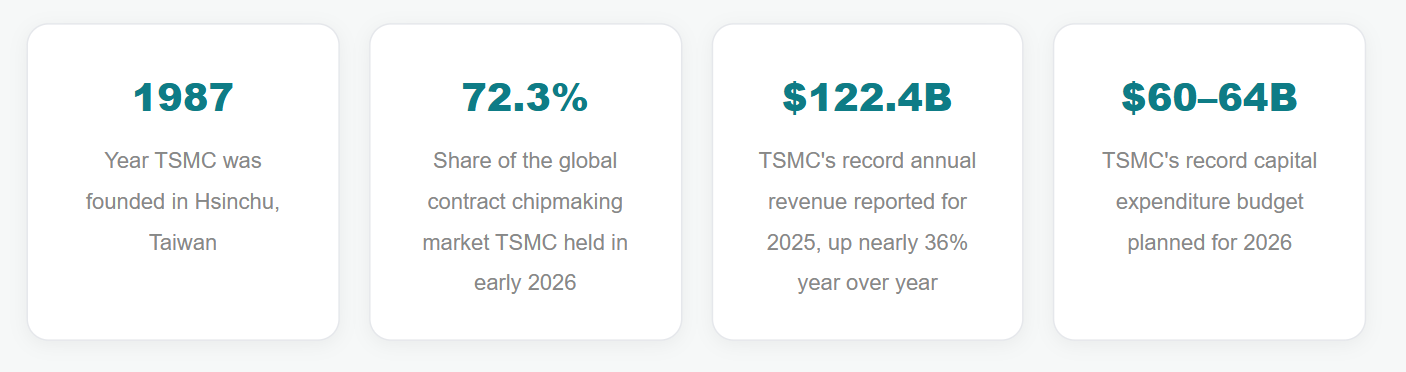
In 1987, a semiconductor executive in his mid-fifties, an age when most successful engineers are winding toward retirement rather than starting over, left a long, well-regarded career at a major American electronics company and returned to Taiwan to build something the industry had never really tried before. His idea sounded almost too modest to matter: a company that wouldn't design any chips of its own at all. It would simply manufacture the chips other companies designed, at a scale and precision nobody else was willing to commit the capital to build. That single decision, to become a pure manufacturing partner rather than a competitor, quietly reshaped the entire structure of the global technology industry over the following four decades. The company is Taiwan Semiconductor Manufacturing Company, known almost universally by its acronym, TSMC. It doesn't put its name on a single phone, laptop, or car sold anywhere in the world. And yet, if its factories in Taiwan stopped running for even a few weeks, the shortage would ripple through smartphones, data centers, cars, medical devices, and military hardware within a matter of months. That's not hyperbole, it's roughly how the last global chip shortage played out, and the concentration of manufacturing that caused it hasn't meaningfully changed since. The business model nobody else wanted to try Before TSMC existed, chip companies typically designed and manufactured their own products in-house, an approach that required staggeringly expensive factories, called fabs, that only the largest, most established firms could justify building. That structure locked smaller design firms and startups out of the industry almost entirely, since building a competitive chip design was one enormous investment, and building the factory to actually produce it was another, even larger one. TSMC's founder proposed splitting those two businesses apart entirely: let chip designers focus purely on design, and let TSMC handle the manufacturing for anyone willing to pay for it, competitor or not.
That decision to serve everyone rather than compete with anyone turned out to be the entire foundation of the modern chip industry. Companies like Nvidia, AMD, and Qualcomm exist in their current form largely because TSMC's pure-play foundry model let them focus entirely on chip architecture and design without ever needing to own a single factory, an arrangement so foundational now that most people assume it was always how the industry worked. It wasn't. Someone had to invent it, and convince skeptical investors to fund an enormously capital-intensive factory business built on serving other people's designs rather than its own.
Why so much of the tech industry quietly runs through one company
The reason this concentration matters so much now is the sheer difficulty of the technology involved. Manufacturing the most advanced chips on the market requires printing circuit patterns measured in mere nanometers onto silicon wafers with a precision that only a handful of companies on Earth have ever achieved. TSMC's newest 2-nanometer process entered volume production on schedule in late 2025, and its designers, customers, and manufacturing partners are already racing toward the next generation, a 1.6-nanometer node expected to enter production later in 2026. Falling even one generation behind at that level of precision effectively locks a company out of supplying the fastest, most power-efficient chips in the world.
The customer list that says it all
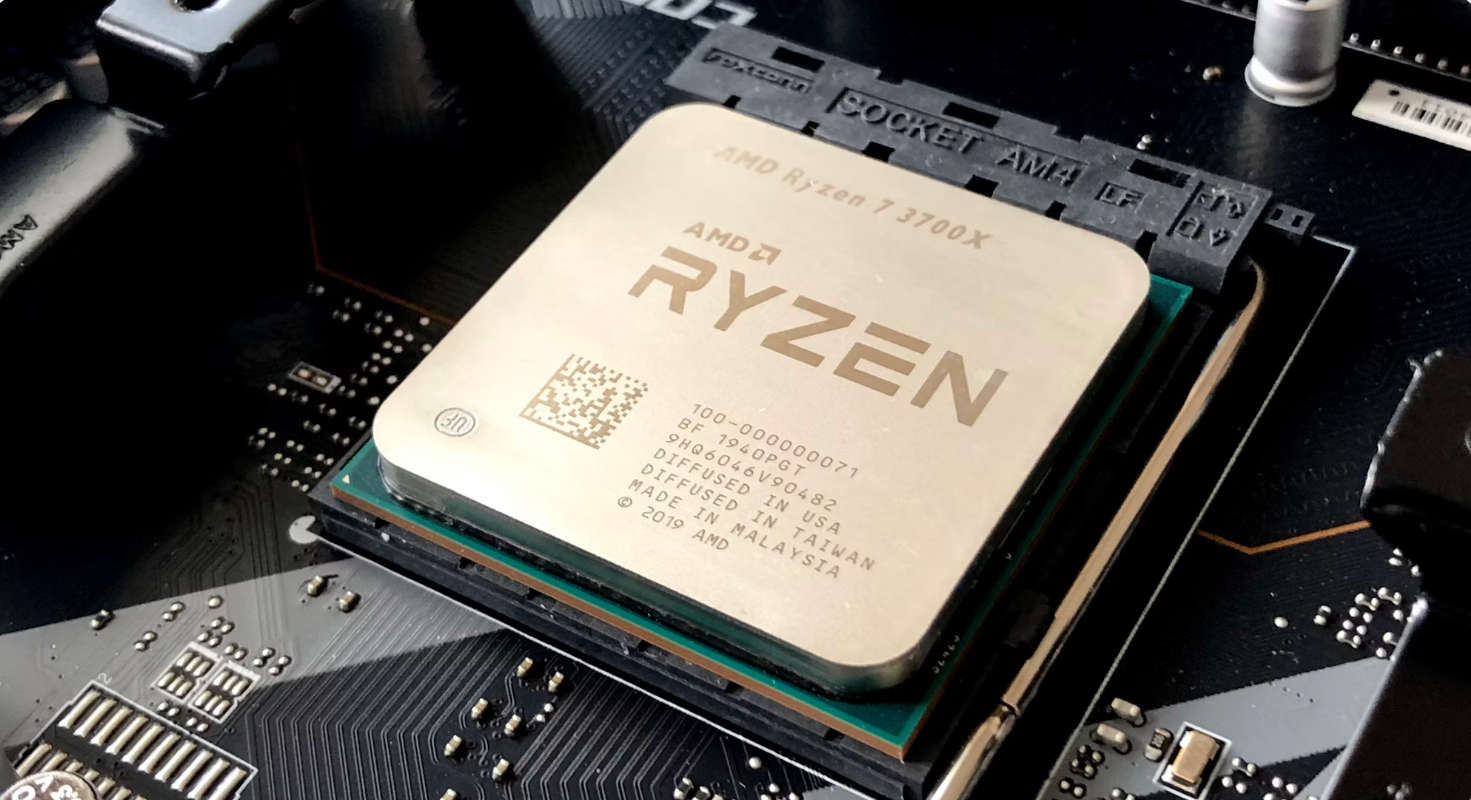
Apple's most advanced processors, Nvidia's AI accelerators powering the current wave of data center buildouts, AMD's server and gaming chips, and Qualcomm's mobile processors are all manufactured, at least in significant part, through TSMC's factories. High-performance computing chips, largely the artificial intelligence accelerators driving the current AI infrastructure boom, made up roughly two-thirds of TSMC's revenue in recent quarters, a dependency that ties the fortunes of the entire AI industry directly to how quickly TSMC can build and staff new factory capacity.
The transition to the 2-nanometer node isn't incremental, it's transformational, with power efficiency gains alone capable of meaningfully increasing AI training throughput for every data center rack that adopts it.
— Paraphrasing analyst commentary from Barclays on TSMC's 2026 technology roadmap
The geopolitical bet nobody can ignore
Nearly all of TSMC's most advanced manufacturing still happens on the island of Taiwan, a fact that's become one of the most closely watched geopolitical variables in the global economy. Tensions across the Taiwan Strait, and Taiwan's near-total reliance on imported energy to power factories that alone consume close to a tenth of the island's electricity, have turned a single company's manufacturing footprint into a genuine matter of national security planning for multiple governments simultaneously. That combination of technical irreplaceability and geographic concentration is sometimes described as Taiwan's "silicon shield," a deterrent built less on military hardware than on the sheer economic cost the rest of the world would absorb if that manufacturing capacity were disrupted.
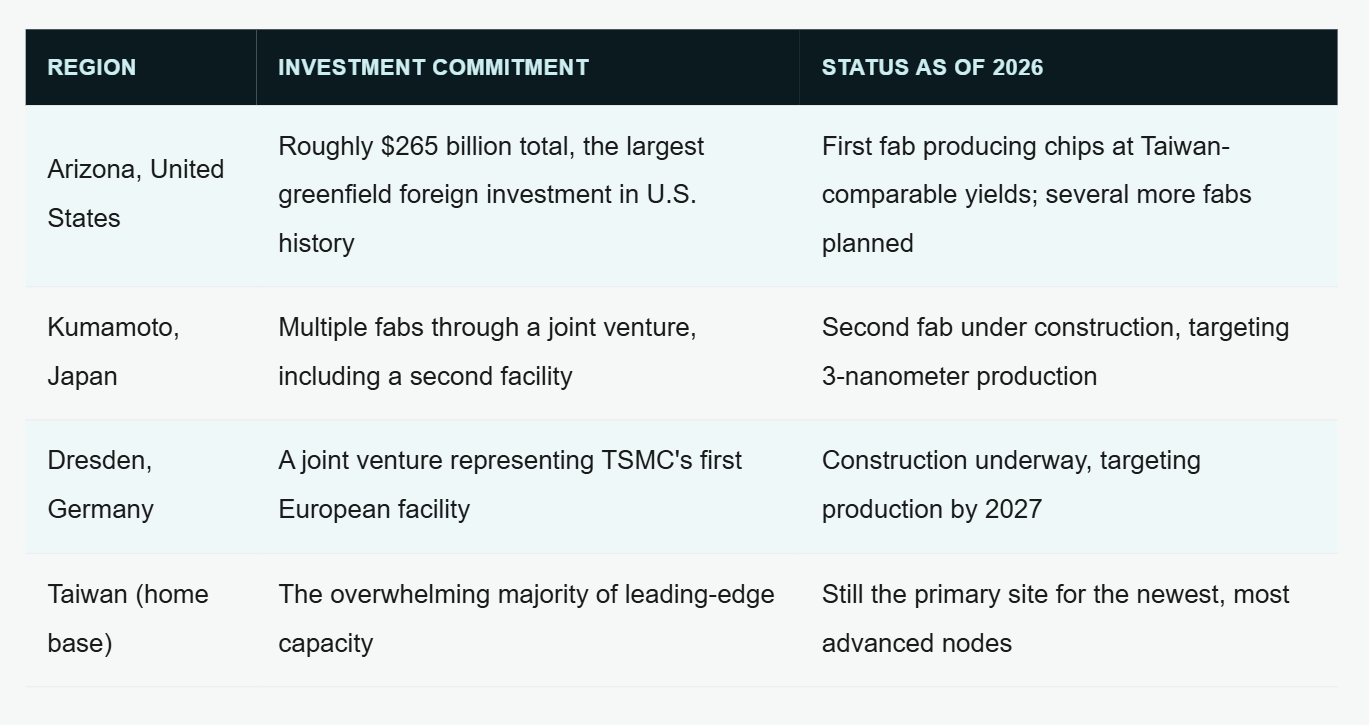
That's precisely why TSMC has committed such enormous sums to building manufacturing capacity outside Taiwan, in Arizona, Japan, and Germany, even though building chips in those locations costs meaningfully more than building them at home. Diversifying the physical footprint of the world's most concentrated manufacturing chokepoint isn't just a business decision, it's become something closer to a global infrastructure project that multiple governments have a direct stake in seeing succeed.
Why this expansion is harder than it sounds
Replicating Taiwan's manufacturing ecosystem elsewhere isn't simply a matter of money. Running a leading-edge cleanroom at the 2-nanometer level requires a depth of specialized engineering talent that remains genuinely scarce worldwide, and TSMC is now competing with itself across multiple new international sites for the same limited pool of qualified engineers, even as it maintains margins above 50% in markets where labor and construction costs run significantly higher than at home.
What happens after the founder steps back
TSMC's founder retired from his final leadership role in 2018, handing the company to a new generation of executives who have kept the original pure-play foundry philosophy fully intact while steering the company through its most capital-intensive expansion yet. That continuity matters more than it might seem. A founder's original insight, that manufacturing and design should be separate businesses serving a shared industry rather than competing empires, has held up remarkably well across nearly four decades and multiple leadership transitions, a rare feat in an industry that moves as fast as semiconductors do.
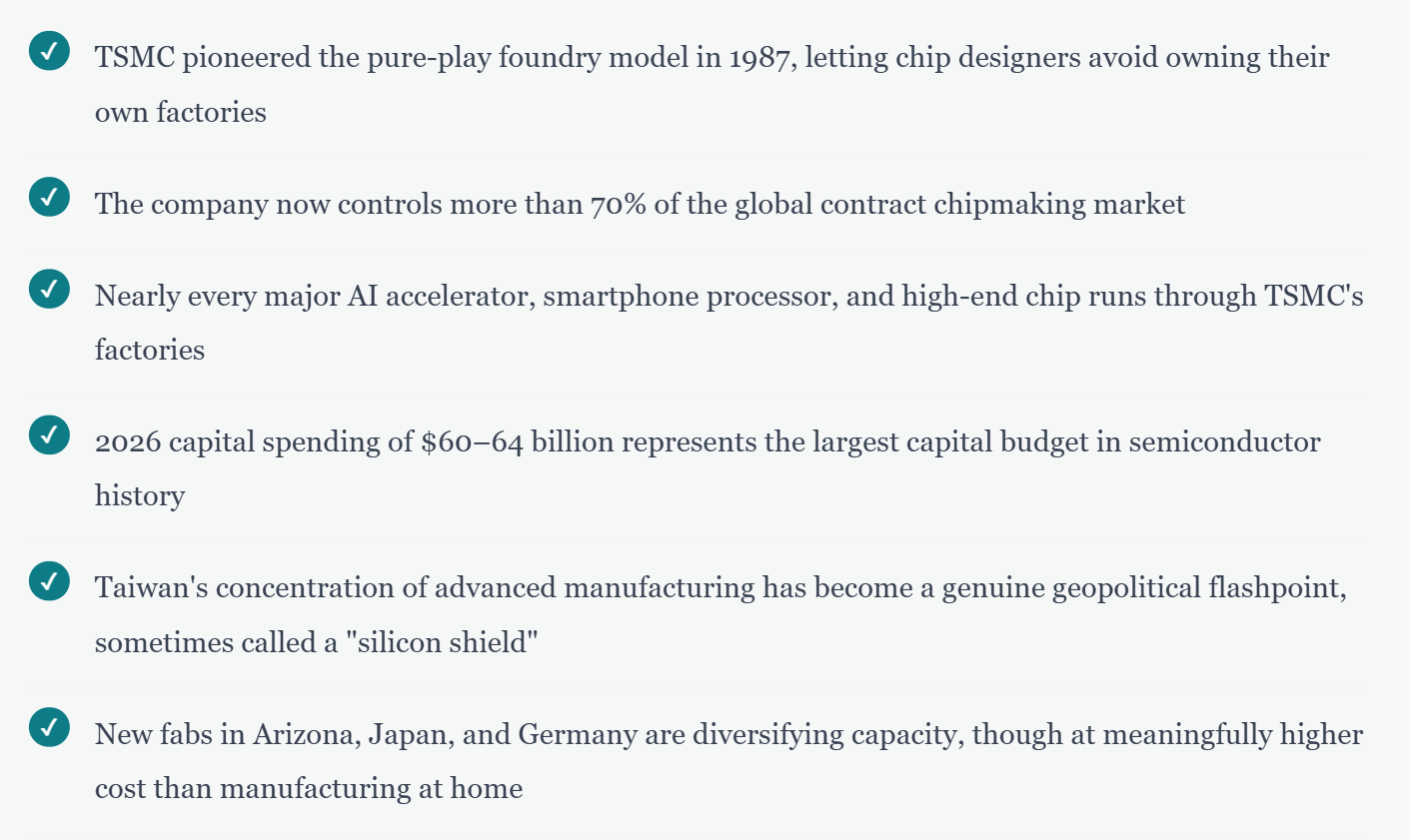
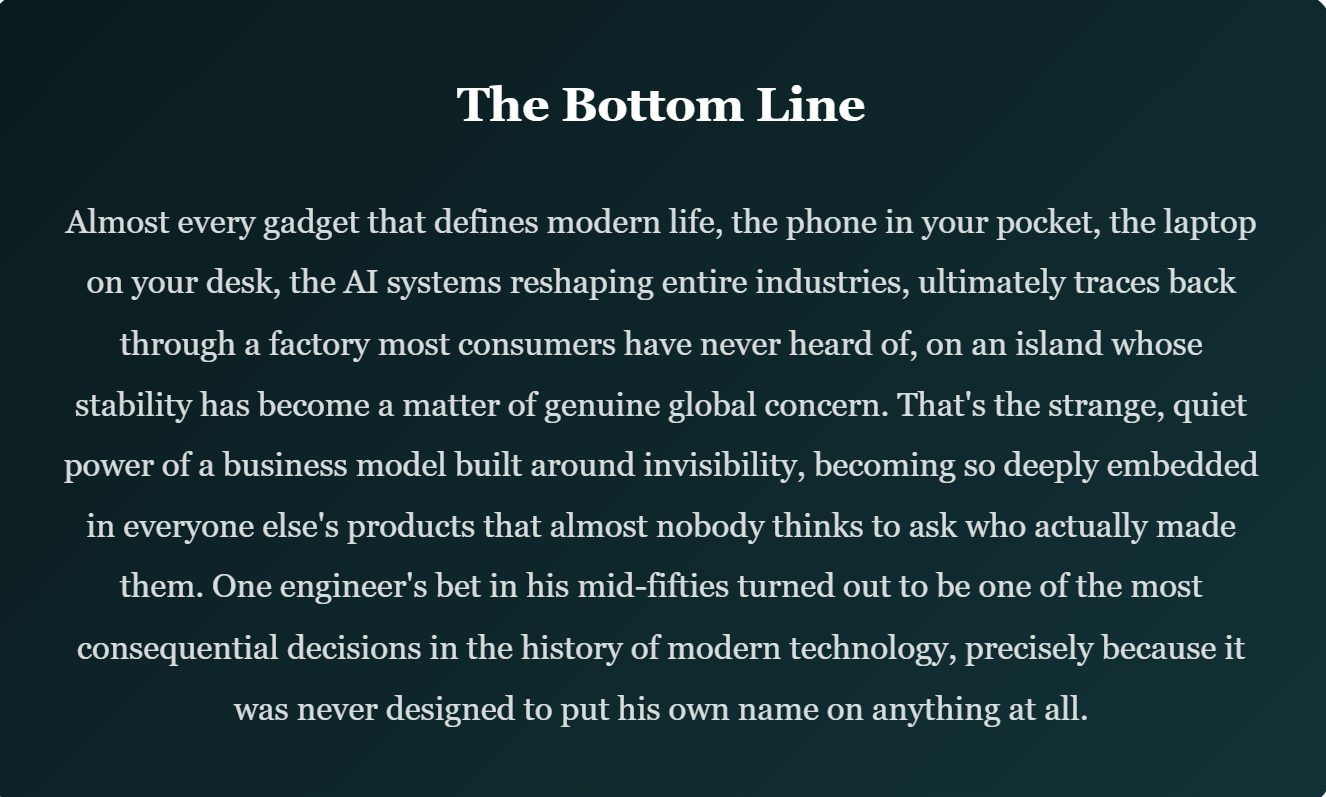
None of this is a household name in the way of the companies whose products actually reach consumers. That's rather the point. TSMC's entire business model was built around staying invisible to the end customer while becoming utterly indispensable to nearly every company that does reach one. A decision made by one engineer in his mid-fifties, to build factories for other people's ideas rather than his own, quietly became one of the load-bearing pillars of the entire modern economy.