 William BensonVIEW PROFILE →
The machines that eat cities
Silicon Valley didn't run out of ideas. It ran out of concrete, copper, and megawatts , and the bill for what comes next reads like a national infrastructure budget.
Silicon Valley didn't run out of ideas. It ran out of concrete, copper, and megawatts — and the bill for what comes next reads like a national infrastructure budget.
Silicon Valley didn't run out of ideas. It ran out of concrete, copper, and megawatts — and the bill for what comes next reads like a national infrastructure budget.
There's a particular kind of vertigo that hits when you realize the smartest companies on Earth have started talking like utility commissioners. Listen to an Amazon earnings call this year and you'll hear less about model architectures and more about transmission rights, substation queues, and reactor restart timelines. Listen to Microsoft, and you'll hear the CFO explain that a large chunk of new spending simply went toward the rising price of memory chips — not toward anything you'd recognize as software.
Something has quietly inverted. For three years, the AI story was told almost entirely in the language of code: parameters, context windows, benchmark scores, chatbot personalities. That story was cheap to tell and thrilling to watch, because software has always behaved like it's exempt from the physical world — copy a file, ship an update, scale to a billion users overnight, no factories required. It's the industry's founding myth, and for a while it was even true.
It isn't anymore. Intelligence, it turns out, is not a purely digital good. It's closer to a smelting operation. Every large model that gets trained and served to the public runs on a chain of unglamorous, brutally physical inputs — etched silicon, high-voltage copper, refrigerant-grade coolant, poured concrete, and, increasingly, uranium. The AI race hasn't slowed down. It has simply changed venues, moving out of the code repository and onto the construction site, the foundry floor, and the grid interconnection queue. Call it what it is: intelligence has become heavy industry, and heavy industry has a supply chain that doesn't care how good your algorithm is.
This is a story about money, mostly — obscene, almost unbelievable sums of it — but it's also a story about limits. Because the physical world, unlike a software stack, does not scale on command. And the handful of companies currently spending more on infrastructure than most G20 nations spend on defense are learning that the hard way, in real time, in public.
The illusion of "free" code
For a long time, the pitch to investors was seductively simple: train a better model, ship it, watch margins expand toward infinity, because software has near-zero marginal cost. That pitch worked when the constraint was talent and data. It stops working the moment the constraint becomes physical capacity — and right now, it has.
Start with the chip itself. Everyone understands, at this point, that Nvidia's GPUs are the closest thing the AI economy has to a reserve currency. What fewer people appreciate is that the actual fabrication of the silicon die is no longer the tightest part of the pipeline. Supply-chain trackers following TSMC's operations point to a chokepoint one step downstream, in a process called advanced packaging — the delicate, capital-intensive art of fusing a processor die to stacks of high-bandwidth memory so they function as a single unit. TSMC's flagship packaging technology, known as CoWoS, has effectively been sold out for the better part of two years, with reports indicating Nvidia alone has locked up somewhere between 500,000 and 850,000 wafers of that capacity for 2026 — a share estimated at more than half of everything TSMC can produce.
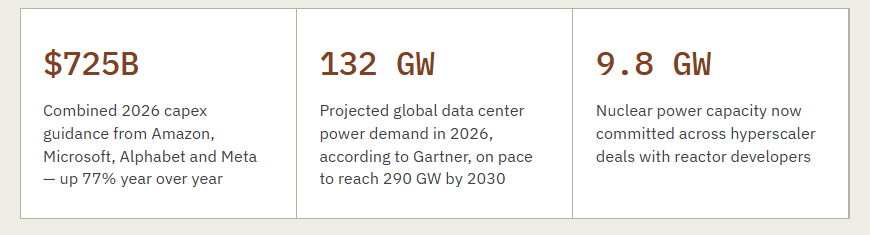
That's not a metaphorical bottleneck. It is a literal one, measured in wafers per month, and TSMC has been racing to widen it — reportedly scaling CoWoS output from roughly 35,000 wafers monthly in late 2024 toward something like 130,000 by the end of this year. Even that near-quadrupling of capacity, according to industry analysts, isn't loosening the market as much as you'd expect, because demand from hyperscaler capital budgets has been rising even faster than supply. It's a treadmill problem: Amazon, Google, Microsoft, and Meta collectively pushed their combined 2026 capital expenditure toward roughly $725 billion, up about 77% from the prior year's already-record $410 billion — and packaging capacity, however impressive its growth curve looks on a chart, simply cannot compound at that pace. You cannot 3D-print a cleanroom.
A breakthrough model architecture is worthless if there's no physical silicon to run it on — and there is no version of "just write better code" that gets you around a two-year packaging lead time.
TSMC's own capital spending guidance for this year sits toward the top of a $52–56 billion range, with an increasing share — reportedly 10 to 20% and climbing — funneled specifically into advanced packaging lines rather than traditional wafer fabrication. That's a foundry effectively admitting the bottleneck has moved, and that it now controls a market as tightly as OPEC once controlled oil.
The uncomfortable part, for anyone still thinking in software-first terms, is that TSMC's fabs are reportedly booked out through 2028. Which means the ceiling on how much "AI" the world can produce over the next two years was mostly decided already, in capital allocation meetings in Hsinchu, not in a research lab in San Francisco.
2. The megawatt bottleneck
If silicon is the brain, electricity is the bloodstream — and this is where the story turns from merely expensive to genuinely strange, because the biggest tech companies on the planet have started acting like regulated utilities.
The numbers involved are difficult to hold in your head. Goldman Sachs Research projects that US data center power demand will climb from roughly 31 gigawatts in 2025 to 41 gigawatts this year, then jump again to around 66 gigawatts the year after — pushing data centers' share of the country's total peak summer electricity demand from about 4% toward nearly 9% inside two years. Gartner, tracking the picture globally, projects worldwide data center power demand rising 27% this year alone, to roughly 132 gigawatts, on its way to something like 290 gigawatts by 2030. Put plainly: the industry is trying to bolt the electrical footprint of a mid-sized industrialized nation onto a grid that was built, planned, and permitted for an entirely different century.
Utilities cannot move at the speed venture capital demands. A new transmission line takes years to permit. A natural gas turbine order now carries a multi-year backlog. So the hyperscalers did something almost nobody predicted three years ago: they started buying nuclear power plants, or at least the output of them, directly.
Every major AI company — Microsoft, Amazon, Google, and Meta — has now signed at least one nuclear power deal this year, and industry trackers put the combined committed capacity across roughly a dozen agreements at somewhere close to 9.8 gigawatts, enough to power millions of homes. Microsoft's approach has been to move fast by reviving what already exists — its agreement to restart a reactor at the former Three Mile Island site, rebranded the Crane Clean Energy Center, is targeting a 2027 return to service. Amazon has taken the opposite bet, pouring roughly $700 million into X-energy to help build a fleet of small modular reactors, while also expanding a power-purchase agreement with Talen Energy to nearly 1,920 megawatts. Google has spread commitments across next-generation reactor developers pursuing molten-salt and other advanced designs. Meta's nuclear commitments, spanning multiple developers, reportedly add up to the largest single footprint of the group — north of five gigawatts on paper, though on the longest timeline, stretching into the early 2030s.
3. What makes this genuinely new isn't that tech companies suddenly care about carbon accounting. It's that they're now financing the riskiest, most capital-intensive form of power generation on Earth because it's the only source that can deliver the kind of round-the-clock, weather-independent baseload a training cluster actually needs. A 20-year nuclear power-purchase agreement isn't a sustainability initiative. It's a company deciding that owning its electron supply is now as strategically important as owning its chip supply — and in doing so, these firms are achieving something the US utility industry couldn't manage on its own for forty years: making new nuclear construction bankable again, simply by being rich and impatient enough to underwrite the risk themselves.
There's a sharper way to say it. The AI arms race used to be measured in FLOPs. Increasingly, it's being measured in interconnection queue position.
4. The new geopolitics of copper, coolant, and concrete
Chips and electricity get the headlines, but underneath both sits a layer of industrial supply chain that almost never makes it into an AI keynote: the raw materials required to physically build a data center campus at gigawatt scale.
A single hyperscale AI campus today isn't a building — it's closer to a small industrial city. It needs copper busbars and cabling by the mile to move power from substation to server rack. It needs specialized liquid-cooling loops, because a modern AI accelerator running at full tilt throws off far more heat per square foot than a server room's traditional air conditioning can remove; AI-dense server racks now demand somewhere between 50 and 100 kilowatts apiece, versus 5 to 10 kilowatts for a conventional rack, which is exactly why liquid cooling has gone from a niche engineering choice to a default design requirement. It needs staggering volumes of structural steel and poured concrete, going up faster than most cities' entire annual construction pipelines. And because campuses have grown so large — with roughly one in three new hyperscale sites expected to exceed a full gigawatt of capacity by the mid-2030s, each one drawing something like a fifth of New York City's total electricity load — the commodity math behind a single project now resembles the bill of materials for a steel mill or an oil refinery, not a tech office park.
What's emerging is a genuinely new kind of geopolitics — one where a country's standing in the AI race depends less on how many machine learning PhDs it graduates and more on whether it has spare grid capacity, domestic transformer manufacturing, permitted uranium supply, and a construction sector that can pour concrete fast enough. Taiwan controls the packaging chokepoint. The US and its utilities control the interconnection queue. A handful of specialized industrial manufacturers, mostly unfamiliar to retail investors, control the switchgear and turbines. The AI race, in other words, has quietly become a subset of industrial policy — and the countries treating it that way, fast-tracking nuclear permitting and transformer manufacturing, are the ones positioning themselves to actually capture the compute buildout rather than just talk about it.
5. Who wins when intelligence becomes heavy industry?
Here's the part that should worry anyone rooting for a level playing field: heavy industry rewards balance sheets, not brilliance. And that reshuffles who's actually positioned to win the AI era.
A scrappy startup with a genuinely superior model architecture cannot out-compete a hyperscaler for TSMC packaging slots, because TSMC allocates that capacity years in advance to whoever can write the biggest, most credible purchase commitment — and Nvidia, sitting at the center of that allocation, effectively decides who gets GPUs at all. A startup cannot sign a 20-year nuclear power-purchase agreement, because no reactor developer will bet a multi-billion-dollar construction project on a company that might not exist in five years. A startup cannot self-finance a gigawatt data center campus, because that's now a commitment measured in tens of billions of dollars before a single model gets trained on the hardware.
The moat isn't the model anymore. It's the capital structure.
Goldman Sachs analysts now model something like $5.3 trillion in combined capital expenditure from the four largest hyperscalers between fiscal 2025 and 2030, with a broader baseline aggregate estimate near $7.6 trillion across compute, data centers, and power through 2031. Numbers at that scale don't just fund server farms; they function as an entry barrier, a wall so tall that only four or five companies on the planet can even attempt to climb it. Everyone else — the well-funded AI labs, the ambitious startups, the sovereign compute initiatives of mid-sized nations — is, in practice, renting capacity from whoever owns the physical plant.
That's part of why the pure-play AI model companies, for all their revenue growth, remain financially dwarfed by the infrastructure being built underneath them; their combined revenues are still a fraction of the capital being deployed on their behalf, funded largely by the hyperscalers and by debt markets betting the returns eventually show up. It's also why sovereign wealth funds and national governments — from Gulf states to East Asian manufacturing powers — have started treating gigawatt-scale compute campuses the way they once treated ports and pipelines: as strategic national assets worth co-financing directly, rather than infrastructure to simply lease from an American cloud provider.
There is real investor skepticism baked into this picture, and it deserves to be taken seriously rather than waved away. When Meta raised its capital spending guidance and framed it around long-term ambitions rather than near-term revenue, its shares fell sharply the same week — a visible crack in what had otherwise been unquestioning enthusiasm for the spending curve. Free cash flow across the hyperscaler cohort has been compressing as capex outpaces even their considerable operating profits, and more than one analyst has now openly asked the obvious question: what happens if the AI revenue those data centers are supposed to generate arrives a few years later than the depreciation schedule assumes. Heavy industry doesn't forgive a bad forecast the way software did. A canceled feature costs you an afternoon of engineering time. A canceled gigawatt campus costs you a stranded nuclear power-purchase agreement, a half-built substation, and several billion dollars of poured concrete with no tenant.
5. The final takeaway
Step back from the individual data points — the wafer counts, the gigawatt tallies, the capex guidance ranges — and a simpler picture comes into focus. The AI industry spent its first act convincing the world that intelligence was a form of alchemy: pour in data and compute, and value appears, nearly for free, at software margins. That story is over. What's replaced it is closer to nineteenth-century industrial capitalism wearing a very modern costume — a race to control scarce physical inputs, fought by a handful of companies with balance sheets large enough to out-bid entire nations for turbines, transformers, and reactor output.
The next five years will not be decided primarily by whose model scores highest on a benchmark. They'll be decided by whose name is at the top of a TSMC packaging allocation list, whose power-purchase agreement gets the reactor built first, and whose data center campus actually gets an interconnection date rather than sitting in a multi-year utility queue. Intelligence, it turns out, still obeys the oldest rule in industrial history: you can't ship what you can't build, and you can't build what you can't power. Silicon Valley didn't out-invent that constraint. It just spent three-quarters of a trillion dollars in a single year rediscovering it.