 William BensonVIEW PROFILE →
The Man They Called "Let's Go": Remembering Sulemana Abdul Samed, Ghana's Tallest Man
He stood 7 feet 4 inches tall and never once let it become the saddest thing about him. This week, the whole country said goodbye.
He stood 7 feet 4 inches tall and never once let it become the saddest thing about him. This week, the whole country said goodbye.
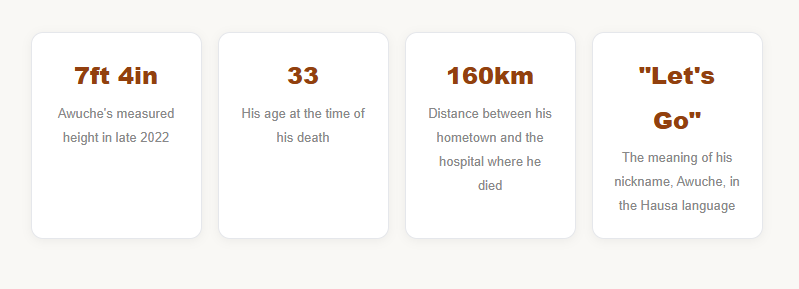
In the small town of Gambaga, in Ghana's Northern Region, there's a house that's been full of visitors for days. People keep arriving, some who knew him well, many who simply wanted to be near where he lived, all of them asking some version of the same question: how did this happen, and how does a place go on without its most famous resident? The man they're mourning stood taller than almost anyone most of them will ever meet in person. But everyone who's spoken about him since his death has led with something else entirely: how kind he was. Who Was Awuche Sulemana Abdul Samed was born in 1994 in Ghana's Northern Region, and for most of his childhood, nothing about his height set him apart. That changed dramatically in his early twenties. His tongue began to swell first, he later recalled, making it briefly hard to breathe, and then the rest of his body followed, growing at a pace that alarmed everyone around him, including himself. By the time the BBC measured him properly in late 2022, using proper equipment for the first time in his life, he stood 7 feet 4 inches, roughly 223 centimetres, tall. Those close to him believe he had grown even taller in the years since. He became known nationally, and eventually internationally, by a single nickname: Awuche, meaning "Let's Go" in the Hausa language. It suited him. Despite a condition that reshaped nearly everything about his daily life, people who knew him consistently described someone who carried his fame with warmth rather than bitterness, someone who introduced himself proudly as being from Gambaga wherever he travelled, turning a small, little-known town into a place instantly recognisable across Ghana simply because that's where the country's tallest man came from.
Living With a Body That Wouldn't Stop Changing
Doctors eventually diagnosed Awuche's rapid, extreme growth as a result of Marfan syndrome, a rare genetic disorder affecting the body's connective tissue, often producing unusually long limbs and, in more severe cases, significant strain on the heart and skeletal system. It's a condition that reshapes far more than appearance, and for Awuche, its cost was measured in the things he could no longer do rather than simply how he looked.
He had once dreamed of becoming a professional driver, a plan the condition made impossible. Football, something he'd genuinely loved as a younger man, an activity he described himself as having been athletic and skilled at, became entirely out of reach. In an interview reflecting on the change, he put it simply: he used to play like every other young man his age, and now he couldn't even manage to walk short distances without difficulty. It's a stark, honest admission from someone who, by every account from people who actually knew him, refused to let that loss define how he showed up in the world.
A Community That Rallied When It Mattered Most
For years, one of the quieter burdens Awuche carried was financial. Managing a condition like his, particularly as complications developed, required medical care that was genuinely difficult for his family to afford on their own. That changed when Ibrahim Mahama, a prominent Ghanaian businessman and brother of President John Mahama, stepped in to personally cover his treatment costs at Tamale Teaching Hospital. Mahama had met Awuche in person, and just weeks before Awuche's death, had publicly given an update on the ongoing plans for his care, a small but telling sign of how far his story had travelled beyond his hometown, and how many people, some with genuine means to help, had come to care about what happened to him.
"Everyone Knew How Generous and Kind He Was"
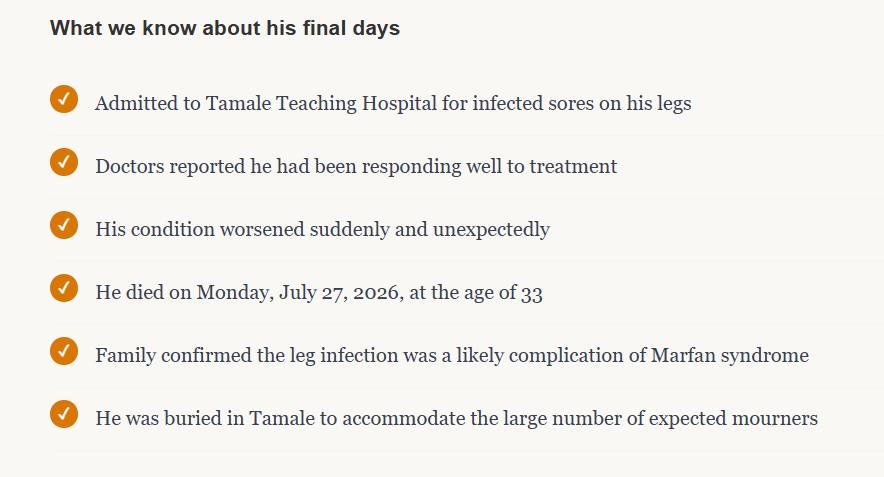
The infection that ultimately led to his death began, according to a relative who spoke with the BBC, from sores on his legs, not something directly caused by Marfan syndrome itself but understood to be a complication tied to the broader condition. He was admitted to Tamale Teaching Hospital as the wounds worsened, and for a time, doctors had reason for cautious optimism. His relative, Sulemana Abdul Kudus, later explained that Awuche had genuinely appeared to be responding well to treatment before his condition deteriorated with little warning.
"Everyone knew how generous and kind he was," his relative told the BBC in the days after his death. "From when he died until now, a lot of people are still coming to the house to find out what exactly happened."
That detail, the steady stream of visitors still arriving days later, says something real about the scale of what Gambaga and the wider Northern Region lost. Kudus described the community as genuinely shocked by how suddenly it happened, a sentiment echoed across the tributes that followed from people who had met Awuche only briefly, at a market, in passing on a street, and had never forgotten the encounter.
Why His Story Resonated So Widely
It would be easy for a story like this to reduce a person entirely to their measurements, treating extraordinary height as the whole of who they were. What made Awuche's story different, and what clearly shaped how deeply Ghana has mourned him, is that nearly everyone who spoke publicly about him after his death led with his character rather than his stature. The BBC's original 2022 profile of him, the one that first brought his story to a wider audience, captured someone who had made peace with an extraordinarily difficult physical reality without losing his sense of humour or his evident warmth toward strangers.
His fame, once it arrived, became something he shared generously with his hometown rather than keeping for himself. Gambaga, a town most Ghanaians outside the Northern Region had likely never heard of before, became known nationally specifically because of him, a fact residents credit him with directly. It's a rare kind of legacy, fame that expanded outward to benefit an entire community rather than settling only on the person who earned it.
A Few Honest Questions People Are Actually Asking
What exactly is Marfan syndrome, and how common is it? Marfan syndrome is a genetic disorder affecting the body's connective tissue, which can lead to unusually long limbs, skeletal changes, and in more serious cases, complications involving the heart and blood vessels. It's considered rare, affecting roughly 1 in 5,000 people globally, though severity varies significantly from case to case.
Was Awuche's condition initially misdiagnosed? Some earlier reporting referenced gigantism, a separate condition caused by excess growth hormone, before later, more detailed medical assessment identified Marfan syndrome as the underlying cause of his rapid growth and its associated complications.
Why was he buried in Tamale rather than his home village? His family made the decision specifically to manage the very large number of mourners expected to attend, a practical choice given how widely known and deeply respected he had become across the region.
What Gambaga, and Ghana, Are Left With
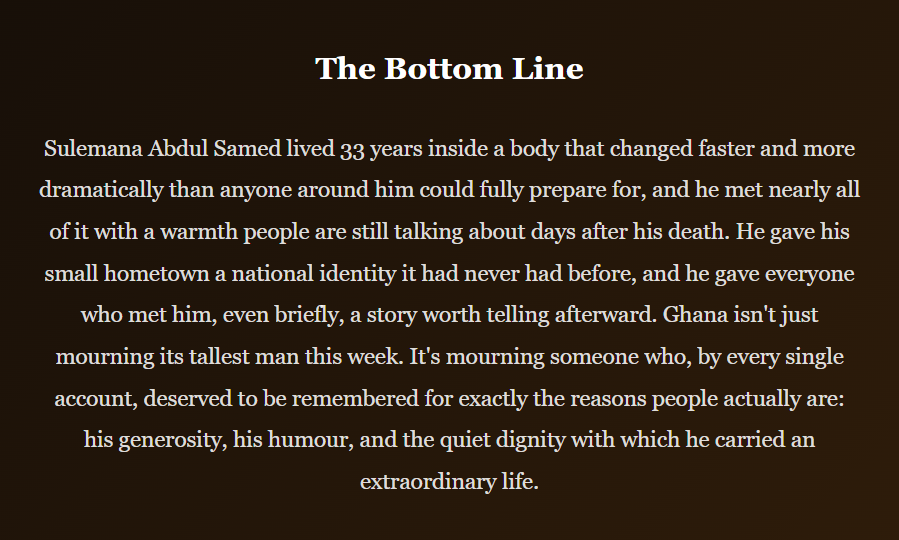
There's a particular kind of grief that settles over a small community when it loses the person who, fairly or not, had come to represent it to the outside world. Gambaga's residents aren't just mourning a neighbour, they're mourning the person who gave their town a national identity, someone who wore that responsibility, largely unasked for, with genuine grace for over a decade. The tributes pouring in from across Ghana in the days since his death suggest that recognition extended well beyond his home region.
What lingers most, reading through the accounts of people who actually knew him, isn't his height at all. It's the small, specific memory a relative offered to the BBC almost as an aside: that people are still showing up at his family's home, days after his death, simply needing to be near where he lived, needing to ask what happened, needing, in some small way, to say a proper goodbye to someone whose kindness clearly outlasted every headline written about how tall he was.
A note on this piece
Details in this article are drawn from public reporting by the BBC, Africanews, and other outlets following Sulemana Abdul Samed's death on July 27, 2026, and reflect information available as of publication. It is written as a respectful tribute to his life and the community that mourns him.