William BensonVIEW PROFILE →
The Milestone Illusion: How Social Media Convinced an Entire Generation They're Falling Behind
Nobody's actual life moves in a straight, evenly paced line toward marriage, a house, and a promotion by a certain birthday. The feed just looks like everyone else's does, and that gap between the two is where a very specific, very modern kind of dread lives.
Nobody's actual life moves in a straight, evenly paced line toward marriage, a house, and a promotion by a certain birthday. The feed just looks like everyone else's does, and that gap between the two is where a very specific, very modern kind of dread lives.
One sitting of scrolling can hold an engagement, then another engagement, a promotion announcement, someone's first house keys dangling in front of a front door, a gender reveal, and a "6 months into building my dream business" update, stacked one after another with no space between them to breathe. None of it is fake, exactly. It's just compressed. Milestones that took other people years, sometimes a decade, of ordinary, unremarkable effort arrive in your feed within the same ninety seconds, stripped of everything that came before the announcement. The brain, which was never built to process a hundred strangers' best days back to back, quietly does the only thing it knows how to do with that information: it compares. That feeling has a name now, even if it doesn't have a clean clinical label, the sense of being behind, of having somehow missed a schedule nobody actually agreed to. It shows up in the same unmistakable shape across group chats and comment sections everywhere: a mix of happiness for the person posting and a low, uncomfortable hum underneath it, the sense that everyone else got the memo about how life is supposed to go and you're the one running late. The strange part is how universal that feeling has become, given that, mathematically, it's not possible for almost everyone to actually be behind at once. Milestones used to be private. Now they're programmed content. For most of human history, a milestone was something you found out about slowly, from a phone call, a wedding invitation, a letter, a conversation at a family dinner months after it happened. The gap between the event and you hearing about it did something quietly useful: it gave the news time to lose its edge, to become just another fact about someone's life rather than a live comparison point. Social media collapsed that gap to nearly zero, and in doing so, changed what a milestone actually is. It's no longer just something that happened to someone. It's content, shaped, captioned, and often timed for maximum visibility, because posts about big, positive life events reliably outperform almost everything else a feed serves up.
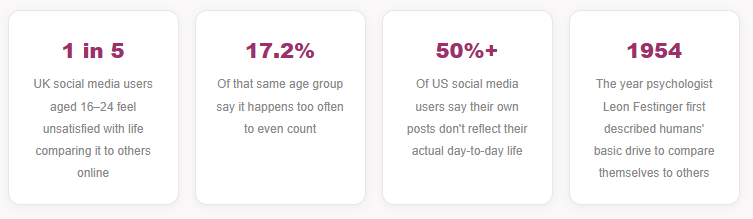
That last figure matters more than it might seem. Social comparison itself isn't a social media invention, it's a documented, decades-old feature of how people evaluate themselves, especially when there's no objective yardstick available. What's changed isn't the instinct. It's the volume, speed, and one-sidedness of the material that instinct now has to work with.
The math nobody's feed is showing you
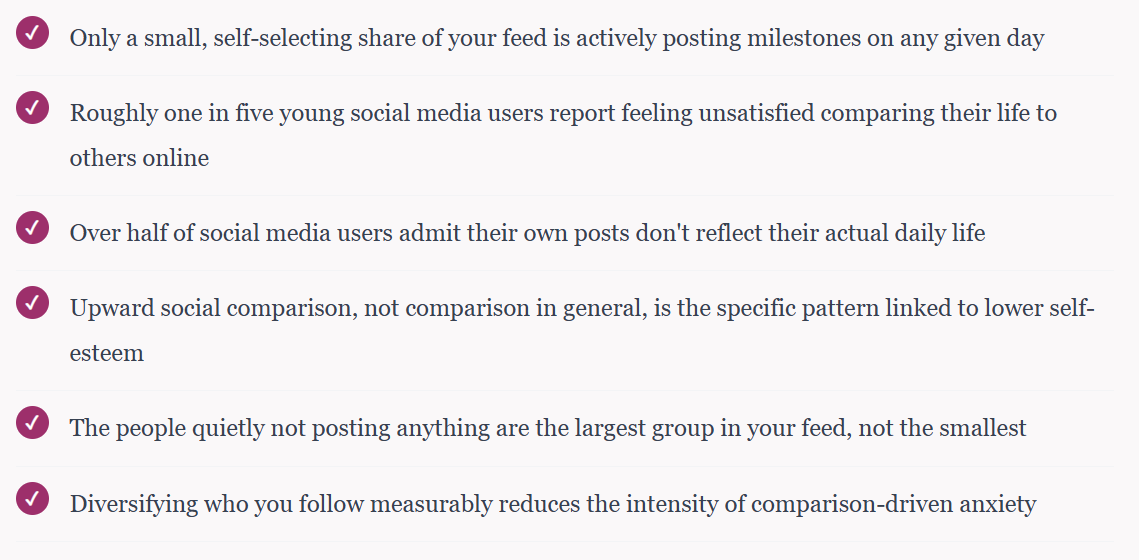
Here's the part that rarely gets said out loud: the people posting engagement photos, new job announcements, and house keys on any given day are a small, self-selecting slice of everyone you follow, not a representative sample of your actual peer group. Most people going through an ordinary Tuesday, the much larger, quieter majority, simply aren't posting about it, because there's nothing to announce. That silence doesn't show up anywhere. A feed can only ever show you the numerator, the wins, the announcements, the finish lines. It has no mechanism for surfacing the much larger denominator of people quietly living completely normal, unremarkable, perfectly fine lives with nothing to caption.
Upward comparison, and why it hits harder online
Researchers studying this pattern describe it as "upward social comparison," the specific and more damaging habit of measuring yourself against people who appear to be doing better, rather than against a realistic cross-section of people doing about the same or worse. Studies on this exact mechanism have linked heavier exposure to it with lower self-esteem, more anxiety, and measurable dips in reported life satisfaction, particularly among younger users who are also, not coincidentally, the demographic spending the most time in front of these feeds during years when their own lives genuinely are still taking shape.
When people lack a clear, objective way to judge their own progress, they instinctively judge themselves against others instead, and a feed built entirely from other people's highlight reels is one of the most distorted comparison sets a person could possibly choose.
— Building on Festinger's Social Comparison Theory, widely cited in current social media research

The specific milestones doing the most damage
Not every kind of post carries the same weight. A handful of very specific life events, the ones with a clean visual and an obvious caption, dominate the feeling of being behind far more than everything else combined: engagement rings, home purchases, pregnancy announcements, and a certain flavor of career update built around a big round number reached suspiciously young. These are the posts that travel furthest and stick longest, precisely because they're the easiest to photograph and the hardest to contextualize in a five-second scroll.
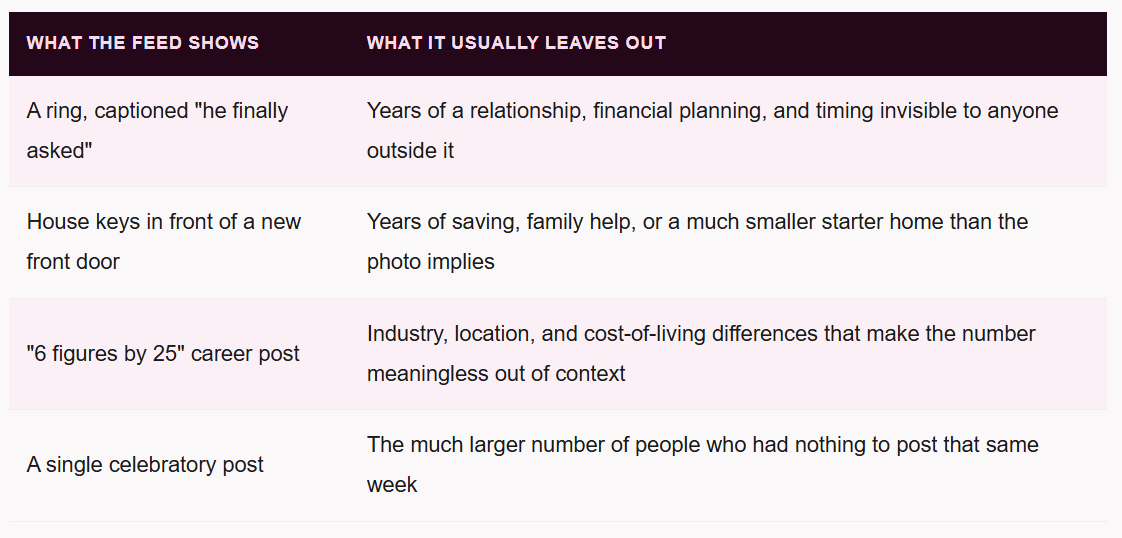
None of this means the people posting are being dishonest. Most of them are simply sharing something genuinely good that happened to them, which is a perfectly reasonable thing to do. The distortion isn't in any single post, it's in the aggregate, in what a feed selects for at scale, over and over, until an entirely accurate collection of individually true moments adds up to a badly misleading picture of what "normal" actually looks like.
Worth remembering next time it stings
A feed is not a census. It's a highlight reel selected by an algorithm optimizing for engagement, not for accuracy about how most people your age are actually doing. The absence of a milestone post from someone isn't evidence that they're behind either, it usually just means their week looked like most weeks do: ordinary, and not particularly photogenic.

What actually breaks the spell
Awareness of how a feed is built doesn't automatically make the sting disappear, but it does change what the feeling is responding to. A few practical shifts consistently come up in research and in the accounts of people who've deliberately worked on this: following a wider, more varied mix of accounts rather than a narrow band of peers at the exact same life stage, muting or unfollowing specific accounts that reliably trigger comparison rather than connection, and simply noticing, in the moment, that a single post is a highlight, not a full timeline. None of that requires quitting social media outright. It just requires treating the feed as the curated, incomplete thing it actually is, rather than the accurate scoreboard it's designed to feel like.
None of this erases the fact that some milestones genuinely do matter and are worth celebrating, including your own, whenever they arrive. What it does is put the "behind" feeling back where it belongs: as a predictable side effect of a system built to show you other people's best five seconds, not a verdict on how your life is actually going.