 William BensonVIEW PROFILE →
The Moon Is About to Nearly Vanish Into Earth's Shadow , Here's Your Complete Guide to Watching It Happen
Sometime after the sun goes down on Thursday, August 27, a full Moon that looks perfectly ordinary at first will start sliding into darkness, and by the time it reaches its deepest point, 96 percent of its face will be swallowed by Earth's own shadow. That's not quite a total eclipse — but it's close enough that most people watching won't be able to tell the difference, and for a huge stretch of the United States, the entire show happens with the Moon comfortably up in the sky.
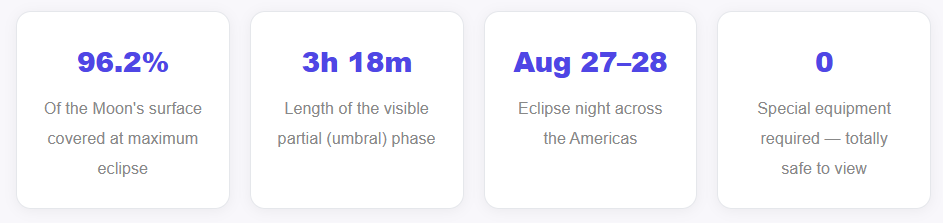
What's Actually Happening on the Night of August 27–28 This is the second lunar eclipse of 2026, following the total lunar eclipse back in March, and it's technically classified as a deep partial lunar eclipse rather than a total one. The distinction matters less than you'd think once you're actually standing outside looking up. At maximum eclipse, roughly 96.2 percent of the Moon's visible surface will be tucked inside Earth's dark umbral shadow, leaving only a thin, brilliant sliver of the lunar disc still catching direct sunlight. Astronomers sometimes call this kind of event "almost total," because visually it delivers nearly everything a total eclipse does — the deep copper-orange glow, the dramatic shadow line creeping across the surface — while technically falling just short of full coverage. The good news for anyone in the US is that this is shaping up to be one of the best-placed lunar eclipses North America will see for the rest of the decade. Across the central and eastern United States, the Moon stays comfortably above the horizon for the entire event, from the first faint dimming to the last moment the shadow pulls away. Farther west, the timing shifts so that the Moon is rising right around the start of the dramatic phase, which actually makes for a striking scene if you can find a clear view toward the eastern horizon.
Exact Eclipse Times for Every US Time Zone
Because the eclipse unfolds gradually over several hours, the moment you actually want to be outside depends heavily on where you live. The full event includes a subtle penumbral phase that's genuinely hard to notice, followed by the umbral phase — the part where the visible "bite" appears and grows across the Moon. That umbral phase is what you actually want to catch. Here's how the key moments line up across the continental time zones, based on official eclipse predictions.
For Pacific time zone viewers, the Moon rises around 7:20 to 7:35 p.m. local time on August 27 — right as the partial phase is already getting underway — so it climbs into view already showing that first dark bite along its edge, rather than starting out as a plain full Moon.
That's actually a gift for photographers and casual watchers alike: an already-eclipsed Moon rising low over the horizon, framed against buildings, trees, or hills, tends to make for a far more memorable scene than watching the same event high overhead later in the night. If you're on the West Coast, find an unobstructed eastern to southeastern view well before 7:20 p.m. and let the Moon come to you.
Why This Eclipse Looks Almost Total (Even Though It Isn't)
A lunar eclipse happens whenever the Sun, Earth, and Moon line up closely enough that Earth's shadow falls across the lunar surface. That shadow actually has two parts: a faint outer region called the penumbra, where only some sunlight gets blocked, and a much darker inner core called the umbra, where sunlight is blocked almost entirely. A total lunar eclipse happens when the whole Moon slides into that dark umbra. This time, the Moon's path takes it deep into the umbra — deep enough to cover 96 percent of its disc — but not quite all the way across.
In practice, that 4 percent that stays outside the deepest shadow shows up as a thin, dazzlingly bright sliver along one edge of the Moon, while the rest of the disc turns a deep orange or copper-red. Plenty of longtime skywatchers actually find eclipses like this one more striking than a full total eclipse, because the contrast between the glowing sliver and the darkened body of the Moon creates a visual drama that a uniformly dimmed, fully eclipsed Moon doesn't quite match.
Why the Moon Turns Orange Instead of Just Going Dark
It's a fair question — if Earth is blocking the Sun, why doesn't the Moon simply disappear? The answer comes down to a phenomenon called Rayleigh scattering, the same physics responsible for red and orange sunsets here on Earth. As sunlight grazes the edge of our planet's atmosphere on its way toward the Moon, the shorter blue wavelengths get scattered away, while the longer red and orange wavelengths bend around Earth and continue on toward the lunar surface. In effect, the light reaching the eclipsed Moon is the combined glow of every sunrise and sunset happening around the globe at that exact moment.
That's also why the exact shade varies from one eclipse to the next. A clean, relatively dust-free atmosphere tends to produce a brighter, more orange-toned eclipse, while volcanic ash or heavy pollution higher in the atmosphere can shift the color toward a darker, deeper red. Astronomers even have a formal scale for this, called the Danjon scale, running from very dark and barely visible eclipses to bright orange-red ones with a noticeable blue tint along the rim. It's a genuinely fun thing to watch for on the night itself — you won't know exactly what shade this eclipse will produce until it's actually happening.
The Best Ways to Watch, From Naked Eye to Telescope
One of the most appealing things about a lunar eclipse, especially compared to a solar eclipse, is that there's no risk involved and no special gear required. You can watch the entire thing standing in your backyard with nothing but your own eyes, and it'll still be a beautiful sight. That said, a few simple upgrades noticeably improve the experience.
A basic pair of binoculars, even a modest 10x50 set, brings out far more detail than the naked eye alone — you'll start to notice individual craters near the shadow's edge and a much richer range of color across the lunar surface. If you happen to have access to a telescope, even a small one, the view becomes genuinely mesmerizing: the shadow line crawling slowly across specific craters, revealing texture and depth that simply isn't visible otherwise. None of this requires any filters or protective lenses — unlike staring at the Sun, looking directly at an eclipsed Moon carries zero risk to your eyes.
If you want to photograph the event, you don't need professional equipment to get a satisfying shot. A smartphone on a small tripod, set to night mode, can capture a surprisingly good wide shot of the orange Moon rising above a recognizable skyline or tree line — and that kind of composition, with the Moon in context rather than as an isolated dot, usually makes for a far more compelling photo than a tightly zoomed-in shot anyway. For anyone with a DSLR or mirrorless camera and a telephoto lens, a starting point of around ISO 400–800 at f/8 with a shutter speed in the range of one to a few seconds for the darkened portion of the Moon is a reasonable place to begin experimenting, adjusting from there based on how bright the remaining sliver appears.
A Few Honest Questions People Are Actually Asking
Do I need special glasses like I would for a solar eclipse?
No, and this trips people up because solar eclipse safety has been so heavily emphasized in recent years. A lunar eclipse involves reflected sunlight that's far too dim to cause any harm, so naked-eye viewing is completely safe throughout the entire event.
Will the Moon actually turn "blood red"?
It'll come close. Because this eclipse reaches 96 percent coverage rather than a full 100 percent, most of the Moon will take on that classic deep orange to copper-red color, while a thin edge stays bright silver-white. It's not quite the uniform "blood moon" look of a total eclipse, but the visual effect is dramatic in its own right — arguably more so, thanks to that striking contrast.
What if it's cloudy where I live?
Check your local forecast a day or two out and, if possible, be ready to drive toward clearer skies if your immediate area looks socked in. Because the eclipse plays out over several hours, even scattered or intermittent clouds may still leave you gaps to catch the key moments, particularly around maximum eclipse.
When's the next chance to see something like this?
If clouds get in the way this time, the next partial lunar eclipse visible from North America comes in January 2028, though it's a much shallower one, covering only a small portion of the Moon. The next total lunar eclipse widely visible across the US doesn't arrive until 2029, which makes this August's deep partial eclipse the standout lunar event of the next few years for American skywatchers.
One thing worth keeping in mind Eclipse timing is based on precise astronomical calculations and won't change, but your actual view on the night depends entirely on local weather. Check a short-range forecast for your specific area in the day or two before August 27, and have a backup viewing spot in mind if clouds are forecast to roll through during the key hours.