 William BensonVIEW PROFILE →
The NFL Betting Arms Race: Inside the DraftKings-FanDuel Duopoly's Fight Against a New Kind of Rival
A regulatory loophole nobody built for football has turned into the most consequential competitive threat the sports betting industry has faced in a decade.
A regulatory loophole nobody built for football has turned into the most consequential competitive threat the sports betting industry has faced in a decade.
For most of the past several years, betting on American football has meant choosing between two apps, and not much else. DraftKings and FanDuel, the parent company of which is Flutter Entertainment, built a duopoly so dominant that most casual bettors couldn't name a third option even if asked. That comfortable arrangement has started to crack, not because of a scrappy new sportsbook trying to undercut them on odds, but because of an entirely different category of company that isn't, technically, a sportsbook at all. Kalshi and Polymarket don't call what they offer "bets." They call them contracts, event outcomes traded on an exchange the same way you'd trade a futures contract on wheat or oil. That distinction sounds like semantics until you realize it's the entire reason these platforms have been able to offer NFL trading in all fifty states, including places where traditional sports betting remains flatly illegal, by routing around state gambling law entirely and operating instead under federal commodities regulation. For an industry that has spent a decade fighting state-by-state legalization battles one legislature at a time, that's not a minor inconvenience. It's an existential question. How a commodities exchange became a sportsbook's biggest problem Prediction markets in the U.S. operate under the Commodity Futures Trading Commission rather than state gaming regulators, a structural quirk that traces back to how these platforms were originally built to trade contracts on elections, economic indicators, and other real-world events rather than sports specifically. Kalshi has been CFTC-registered since 2021, giving it a genuine regulatory head start, while Polymarket built its early reputation largely on political and economic markets before both platforms discovered, over the past year or so, exactly how much demand existed for football. The numbers back up why that pivot mattered. Kalshi CEO Tarek Mansour summed up the shift bluntly on social media: "Nothing beats football in America." His platform, alongside Polymarket, reported a combined $7.4 billion in trades during a single record month, according to industry tracking, with sports contracts increasingly dominating volume that used to be led by political and economic predictions. Robinhood, which has also moved into this space, reported billions of contracts traded over the same period, underscoring just how quickly football-driven demand scaled once these platforms leaned into it.
The sportsbooks strike back
DraftKings and FanDuel didn't spend years building the most recognizable brands in American sports betting just to watch a federally regulated side door siphon off their most valuable customers. Both companies moved decisively, and expensively, to compete on the exact same regulatory ground.
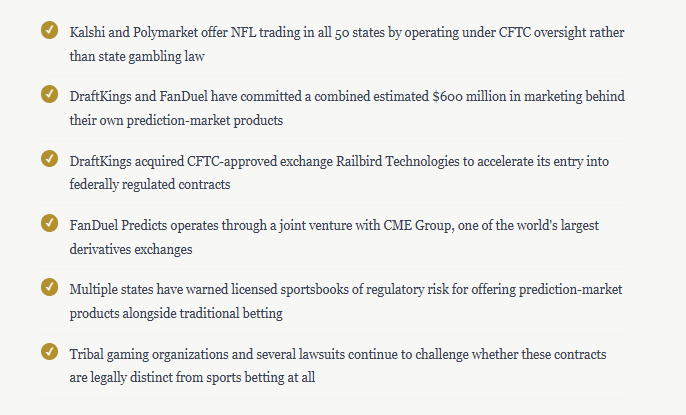
FanDuel moved first on the partnership front, announcing a joint venture with CME Group, one of the world's largest derivatives exchanges, to build and launch its own event-based contracts. FanDuel Predicts now offers team-based NFL futures, including Super Bowl and conference championship markets along with all eight division winners, plus single-game trading on winners, totals, and player props, though notably not individual awards markets like MVP.

DraftKings took a more aggressive route, acquiring Railbird Technologies, a CFTC-approved designated contract market founded in 2021 by two former Point72 analysts and accepted into the Y Combinator accelerator, in a deal that became official on October 21. DraftKings CEO Jason Robins framed the acquisition in a letter to shareholders as central to the company's growth strategy, writing that the company saw "Predictions as a significant incremental opportunity" and expected the new product "to enter many states with sport event contracts, unlocking a new customer base and revenue stream." Robins pointed specifically to the roughly half of the U.S. population that still lacks access to legal online sports betting as the addressable market this move was designed to unlock.
"Nearly half the country's population remains without access to legal online sports betting, but there are several other companies offering federally regulated Predictions in all 50 states."
— Jason Robins, CEO and co-founder, DraftKings
DraftKings Predictions officially launched as a standalone mobile app in 38 states, operating through a DraftKings subsidiary registered as a CFTC Introducing Broker and National Futures Association member, initially routing sports and finance contracts through CME Group before eventually integrating Railbird's own exchange infrastructure. Combined, DraftKings and FanDuel have reportedly committed somewhere in the neighborhood of $600 million in marketing spend behind these new products, a figure that puts their entry on a scale few, if any, competitors can realistically match.
Why "sports" was left out of the early announcements
When FanDuel and CME first announced their joint venture, and when DraftKings announced the Railbird acquisition, neither press release explicitly mentioned sports contracts. That wasn't an oversight. Both companies were navigating a genuinely uncertain regulatory environment, and being cautious in public messaging about sports-specific contracts, an area where state gambling regulators have been most aggressive in pushing back, before quietly rolling those products out once the legal groundwork felt more solid.
A regulatory fight with no clean resolution yet
Here's where the story stops being a simple tale of corporate competition and becomes something closer to a genuine jurisdictional standoff. The core legal question, whether federally regulated sports-event contracts are meaningfully different from state-regulated sports bets, remains unresolved, and multiple parties have strong incentives to keep fighting over the answer.
State gambling regulators in Ohio, Arizona, Michigan, Illinois, and Nevada have warned their own licensed sportsbook operators that offering prediction-market products alongside traditional sports betting could carry serious regulatory repercussions, forcing companies like DraftKings and FanDuel into an uncomfortable balancing act: expand into this new federally regulated category without jeopardizing the state licenses their core business still depends on. DraftKings' own initial rollout reflected that caution directly, limiting sports-event contracts specifically to states where online sports betting remains illegal, including California, Texas, and Georgia, a deliberate choice to avoid direct conflict with its existing state-licensed operations.

Tribal gaming organizations have added another layer of legal pressure entirely, asserting in ongoing litigation that prediction markets violate the exclusivity compacts many tribes hold with individual states, agreements that, in several states, grant tribal entities the sole legal right to offer certain forms of gambling. That litigation continues without a clear resolution, and it sits alongside a broader wave of lawsuits, targeting Kalshi, Polymarket, Crypto.com, Robinhood, and now DraftKings itself, alleging that these platforms are, in substance, operating illegal sportsbooks dressed up in commodities-market language.
DraftKings' own attempt at a middle path
DraftKings Chief Product Officer Corey Gottlieb described the company's approach as an effort to build "something that's scalable, responsible, and sustainable long-term," language that reflects genuine awareness of how precarious the current legal footing is. That carefulness hasn't fully insulated the company; DraftKings has since been named in the same wave of prediction-market lawsuits facing its rivals, a reminder that operating under CFTC oversight doesn't automatically settle the underlying legal question of whether these products are functionally indistinguishable from the sports betting states already regulate separately.
Why this fight is really about market structure, not just market share
It's tempting to read this purely as a familiar corporate story, an incumbent duopoly spending heavily to squash an upstart threat. The more interesting read is structural. Kalshi's core advantage isn't a better product experience; by most trader accounts, Polymarket actually holds the edge there. Kalshi's advantage is regulatory: a peer-to-peer exchange model where the platform's counterparty risk sits with other traders rather than the house, operating under a federal framework that, at least for now, doesn't require the state-by-state legislative fights that have defined sports betting expansion for the better part of a decade.
That's precisely why DraftKings didn't attempt to build a competing product from scratch. Acquiring Railbird bought the company something money alone usually can't move quickly: an already-approved federal regulatory designation. Similarly, FanDuel's decision to partner with CME Group rather than build independent infrastructure reflects the same underlying calculation, that speed to a legitimate federal registration mattered more than doing it entirely in-house.
This article reflects industry reporting and company statements as of August 2026. The regulatory status of sports-event contracts remains actively contested at both the state and federal level, and the legal landscape described here may continue to shift as litigation and regulatory guidance develop.
Who else is watching from the sidelines
The established sportsbook operators beyond DraftKings and FanDuel haven't matched their spending yet, but they're not ignoring the shift either. Industry reporting suggests BetMGM has scoped a prediction-market product for a fall 2026 launch, while Caesars has held preliminary consultations with the CFTC about its own potential entry. Neither company has committed publicly to a timeline, and both face the same core tension DraftKings and FanDuel have been navigating: how to enter a federally regulated category without triggering the exact state-level pushback that has made this whole space so legally fraught.
That hesitation matters strategically. Every quarter that BetMGM, Caesars, Penn Entertainment, and Fanatics stay on the sidelines is another quarter where DraftKings, FanDuel, Kalshi, and Polymarket get to define the customer habits, product expectations, and competitive dynamics of this category before anyone else shows up to contest it. In a sector where first-mover brand loyalty tends to compound quickly, that head start carries real, lasting value.
What happens if the legal question actually gets answered
Nearly every dynamic described here rests on an unresolved legal premise: that sports-event contracts, structured as commodities trades under federal oversight, are meaningfully different from the sports bets states already regulate. If courts, state attorneys general, or Congress eventually settle that question definitively in either direction, the entire competitive landscape shifts immediately.
A ruling that sports-event contracts are effectively unregulated sports betting would likely force Kalshi, Polymarket, and the sportsbook-affiliated products alike into the same state-by-state compliance framework that has shaped traditional sports betting for years, eliminating the nationwide-access advantage that made prediction markets so disruptive in the first place. A ruling that upholds the current CFTC framework, on the other hand, would validate the entire strategy DraftKings and FanDuel have spent hundreds of millions executing, and likely accelerate BetMGM, Caesars, and other holdouts off the sidelines considerably faster than their current cautious posture suggests.