 William BensonVIEW PROFILE →
The One Sentence Keeping Malaysia From Signing the World's Anti-Torture Treaty
For years, one government minister gave the same blunt answer whenever the UN's anti-torture convention came up. In 2026, the law that answer was protecting finally started to change.
For years, one government minister gave the same blunt answer whenever the UN's anti-torture convention came up. In 2026, the law that answer was protecting finally started to change.
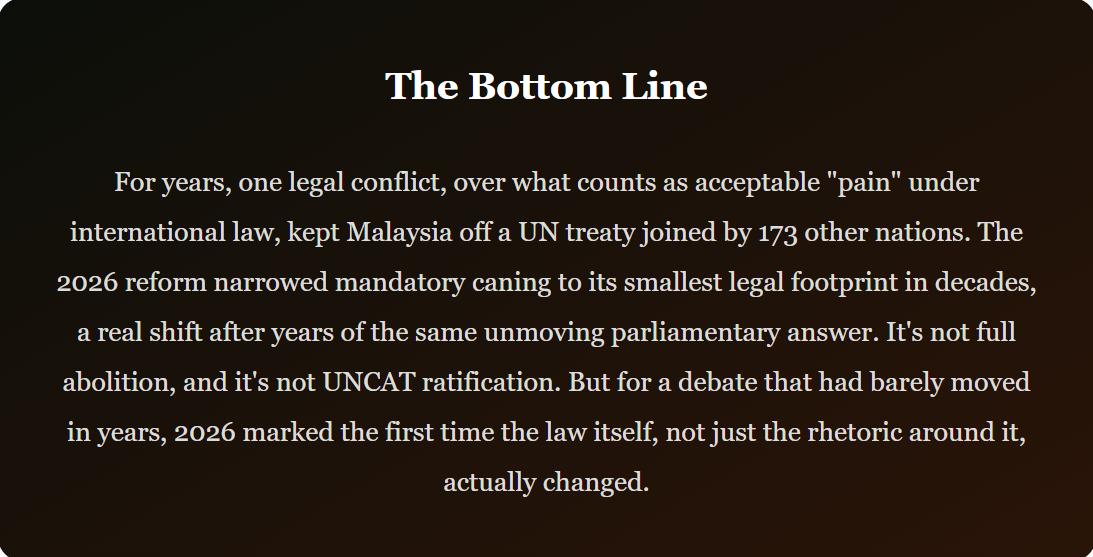
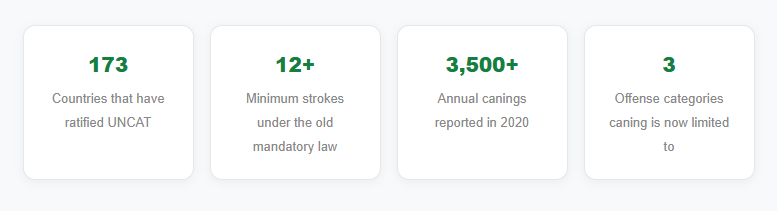
Ask a Malaysian home minister, any of the last several, why the country hasn't signed onto the UN's core anti-torture treaty, and you'll get almost the exact same answer every time. It isn't about politics, or sovereignty, or diplomatic hesitation. It's one specific legal sentence, repeated across parliamentary sessions for years: our laws still allow "severe pain," and this treaty says they can't. That single conflict, between one international standard and one very specific domestic punishment, has kept Malaysia off a list that 173 other countries have already joined. But 2026 brought the first real crack in that standoff in decades, and it didn't come from Geneva or from activists. It came from Parliament itself, rewriting the actual law at the center of the fight.
The Punishment at the Center of the Standoff
To understand why one country's ratification of a UN treaty has stalled for so long, you have to understand what's actually written into Malaysian criminal law. Before 2026, the Criminal Justice Act 1953 and the Criminal Procedure Code empowered courts to impose caning as a mandatory sentence for an unusually broad range of crimes, everything from robbery and rape to drug trafficking, with a legal minimum of twelve strokes for adult men and no framework at all covering women, minors, or non-citizens facing the same courts.
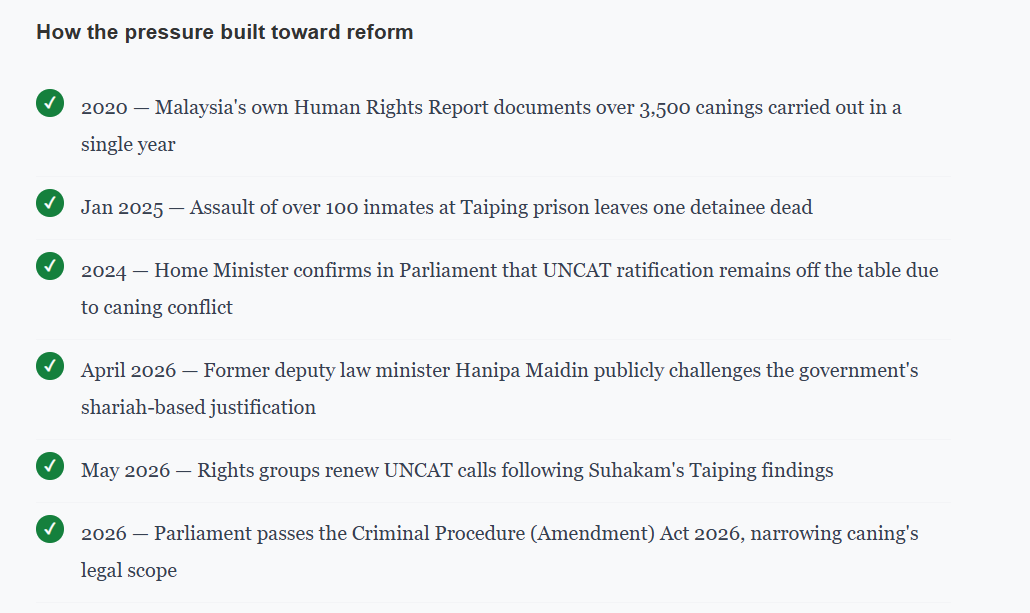
Malaysia's own 2020 Human Rights Report put a number on just how routine this had become: more than 3,500 canings carried out in a single year. That figure became a rallying point for domestic and international human rights groups alike, and it's the exact backdrop against which the UN treaty debate has played out for years.

Why One Sentence Has Blocked Ratification for Years
The legal logic behind Malaysia's refusal to sign UNCAT has been remarkably consistent across successive governments. Home Minister Saifuddin Nasution Ismail laid it out plainly during a 2024 parliamentary session, a position he'd repeat again in subsequent years: "Our reason for not ratifying UNCAT is that certain sections explicitly state that our national laws cannot have elements that cause severe pain, while our laws include caning, and the Syariah Court also has caning."
In other words, the treaty's own text creates the block. UNCAT defines torture in a way that would, according to the government's reading, directly conflict with a punishment still actively written into Malaysian criminal law, and separately, into shariah court provisions that also allow whipping. Signing the convention as written would mean amending both systems simultaneously, a legislative undertaking successive governments have repeatedly declined to commit to.
Not everyone in Malaysian legal circles accepts that framing. Former deputy law minister Hanipa Maidin has directly challenged the government's position, arguing that criminal whipping and shariah whipping serve fundamentally different purposes, one punitive, the other rooted in religious discipline, and that treating them as identical obstacles to ratification "conveniently overlooks the fundamental differences" between the two systems.
A Prison Death That Reopened the Debate
The push for reform gained new urgency following a documented incident that human rights groups say crystallized exactly what's at stake. Malaysia's national human rights commission, Suhakam, investigated the assault of more than 100 inmates at Taiping prison in January 2025, an incident that left one detainee dead. When findings from that investigation surfaced in 2026, the National Human Rights Society renewed its call for the government to overhaul the prison system entirely and finally ratify UNCAT.
N. Ramachelvam, representing the group, framed the issue in terms that moved beyond legal technicalities: "Inhumane treatment, unsafe living conditions, violence, neglect, or degrading treatment should never form part of the sentence, regardless of the offence committed." His argument echoed a broader point rights advocates have made for years, that prison reform isn't just a criminal justice issue, it's fundamentally a matter of human dignity.

What the 2026 Reform Actually Changes
The Criminal Procedure (Amendment) Act 2026 doesn't abolish caning outright, and it's important to be precise about that distinction. What it does is narrow the punishment's legal reach more sharply than any reform since the colonial era: caning is now confined specifically to aggravated homicide, violent sexual assault, and armed robbery. Offenses that previously carried mandatory caning, including drug possession and a range of property crimes, are now explicitly exempt.
The amendment also introduces procedural safeguards that didn't exist before: defendants must now receive written notice of any intent to carry out caning, a medical officer must certify the person's fitness immediately before the punishment is administered, and defendants gain a specific fourteen-day window to lodge procedural appeals. None of this satisfies international rights groups calling for total abolition, but legal analysts have described it as the most significant retreat from mandatory caning Malaysia has enacted in decades.
This Follows a Pattern, Not a Single Reform
The 2026 amendment doesn't exist in isolation. It builds directly on the Abolition of Mandatory Death Penalty Act 2023, which similarly didn't eliminate capital punishment outright but removed its mandatory nature, giving judges discretion where the law had previously demanded automatic sentencing. Read together, the two reforms suggest a government moving cautiously, narrowing the harshest edges of its criminal justice system incrementally rather than through the kind of sweeping abolition international bodies have repeatedly called for.
That incrementalism is precisely what frustrates groups like the International Commission of Jurists, which has argued for years that "any form of corporal punishment is contrary to the prohibition of torture," a standard drawn directly from the UN Special Rapporteur on Torture's own position, and one that treats caning itself, regardless of how narrowly applied, as fundamentally incompatible with international law rather than a practice that becomes acceptable once sufficiently restricted.
Questions People Are Actually Asking
Does this mean Malaysia will finally ratify UNCAT? Not automatically. The 2026 reform narrows caning's scope but doesn't eliminate it, and the government's stated legal objection to ratification centers on the existence of caning itself, not merely how broadly it's applied. Whether the narrower law is enough to change the calculus in Parliament remains an open question rights groups are actively pushing on.
Why does shariah law complicate this even further? Malaysia operates a dual legal system, civil criminal courts alongside state-level shariah courts, and shariah enactments in several states separately provide for whipping as a punishment. The home ministry has argued that ratifying UNCAT would require amending both systems simultaneously, a claim that legal figures like Hanipa Maidin have publicly disputed as an oversimplification.
Is Malaysia unusual among Southeast Asian nations in not ratifying UNCAT? Not entirely, though it's increasingly an outlier among larger, more developed nations. Malaysian officials have specifically noted that neighboring Singapore and Brunei also haven't signed the convention, though critics argue that comparison doesn't resolve the underlying human rights obligations at stake.
Where This Actually Leaves Things
What makes this story worth following closely isn't a single dramatic reform, it's the shape of a slow, contested negotiation between international human rights standards and a domestic legal system reluctant to fully let go of a punishment with deep roots in its criminal justice history. The 2026 amendment proves that meaningful legislative movement is possible even on an issue the government has treated as politically untouchable for years. What it doesn't prove is that the underlying standoff, the one keeping Malaysia off a 173-country treaty list over a single legal definition of pain, is anywhere close to resolved.
Rights groups have made clear they view narrower caning laws as a floor, not a finish line. Whether Malaysia's Parliament sees the 2026 reform the same way, as a first step rather than a settled compromise, will likely determine how much longer this particular debate stays unresolved.
A note on this reporting
Details in this piece reflect Malaysia's Criminal Procedure (Amendment) Act 2026, Suhakam's findings on the Taiping prison incident, and reporting and statements from Free Malaysia Today, Bernama, Malay Mail, and the OMCT's Global Torture Index, current through mid-2026. This piece presents documented statements and legislative facts without taking a position on the broader shariah law debate.