 William BensonVIEW PROFILE →
The Quiet End of App-Hopping: How AI Agents Are Learning to Run Your Errands For You
The typical household reorders the same forty or so items every month, renews subscriptions it forgot it had, and refills prescriptions on a schedule it never quite remembers. In 2026, a growing number of people have quietly stopped doing any of that by hand.
The typical household reorders the same forty or so items every month, renews subscriptions it forgot it had, and refills prescriptions on a schedule it never quite remembers. In 2026, a growing number of people have quietly stopped doing any of that by hand.
Sunday used to have a small, tedious ritual built into it. Open the grocery app, scroll past the things you don't need to find the six you do, add them to a cart that never quite matches last week's order, then switch over to a pharmacy app to check if the refill is ready, then a third app to see whether that streaming subscription auto-renewed again without asking. None of it took real thought. It just took time, and a specific kind of low-grade attention that made a free afternoon feel less free. That ritual is starting to disappear, not because someone built a better grocery app, but because fewer people are opening one at all. What's replacing it isn't a single super-app. It's a shift in who's doing the clicking. AI agents built into everyday tools, ChatGPT, Gemini, and a fast-growing list of retail-native assistants, can now read a shopping list, compare it against what's actually on sale, place the order, and hand back a receipt, without a person touching a single product page. Ask one to reorder your usual groceries and skip anything currently overpriced, and it doesn't just suggest what to buy. It buys it. The interface hasn't vanished. What's vanished is the requirement that a human personally operate five different pieces of software to get one week's worth of errands crossed off. From giving advice to actually placing the order Until fairly recently, AI shopping help meant a chatbot handing back a well-organized list of options and then stepping aside. Ask it to find a decent air purifier and it would compare a few models, note the price differences, and leave the actual add-to-cart, the shipping address, the payment details, entirely up to you. That division of labor is what's actually shifted. A growing share of AI tools can now finish the job themselves, searching multiple retailers, applying the filters a person would have applied manually, and completing checkout while that person is doing something else with their afternoon.
Grocery and household essentials turn out to be an unusually good fit for this. Unlike a one-off purchase like a laptop, a weekly shop is repetitive by nature, largely the same list with small variations, which is exactly the kind of pattern an agent can learn and execute without needing much guidance each time. Industry forecasts now point to household staples as one of the biggest categories of AI-driven spending by the end of the decade, precisely because there's so little actual decision-making involved once the pattern is established.

The hard part was never the shopping list, it was the checkout page
An AI agent being clever enough to build a decent shopping list was never really the obstacle. The actual sticking point has been the moment right before payment: how does a retailer know a piece of software is genuinely authorized to spend a real person's money, and how does that software prove it without just being handed the raw card number. That's the piece that's been getting solved through 2026, largely by the payment infrastructure providers rather than the AI labs themselves.
Where the actual plumbing changed
A new standard called the Agentic Commerce Protocol, introduced through a partnership between a major payments company and an AI lab, gives agents a structured, machine-readable way to browse a retailer's live catalog and complete a purchase using a scoped, single-use credential rather than a stored card number. Card networks have built comparable systems of their own, issuing tokenized permissions that only work for one agent, one merchant, and one transaction window, so the software carrying out the purchase is never actually holding anything it could misuse elsewhere. Millions of merchants are already reachable through this kind of integration, according to industry estimates published this year.
Grocery and household essentials are expected to be the single largest driver of AI-directed consumer spending by 2030, precisely because the decisions involved are so repetitive.
— Based on 2026 industry forecasting from Morgan Stanley analysts
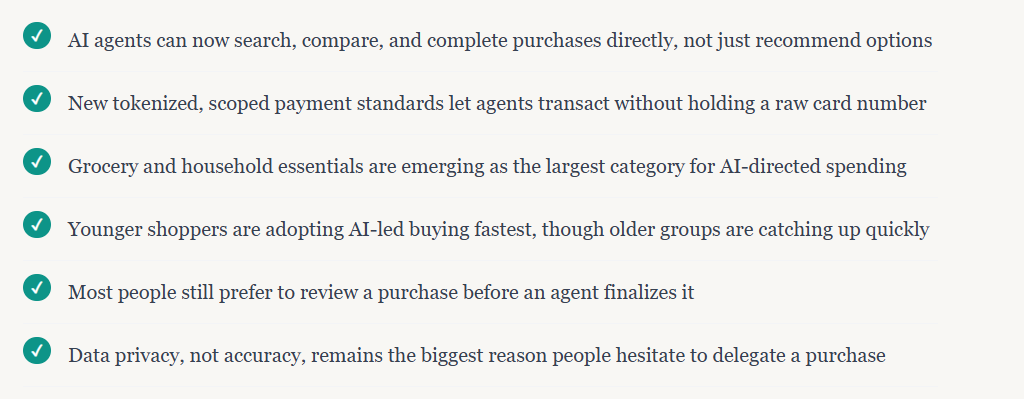
The practical upshot is that letting an agent handle checkout doesn't mean handing it a blank check. Most of these systems are built around limits a person sets in advance, a maximum spend, a specific list of approved merchants, an easy way to revoke access instantly if something looks off. Surveys of shoppers considering this kind of delegation consistently point to spending caps and instant revocation as the two conditions people care about most before they'll actually let an agent pay on their behalf.

What this looks like on an ordinary Tuesday
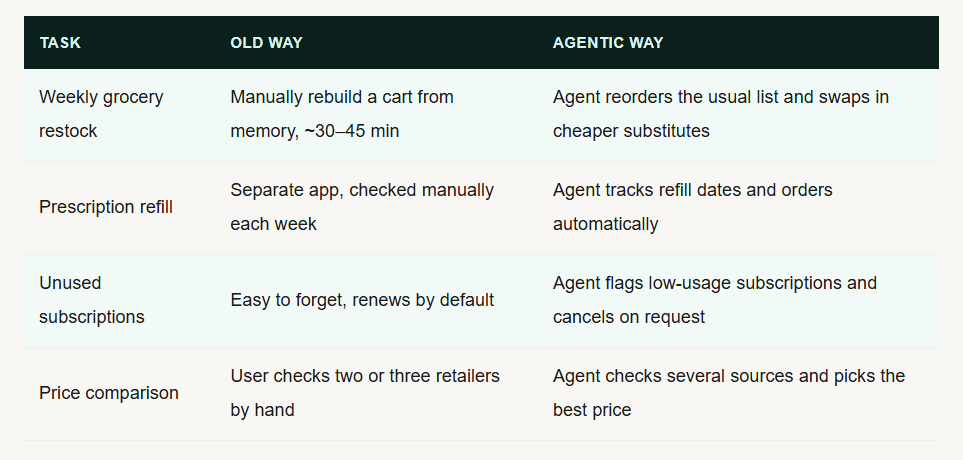
Strip away the infrastructure talk and the everyday version is easy enough to picture. Instead of opening a grocery app, then a pharmacy app to check a refill, then a subscriptions screen to see what quietly renewed, a person tells their AI agent what they actually want done, restock the usual groceries, refill anything due this week, cancel the streaming plan nobody's watched in two months, and the agent works through each task against real, live information rather than guessing what's probably still true.
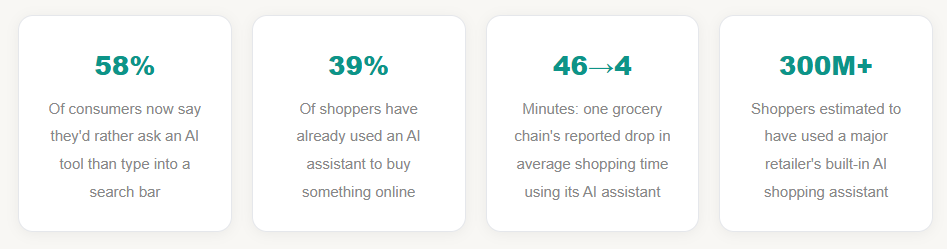
Retailers have started building for this shift rather than just reacting to it. A number of major grocery and retail chains have rolled out AI assistants directly inside their own apps this year, and the newer machine-readable commerce standards are becoming the accepted way an AI tool actually queries live inventory and pricing, instead of just describing what it thinks it found.
Worth knowing before you rely on this
Most people still stop short of letting an AI agent complete the purchase on its own. Surveys this year found a large majority research products with AI, but only a small fraction let it finish the transaction unsupervised, usually because they want a final look before the money actually moves. That gap between researching and buying is closing, but slowly, and it's worth knowing which side of it your own tools currently sit on.
Not everyone is adopting this at the same pace
The generational split here is sharper than most tech shifts. Younger shoppers have taken to AI-driven buying noticeably faster, with some surveys putting Gen Z adoption at multiple times the rate seen among older Gen X and Boomer shoppers. What's more interesting is that the older groups aren't standing still either, some tracking studies have recorded a bigger year-over-year jump in AI shopping adoption among Boomers than among younger cohorts, even if they started from a much smaller base. The habit is spreading in both directions, just at very different speeds.

Why the app icon isn't going away just yet
It's tempting to read all of this as the beginning of the end for the app icon altogether, but that overstates where things actually stand. Retailers still very much want people using their own apps directly, both for the relationship it builds and for everything an agent hasn't fully taken over yet. Privacy remains the biggest brake on faster adoption: a large share of shoppers surveyed this year cited data privacy as their main hesitation about letting AI handle a purchase, well ahead of concerns about price or accuracy.
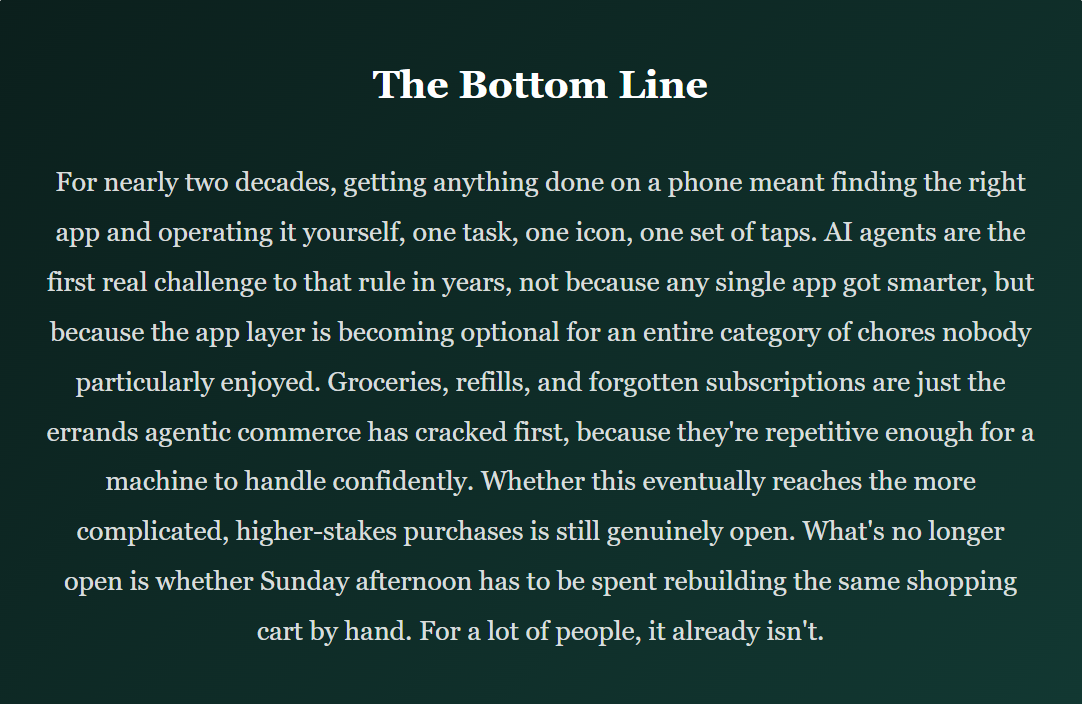
The realistic near-term picture isn't a single app swallowing every other one. It's a slow redistribution of where the actual interface lives, moving away from a home screen full of icons and toward one running conversation that reaches into all of them when it needs to. Merchant apps aren't disappearing, they're becoming one of several ways to reach the same outcome, and for the errands people least enjoy doing by hand, increasingly not the way most people choose.
For now, the honest caveat is that coverage is still uneven. Some retailers have built deep, genuine agent integration already; plenty of others haven't touched it yet. But the direction of travel isn't really in question anymore. The forty-item grocery list that used to eat up half a Sunday afternoon is turning into a five-second instruction, and for a growing number of households, that's already just how Tuesday works.