 William BensonVIEW PROFILE →
The Seaplane Crash Near Bimini That Ended With Everyone Safe, Thanks to Strangers on Nearby Boats
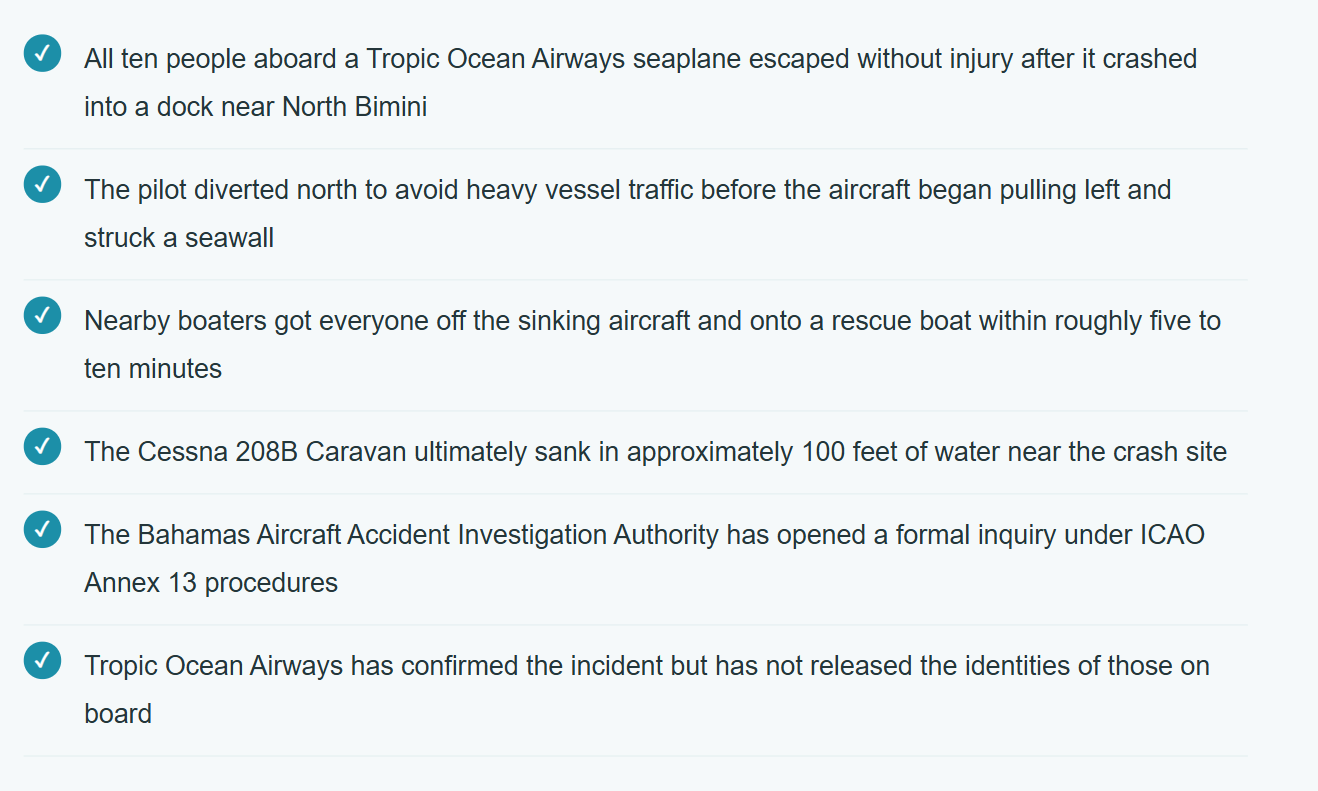
A seaplane carrying ten Americans slammed into a dock near North Bimini and sank in 100 feet of turquoise water. Every single person made it out without a scratch. Here's exactly how it happened.
A seaplane carrying ten Americans slammed into a dock near North Bimini and sank in 100 feet of turquoise water. Every single person made it out without a scratch. Here's exactly how it happened.
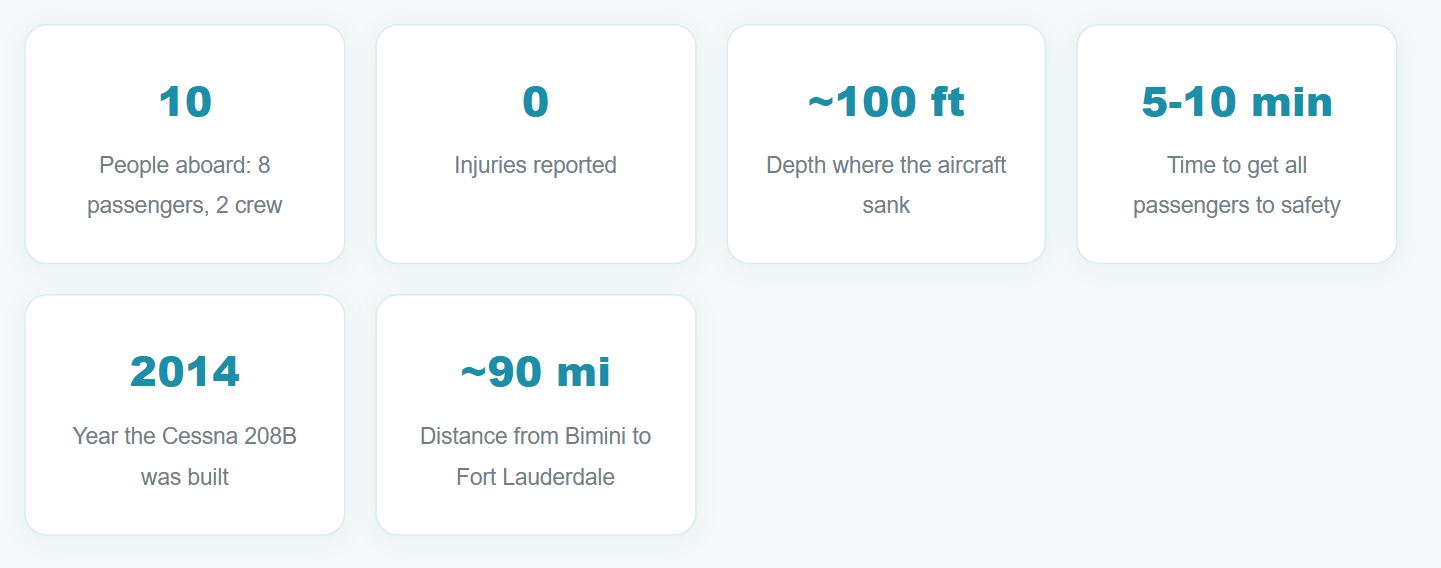
Jack Davoudpour was aboard a yacht near North Bimini when he heard a crash loud enough to stop conversation. Someone shouted that a plane had gone down. By the time he reached the water in his dinghy, he could see the aircraft's nose already dipping beneath the surface, its wing sticking up at an angle that made clear this wasn't a hard landing, it was a genuine crash, and the people inside needed to get out fast. What happened over the next several minutes near a resort dock on North Bimini has become one of the more remarkable aviation near-misses of the year, not because of what went wrong, but because of how completely the response went right. What Actually Happened That Morning The aircraft, a Tropic Ocean Airways Cessna 208B Caravan amphibian registered N388TA, was taxiing at the North Bimini Seaplane Base at around 10 a.m. when the trouble began, according to a preliminary investigation by Bahamian police. Eight tourists and two crew members were aboard, preparing for a routine departure toward Fort Lauderdale, Florida, a short hop that thousands of travelers make between South Florida and the Bahamas every year on exactly this kind of aircraft. The pilot encountered heavier-than-expected vessel traffic in the intended takeoff path and made the reasonable call to divert north in search of a clearer stretch of water. But while taxiing on the water during that repositioning, the seaplane began pulling sharply to the left. Despite attempts to correct course, the aircraft failed to respond and collided directly with a dock, striking a seawall near a beachfront resort. The impact damaged one of the plane's pontoons, and water began flooding in almost immediately. Nearby boaters described the scene as chaotic but strangely orderly at the same time, everyone converging on the sinking aircraft within moments, working together instinctively to get people off before anyone had time to think too hard about the danger of what they were doing. The Rescue That Made All the Difference What happened immediately afterward is the part of this story that has drawn the most attention. Video captured from nearby boats shows passengers scrambling out of the aircraft as water poured into the cabin, with rescuers already positioned to pull them directly onto a boat rather than into open water. According to accounts from people involved in the response, every occupant except the pilot and co-pilot was safely aboard a rescue boat within five to ten minutes of the collision, an astonishingly fast turnaround for an unplanned, improvised water rescue involving ten people and a partially submerged aircraft. By the time it was over, evacuating passengers, retrieving luggage, and getting the rescue boat properly repositioned, the entire operation had stretched to somewhere between 20 and 30 minutes, though those involved say it felt considerably longer in the moment. The aircraft itself didn't stay afloat for any of it. It ultimately rolled and sank in approximately 100 feet of water, coming to rest on the seafloor near the site of the crash, a total loss but, crucially, one that took no lives with it.
The Aircraft and the Airline Behind It
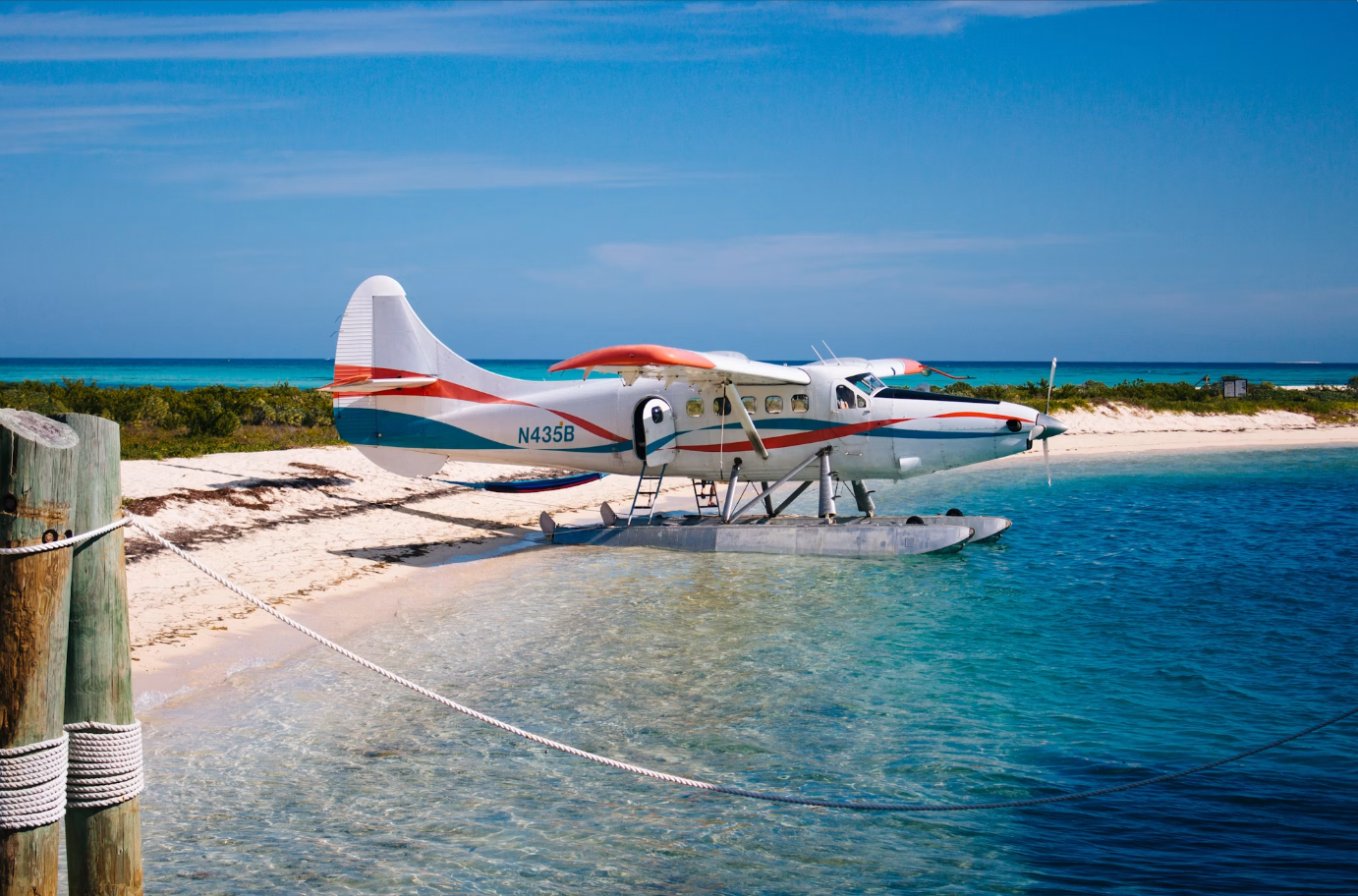
Tropic Ocean Airways operates seaplane routes connecting South Florida with several Bahamian destinations, including Bimini, a roughly 90-mile stretch of water that has made the airline a popular choice for travelers looking to skip the ferry or a longer commercial flight connection. The aircraft involved, a Cessna 208B Caravan built in 2014 and fitted with floats for water operations, is one of the most widely used amphibious aircraft in commercial service worldwide, valued in this kind of short-hop island operation for its reliability and relatively simple single-engine design.
In a statement following the incident, Tropic Ocean Airways described it as an accident and confirmed that all passengers and crew were safely evacuated, without offering further detail while the formal investigation remained ongoing. The airline has not disclosed the identities of those aboard, consistent with standard practice while an active inquiry is underway.
How an incident like this actually gets investigated
The Bahamas' Aircraft Accident Investigation Authority has opened a formal inquiry under International Civil Aviation Organization Annex 13 procedures, the international standard framework governing how aviation accidents and serious incidents are investigated regardless of which country they occur in. That process typically involves recovering physical evidence, in this case likely including the sunken aircraft itself, interviewing the flight crew and witnesses, and reviewing maintenance and flight records before publishing formal findings. The AAIA is working in coordination with the Bahamas Department of Aviation and local police, and has indicated that further updates will follow as the investigation progresses, a timeline that for incidents of this nature typically runs from several months to over a year.
Why a Story With No Injuries Still Matters
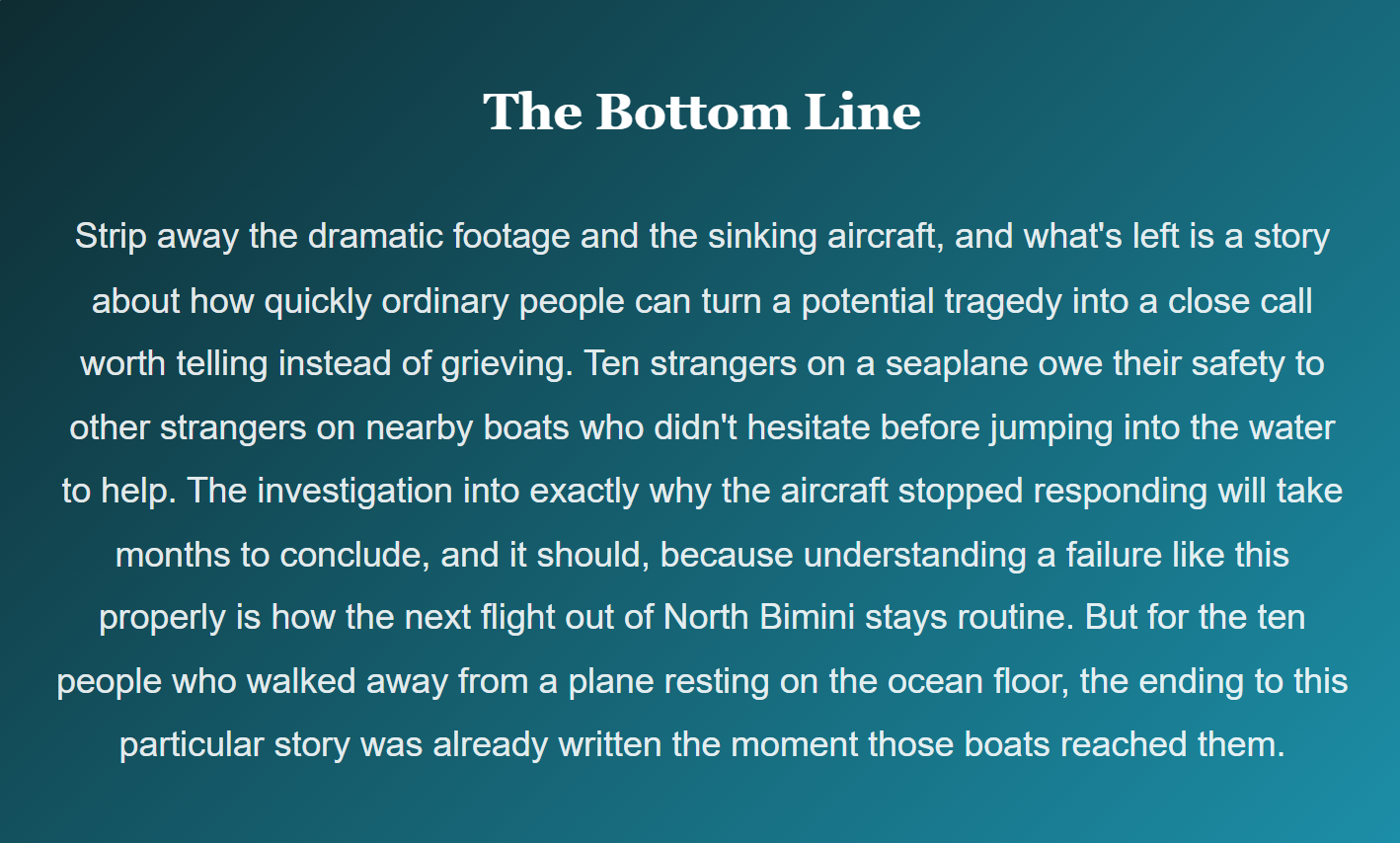
It would be easy to file this away as a dramatic but ultimately minor travel mishap, and in terms of outcome, that's exactly what it was. But incidents like this get scrutinized closely for a reason that has little to do with this specific flight and everything to do with the broader safety record of seaplane operations in the region. Water take-offs and landings introduce variables that conventional runway operations simply don't have to deal with, boat traffic, wave conditions, and water surface behavior that can change from one minute to the next, all factors investigators will be looking at closely as they reconstruct exactly why this particular aircraft stopped responding to course corrections while taxiing.
The Bahamas has a long, largely positive history with seaplane travel, and incidents resulting in zero injuries, however dramatic the visuals, are a very different category from the region's rare but far more serious past accidents. That distinction matters for travelers weighing whether island-hopping by seaplane remains a safe, practical way to reach the Bahamas from Florida, and for an aviation authority working to make sure a scary morning near a resort dock doesn't repeat itself.
What happens to the aircraft now
Recovering a sunken aircraft from roughly 100 feet of water is a nontrivial operation, typically requiring specialized marine salvage equipment rather than a standard tow. Investigators generally want the wreckage recovered where possible, since physical evidence, structural damage patterns, control surface positions, and mechanical components, can reveal far more about the sequence of events than witness accounts alone. Whether a formal salvage operation is already underway near North Bimini hasn't been publicly detailed, but it's a standard next step in any investigation of this kind, particularly when the cause of a sudden, uncorrected course deviation remains unclear.