William BensonVIEW PROFILE →
The Summer Europe Burned: Inside France and Portugal's Worst Wildfire Season in Decades
Record heat, hundreds of thousands evacuated, and a fire season officials are already calling the worst since 1949 , here's what actually happened.
Record heat, hundreds of thousands evacuated, and a fire season officials are already calling the worst since 1949 — here's what actually happened.
On June 23, 2026, the European Union recorded the hottest day since measurements began in 1947. Nobody knew it yet, but that single number was the opening line of a wildfire season that would go on to burn more of France than any year since 1949, force some of the largest evacuations Europe has seen since the Second World War, and turn firefighting crews from three countries into neighbours sharing the same burning hillsides. What follows isn't one fire. It's a season, stretched across two months and two countries, where heat, drought, and wind kept arriving in the same combination just often enough to overwhelm even well-prepared emergency services.
How It Started: A Heatwave That Broke the Thermometer
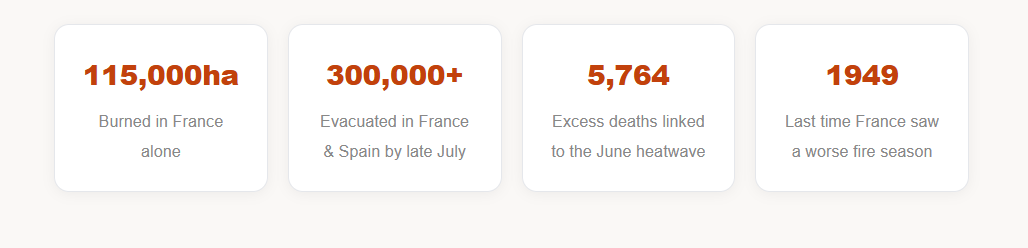
France's Prime Minister Sébastien Lecornu would later say plainly that climate change had pushed the wildfire season earlier than usual, and the data backed him up. The heat that arrived in mid-June 2026 wasn't a passing spike — French health authorities later confirmed that between June 17 and July 2 alone, the country recorded 5,764 more deaths than would normally be expected for that period, a toll attributed to the heatwave itself. Emergency services and military units were placed on wildfire alert almost immediately, well before most of the season's largest fires had even ignited.
By early July, that alert had become reality. On July 2, a major wildfire broke out across the Aude and Hérault departments in southern France, prompting the deployment of 800 firefighters and 150 vehicles and forcing roughly 3,000 people to evacuate. It was an early warning of what the rest of the month would bring.
Trévillach: The Fire That Stopped the Tour de France
Few single incidents captured the scale of the crisis like the blaze that broke out near Trévillach, in the Pyrénées-Orientales region close to the Spanish border, in early July. Strong winds and exceptionally dry vegetation sent the fire tearing through the foothills of the French Pyrénées, ultimately scorching around 4,600 hectares and injuring sixteen people, including four firefighters. Authorities evacuated roughly 10,000 residents from two dozen towns and villages in the fire's path.
The blaze was significant enough to interrupt one of the world's most-watched sporting events: organisers were forced to close the third stage of the Tour de France to the public so firefighting crews could move through the area unimpeded, keeping even the race's support vehicle convoy to a minimum. The European Union responded by sending four waterbombing aircraft from Cyprus and Sweden, along with more than 100 additional firefighters, to reinforce the French response around Trévillach.
Where the worst of France's fires struck
· Aude & Hérault — 800 firefighters deployed, 3,000 evacuated (July 2) · Trévillach, Pyrénées-Orientales — 4,600 hectares burned, 10,000 evacuated, Tour de France stage closed (early July) · Bezouce — 70 residents evacuated (July 5) · Fontainebleau forest — 900 homes evacuated, water drawn from the Seine to help contain the blaze (July 13) · Gironde region — France's biggest peacetime evacuation since World War II, with Bordeaux sheltering thousands of displaced residents (late July)
Portugal's Parallel Crisis
While southern France fought its fires, Portugal was living through its own record-breaking season, driven by the same heatwave pattern. The country's Special Rural Fire Combat Device, its largest wildfire-response mobilisation in a decade, was activated with a budget of €50 million and an 81-aircraft fleet, including Black Hawk helicopters flying wildfire suppression missions for the first time in the country's history.
The northern municipality of Vouzela became the epicentre of Portugal's response after a fire ignited there in the early hours of July 2. Within days it had consumed roughly 13,000 hectares of forest and scrubland, drawing more than 1,100 firefighters and, eventually, support through the EU Civil Protection Mechanism. Satellite imagery from the European Space Agency showed a smoke plume from the Vouzela fires stretching more than 600 kilometres out over the Atlantic Ocean. By the time officials described the blaze as roughly 80 percent contained, similar fires were already burning in Barcelos, Cinfães, and Castelo de Paiva.
Portugal's Secretary of State for Civil Protection, Rui Rocha, summed up the danger plainly: entering peak fire risk during a heatwave, with hot days, tropical nights that never let vegetation recover moisture, and humidity low enough to turn forest into fuel, is, in his words, "always a cause for concern."
When the Fires Refused to Stay Contained
Just as both countries seemed to be gaining ground, a second heatwave arrived in late July and undid much of that progress. By July 26, more than 300,000 people had been displaced across France and Spain combined, with new evacuation orders issued as fires reignited or spread into new territory. In Spain's Castellón and Valencia regions, hundreds of firefighters remained deployed against blazes burning largely in uninhabited terrain, while in France, the Gironde region experienced what officials described as the country's largest peacetime evacuation since the Second World War, sending thousands of residents into shelters in Bordeaux.
The human cost extended beyond property and displacement. In Crete, two firefighters died battling a wildfire during the same stretch of extreme heat, a grim reminder that the people fighting these fires face real, sometimes fatal, risk with every deployment.
Questions People Are Actually Asking
Was this really France's worst wildfire season since 1949? Yes, based on total area burned — roughly 115,000 hectares nationwide by the height of the season, a scale not recorded in France since 1949, according to national fire authorities and multiple international outlets covering the crisis.
Is climate change actually responsible, or is this just a bad year? Climate scientists studying the 2026 fires have pointed to a now-familiar combination: hotter baseline temperatures, drought conditions drying out vegetation earlier in the year, and stronger winds accelerating fire spread — all factors that peer-reviewed attribution research has linked to a warming climate increasing the likelihood of severe wildfire conditions across France and Spain specifically.
Why did Portugal's fires spread so fast in some areas? Beyond the heat and drought, Portugal's Leiria district in particular was left with heavy accumulated fuel on the ground after an earlier storm felled an estimated five to eight million trees, giving fires far more material to burn through once conditions turned dry.
What This Season Actually Changes
It's tempting to file this under "bad summer" and move on once the smoke clears. But the details resist that framing. This wasn't a single catastrophic fire — it was a sustained, multi-front emergency that stretched two countries' firefighting capacity across two separate heatwaves, months apart, each one intense enough on its own to dominate headlines in a normal year. France logged 916 individual wildfires in a single 30-day stretch in mid-July. Portugal doubled its area burned compared to the previous year before July was even over.
The pattern that emerges isn't really about any one blaze near any one village. It's about a fire season that started earlier, burned longer, and required a scale of cross-border cooperation, aircraft from Cyprus and Sweden helping fight fires in the French Pyrénées, Black Hawk helicopters flying suppression runs in Portugal for the first time, that neither country's firefighting infrastructure was originally built to assume as a yearly baseline.
A note on this reporting
Figures in this piece reflect statements from French and Portuguese civil protection authorities, the EU Civil Protection Mechanism, and international wire and broadcast reporting on the 2026 European wildfire season through late July 2026. Area-burned and evacuation figures for ongoing fire seasons are frequently revised as containment efforts continue.