 William BensonVIEW PROFILE →
The Ticket Charge Dispute That Shut Down Lagos and Abuja's Busiest Terminals
How a disagreement over a statutory 5 percent levy escalated into barricaded departure gates, stranded passengers, and an emergency intervention from Nigeria's aviation minister.
How a disagreement over a statutory 5 percent levy escalated into barricaded departure gates, stranded passengers, and an emergency intervention from Nigeria's aviation minister.
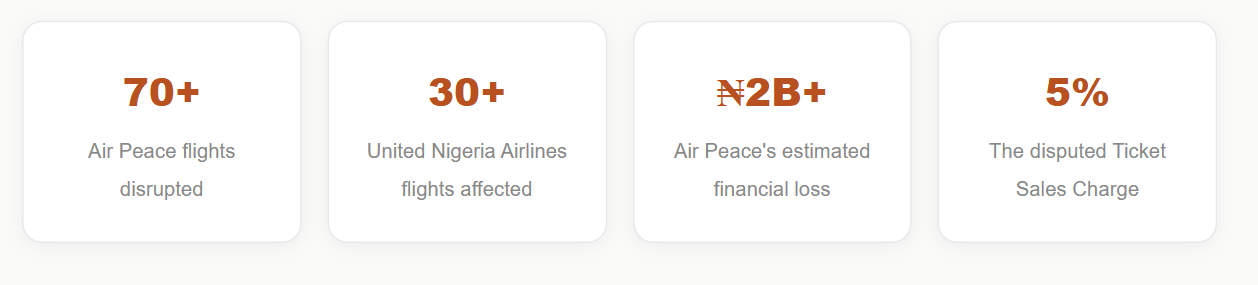
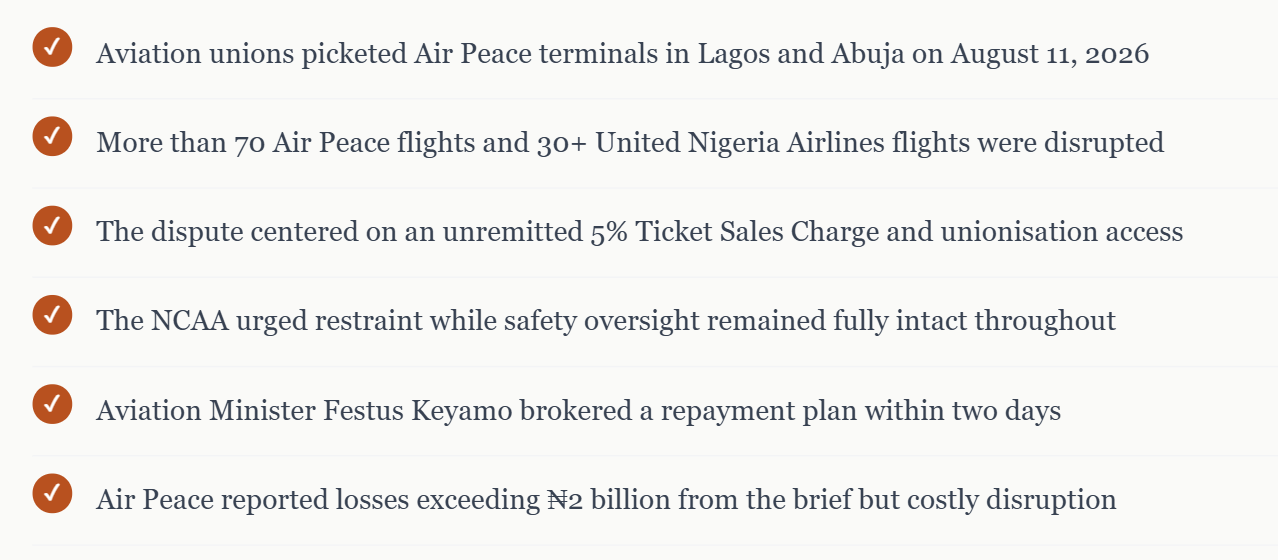
For most travellers moving through Murtala Muhammed International Airport on an ordinary Tuesday morning, the first sign that something had gone badly wrong wasn't an announcement over the PA system. It was the barricade. Union members had physically blocked the entrances to Terminal 1 and Terminal 2 in Lagos, and a mirror scene was unfolding at Nnamdi Azikiwe International Airport in Abuja. Within hours, passengers who'd arrived with boarding passes in hand found themselves stranded outside doors they couldn't get through, watching their flights vanish from the departures board one by one. What triggered the chaos wasn't a security threat or a technical failure, it was a long-simmering dispute over a small percentage on an airline ticket, one that had finally boiled over into one of the most disruptive labour actions Nigeria's aviation sector has seen in years. What Actually Happened on the Ground On Tuesday, August 11, 2026, members of three aviation unions, the Nigeria Labour Congress, the Air Transport Services Senior Staff Association of Nigeria, and the Trade Union Congress, began picketing Air Peace operations at both Lagos and Abuja airports. According to the airline's own statement, the entrances to its departure terminals, Murtala Muhammed Airport Terminal 1's Alpha and Zulu terminals, Terminal 2 in Lagos, and the Nnamdi Azikiwe terminal in Abuja, were physically barricaded, preventing passengers and crew alike from accessing the buildings. Air Peace, Nigeria's largest airline by fleet size, was left with little choice but to ground scheduled departures it couldn't get passengers or aircraft crews through to. In a public statement, the airline apologised for the disruption, describing it as a circumstance entirely beyond its control, and said it was contacting travellers scheduled to fly later that day with updates as the situation developed.
What the Dispute Was Actually About
At the center of the standoff sat the Ticket Sales Charge, a statutory 5 percent levy that airlines are required to collect from passengers on tickets for flights originating in Nigeria, funds that are meant to be passed along to the Nigeria Civil Aviation Authority to help fund airspace safety oversight and regulatory operations. The unions accused Air Peace of withholding TSC funds that had already been collected from passengers rather than remitting them as required, while also alleging that the airline was making it difficult for its workers to freely join trade unions.
Air Peace and the broader Airline Operators of Nigeria pushed back hard against the planned action before it even began, with AON describing the strike as misguided and warning it would only add pressure to airlines already grappling with high aviation fuel costs and a growing list of statutory charges. That warning did little to prevent the walkout: when the unions felt their concerns weren't being adequately addressed, they proceeded with the picket anyway.
The Regulator Steps In
As the disruption unfolded, the Nigeria Civil Aviation Authority moved quickly to address the fallout, issuing a public statement from Director-General Captain Chris Najomo appealing to the unions to suspend their action and return to dialogue. Najomo specifically asked the unions to exercise restraint pending the return of Nigeria's Minister of Aviation and Aerospace Development, Festus Keyamo, who the NCAA said had already been actively working toward resolving the underlying dispute.
According to the regulator, the frustrating part of the standoff was that it may not have needed to escalate at all. Najomo noted that the issues at the heart of the dispute could have been addressed the previous week at a meeting the minister himself had convened, but that meeting never took place because the airline operators failed to honour the invitation. The NCAA was careful to reassure the public on one key point throughout the crisis: aviation safety oversight, it said, remained fully intact and had not been compromised by the industrial action, even as commercial operations ground to a halt.
"We appeal to all parties to embrace dialogue and cooperation." — Captain Chris Najomo, Director-General, Nigeria Civil Aviation Authority
Why This Wasn't Just an Air Peace Problem
Although Air Peace bore the brunt of the picketing, the disruption rippled outward almost immediately. United Nigeria Airlines confirmed that more than 30 of its own flights were affected by the fallout, and Enugu Air also suspended operations amid the chaos. The reason a dispute targeting one airline could cascade so widely comes down to simple geography: Lagos and Abuja aren't just two airports among many in Nigeria, they're the two central hubs through which the overwhelming majority of the country's domestic flight network is routed.
Businessday Nigeria's coverage of the disruption noted precisely this dynamic, observing that the concentration of major airline operations around these two cities means any disruption at either airport carries the potential to spread across the entire domestic network rather than staying contained to a single carrier. That's part of why the NCAA and the Federal Airports Authority of Nigeria treated the incident as more than a routine labour dispute between one airline and its workforce, it was, functionally, a threat to the stability of national air travel for as long as it continued.
Why hub concentration makes strikes so disruptive
In aviation networks built around a small number of central hubs, a disruption at just one or two airports can cascade across dozens of routes almost immediately, since so many connecting flights and aircraft rotations pass through the same handful of terminals each day.
How Keyamo Broke the Deadlock
Two days after the picketing began, Aviation Minister Festus Keyamo convened an emergency meeting bringing together airline operators, union representatives, and the heads of Nigeria's aviation agencies to address the dispute directly. Rather than attempting to resolve the underlying disagreement over the TSC in a single sitting, Keyamo took a more practical route: he directed the NCAA and other aviation agencies to work with the airlines on structured repayment plans for the outstanding statutory charges.
The meeting resolved that relevant agencies should obtain formal payment schedules from the airlines, schedules that would explicitly account for each carrier's operating costs and the current economic pressures facing the industry, rather than demanding an unrealistic lump-sum settlement that could push financially strained airlines further into difficulty. It was, in effect, a negotiated middle ground: acknowledgment that the money owed was real and needed to be paid, paired with a repayment structure airlines could realistically sustain.

The financial toll of a two-day disruption
Air Peace reported losses from the disruption exceeding 2 billion naira, a striking figure for an incident that lasted only a matter of days. The scale underscores just how costly airport-level labour disputes can become for carriers, even when the underlying disagreement involves a relatively small percentage charge on individual tickets.
What This Reveals About Nigeria's Aviation Sector
Beyond the immediate disruption, the episode exposed a set of underlying tensions that have been building in Nigerian aviation for some time. Airlines have repeatedly pointed to high aviation fuel costs and a growing list of statutory charges as sources of serious financial pressure, pressure the Airline Operators of Nigeria referenced directly when warning against the strike before it began. Unions, for their part, argue that statutory charges collected directly from passengers, money that's meant to fund critical safety infrastructure, shouldn't become a point of financial slippage regardless of how tight an airline's margins are.
Both positions carry real weight, and that's precisely what made this dispute difficult to resolve quickly: it wasn't a simple case of one side being clearly right, but a genuine collision between an industry under financial strain and a regulatory funding mechanism that depends on that same industry remaining compliant.
A pattern worth watching
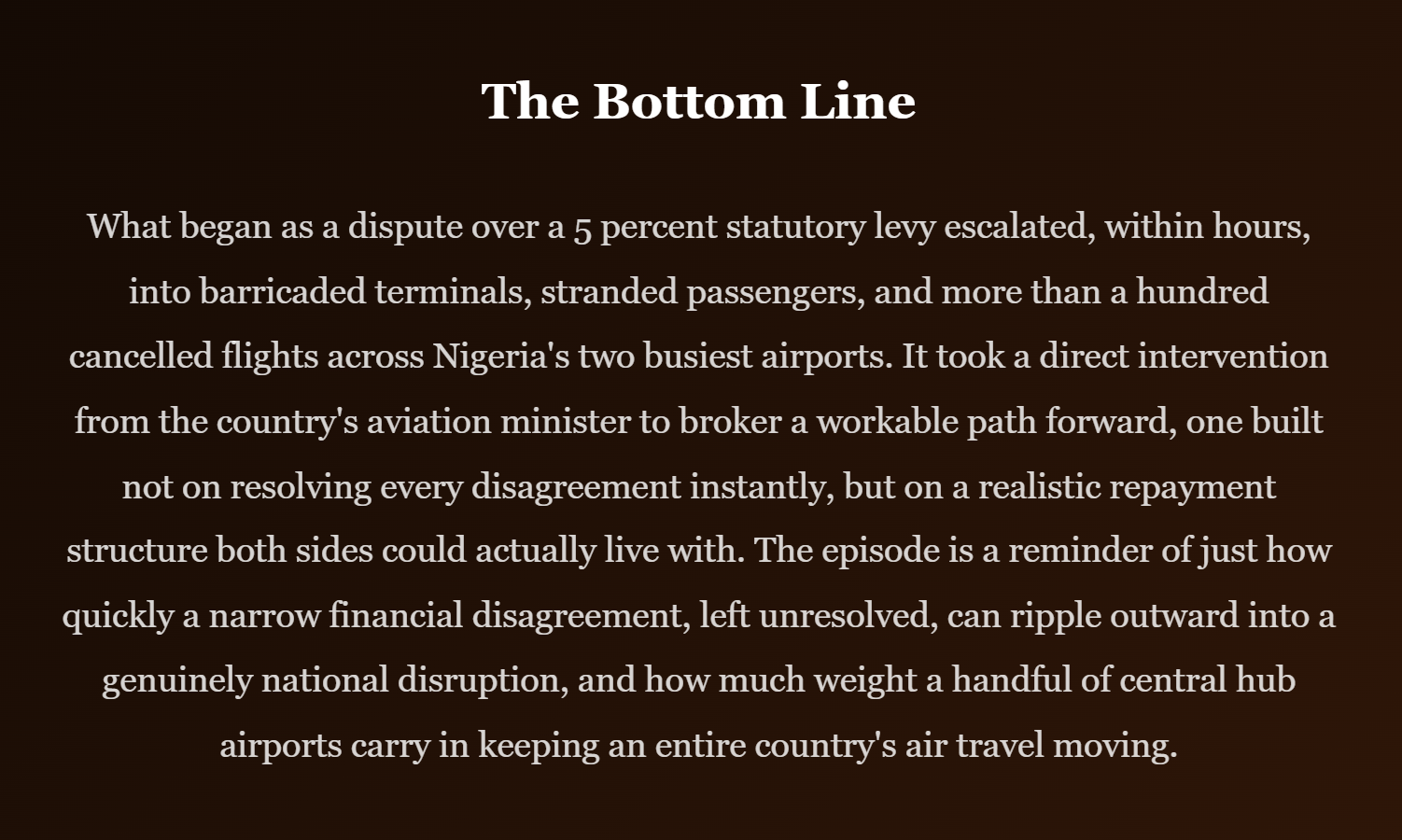
Industrial disputes involving statutory charges aren't unique to Nigeria's aviation sector, but the speed and scale at which this one disrupted national air travel is a useful case study in how tightly interconnected modern aviation networks really are. A disagreement that began over paperwork and remittance schedules ended up stranding passengers hundreds of kilometres from where the underlying dispute was actually happening, a reminder of how quickly a narrow labour disagreement can ripple into a genuinely national problem.
Where Things Stand Now
Following Keyamo's intervention, flight operations across both airports began returning to normal, with airlines advising passengers to confirm flight status before heading to the terminal as schedules remained subject to short-notice change in the immediate aftermath. The repayment framework agreed at the emergency meeting is intended to prevent a similar standoff from recurring, though it remains to be seen whether the underlying financial pressures facing Nigerian airlines, the same pressures AON warned about before the strike even started, will ease enough to make the new payment schedules genuinely sustainable over the months ahead.