 William BensonVIEW PROFILE →
The Tiny Habits That Quietly Undo Hours of Daily Overwhelm
Forget the hour-long morning routine. These are the two-minute habits that actually move the needle on stress, and the science behind why they work so well.
Forget the hour-long morning routine. These are the two-minute habits that actually move the needle on stress, and the science behind why they work so well.
Somewhere along the way, self-improvement got expensive. Ninety-minute morning routines, elaborate journaling systems, color-coded planners, entire apps built just to track other apps. It's exhausting before you've even started, and for most people juggling a job, a family, and a phone that never stops buzzing, none of it survives past the second Tuesday of the month. What actually works tends to be smaller, stranger, and far less impressive-looking than any of that. The habits that genuinely move the needle on daily stress rarely take more than a couple of minutes. They're not flashy. Nobody's filming a slow-motion video of themselves doing the one-minute rule. But stacked together, a handful of these tiny actions can quietly claw back hours of mental clutter from a day that otherwise runs on autopilot from alarm to pillow. Why Small Actions Beat Big Plans There's a reason ambitious routines tend to collapse under their own weight while tiny habits stick around for years. Big changes require willpower, and willpower is a limited, fluctuating resource that tends to run lowest exactly when stress is highest, which is precisely when you need support the most. A two-minute habit sidesteps that problem almost entirely. It's small enough to do even on the worst day, which means it actually gets repeated often enough to become automatic. That repetition is where the real payoff hides. A single two-minute action barely registers on its own. Stacked across a week, a month, a year, those same two minutes start reshaping how cluttered or clear a mind feels by the time evening rolls around, not because any one habit is powerful, but because none of them require the kind of motivation that burns out by Wednesday.
The 1-Minute Rule: Small Enough to Never Skip
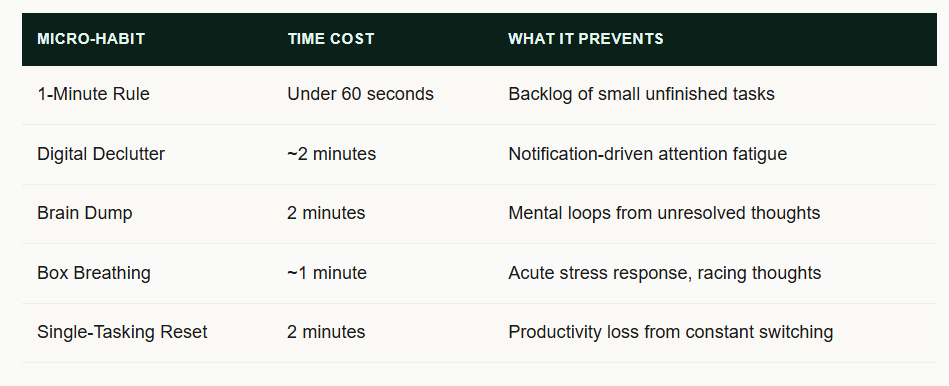
Popularized by productivity writer Gretchen Rubin, the one-minute rule is disarmingly simple: if a task takes less than sixty seconds, do it the moment it appears rather than letting it join the mental pile of things to deal with later. Hanging up a jacket, replying to a one-line message, rinsing a single dish, filing away a piece of mail. None of these are individually significant. What's significant is what happens when dozens of them get deferred instead of done.
Deferred one-minute tasks don't just sit quietly waiting their turn. Each one becomes a tiny background thread of unfinished business, a small tug at attention that resurfaces every time it's glimpsed out of the corner of an eye. Psychologists have a name for this phenomenon, sometimes referred to as the Zeigarnik effect, the tendency for uncompleted tasks to occupy more mental space than completed ones, replaying quietly in the background until they're either finished or deliberately released.
Unfinished tasks don't disappear from awareness just because they're ignored, they keep resurfacing, quietly consuming attention that could otherwise go toward whatever's actually in front of you.

Digital Decluttering: Two Minutes That Undo Hours of Noise
If the one-minute rule handles physical clutter, digital decluttering tackles its noisier cousin. The average adult now checks their phone somewhere in the neighborhood of ninety times a day, and each of those checks carries a hidden cost that has nothing to do with how long the check itself takes.
Research on attention and task-switching consistently points to the same uncomfortable finding: after a genuine interruption, it can take over twenty minutes to fully re-establish the same depth of focus that existed beforehand. A notification doesn't just cost the three seconds it takes to glance at it, it can quietly cost the next twenty minutes of whatever you were actually trying to think about.
The two-minute digital reset
Once a day, usually in the evening, spend two minutes clearing app badges, archiving read emails, and closing browser tabs that have been sitting open for days. It sounds trivial, but a visually cluttered phone or laptop screen functions as a constant low-grade reminder of unfinished business, the same way a messy desk does.

The Two-Minute Brain Dump
Another habit that punches well above its two-minute weight is what's often called a brain dump: sitting down with a blank piece of paper and, without editing or organizing anything, simply writing down every task, worry, or half-formed thought currently taking up mental space. The goal isn't to solve anything in the moment, it's purely to move it from an internal loop onto an external page.
This works for the same reason the one-minute rule works. A mind holding onto a dozen unresolved threads at once is a mind that's constantly, quietly rehearsing all of them, over and over, in the background. Writing them down doesn't make the tasks disappear, but it does let the brain stop treating them as active, urgent things that need continuous monitoring, freeing up bandwidth for whatever's actually happening right now.
Box Breathing: The Fastest Reset There Is
Used by everyone from Navy SEALs to elite athletes before high-pressure moments, box breathing is about as close as it gets to a genuine one-minute stress interrupt. The pattern is simple: inhale slowly for a count of four, hold for four, exhale for four, hold again for four, then repeat the cycle three or four times.
What makes this technique so effective isn't mystical, it's mechanical. Slow, controlled breathing activates the body's parasympathetic nervous system, the branch responsible for calming things down after a stress response has kicked in. It's one of the only tools available that can measurably shift a racing heart rate and a spiraling train of thought within roughly sixty seconds, no equipment, no app, no appointment required.
Why this beats "just try to relax"
Telling yourself to calm down rarely works in the moment because it gives the nervous system no actual instruction to follow. Box breathing works because it gives the body a specific, physical pattern to execute, which interrupts the stress response directly rather than trying to think your way out of it.
The Single-Tasking Reset
Multitasking has a reputation problem, mostly because it doesn't actually exist in the way most people imagine. What feels like doing two things at once is really the brain rapidly switching attention back and forth, and each switch carries a small cognitive cost that adds up fast across a busy day. Researchers studying task-switching have found that heavy multitasking can measurably reduce overall productivity, sometimes substantially, compared with working through the same tasks one at a time.
The two-minute version of fixing this is simple: before starting a new task, take two minutes to close every browser tab, application, and notification unrelated to that one task. It feels almost too basic to matter, but a cluttered digital workspace pulls focus in exactly the same way a cluttered physical desk does, and clearing it, even briefly, resets the mental stage before the next task begins.

Why stacking matters more than any single habit
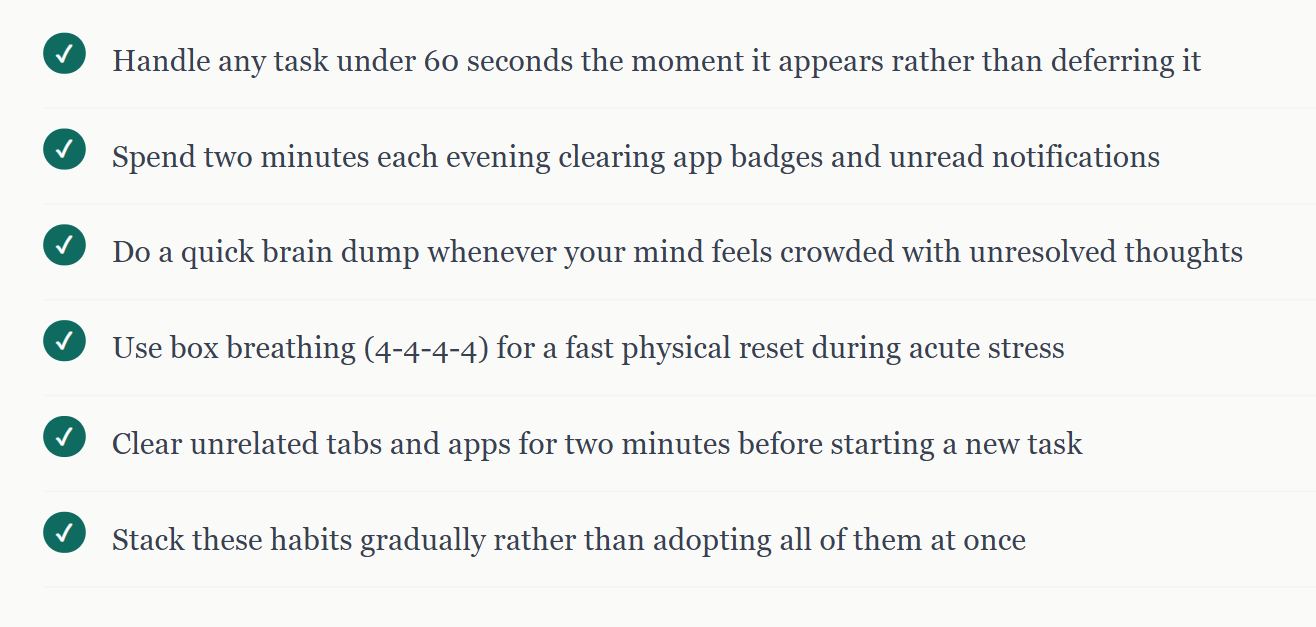
None of these five habits is individually life-changing. That's actually the point. Each one is small enough to survive a bad day, a busy week, a chaotic month, which is exactly the kind of stretch where more demanding routines quietly fall apart. Over time, it's the accumulation, not any single two-minute action, that produces the noticeable shift in how manageable a day feels by the time it ends.
Where to Actually Start
The temptation with any list like this is to try adopting all five habits simultaneously starting tomorrow morning. Resist that urge. The entire premise here is that small, low-effort actions succeed precisely because they don't demand much, and stacking five new habits at once quietly reintroduces the same willpower problem that made the big morning routine collapse in the first place.
A more sustainable approach is picking just one, the one-minute rule is usually the easiest entry point, and letting it run for a couple of weeks before adding a second. By the time all five are running quietly in the background, most people report that the shift feels less like a rigid new system and more like a gradual lowering of the constant hum of low-grade stress that used to feel completely normal.