 William BensonVIEW PROFILE →
There's a Fee Baked Into Every Grocery Run You Take, and Almost Nobody Talks About It
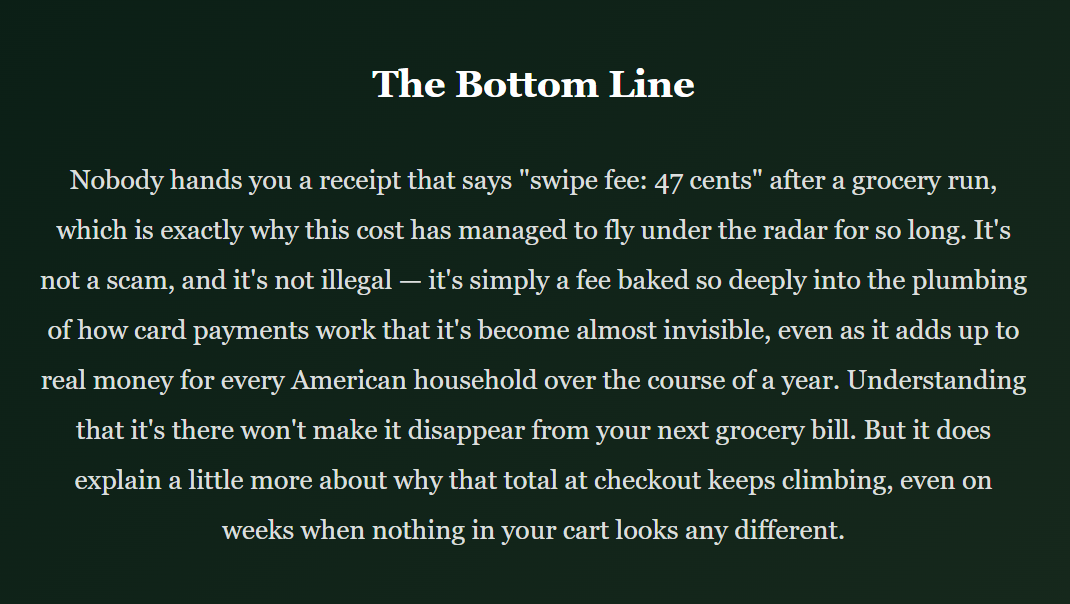
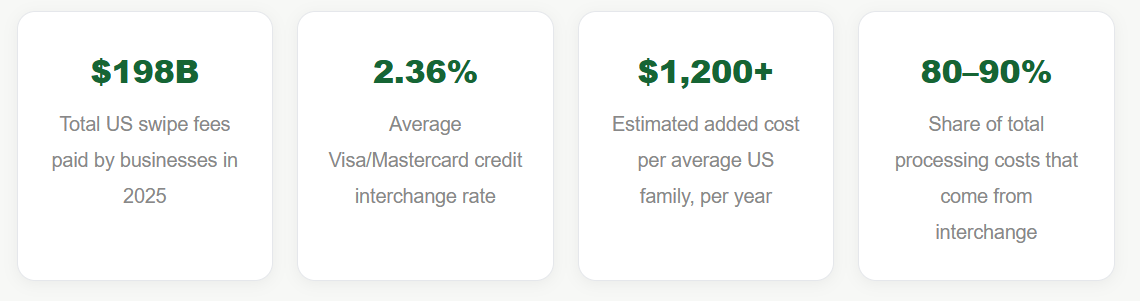
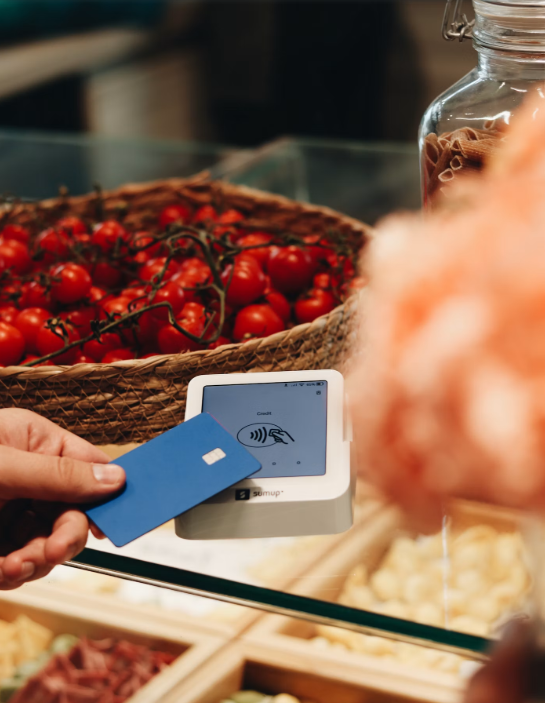
Walk through a grocery store checkout line and watch what happens: the cashier scans your items, the total flashes on the screen, you tap your card, and you walk out. Nothing about that interaction looks like a tax. But tucked inside that transaction is a fee that neither you nor the cashier ever see — one that both Visa and Mastercard collect on nearly every card swipe in the country, and one that economists increasingly agree gets passed straight back to you through higher shelf prices. What a "Swipe Fee" Actually Is Every time a card gets swiped, tapped, or inserted at a US retailer, the store doesn't keep 100 percent of what you paid. A slice of it — known as an interchange fee, or more casually as a swipe fee — gets routed to the bank that issued your card, with the card network itself taking a smaller cut along the way. This isn't a niche cost buried in some retailer's back-office spreadsheet. In 2025 alone, US businesses paid out roughly $198 billion in credit and debit card swipe fees combined, making it the second-largest operating cost most retailers face, right behind labor. The average combined interchange rate for Visa and Mastercard credit cards reached 2.36 percent in 2025, up from 2.02 percent back in 2010. That might sound like a rounding error on a single transaction, but multiply it across the roughly $180-plus billion in weekly credit and debit card spending happening across the country, and it becomes one of the largest, least visible costs woven into the American retail system.

Why Grocery Stores in Particular Feel This So Hard
Not every business feels swipe fees the same way. A jewelry store selling a handful of expensive items a day has more room to absorb a 2 percent fee than a grocery chain running on razor-thin margins across thousands of low-cost items sold every single hour. Grocery is widely regarded as one of the lowest-margin sectors in retail, with typical net margins often sitting in the low single digits. When a cost like interchange eats into that margin on every transaction, a grocer generally has two choices: absorb it and accept a thinner profit, or spread it across shelf prices so the cost gets shared invisibly among every shopper who walks through the door.
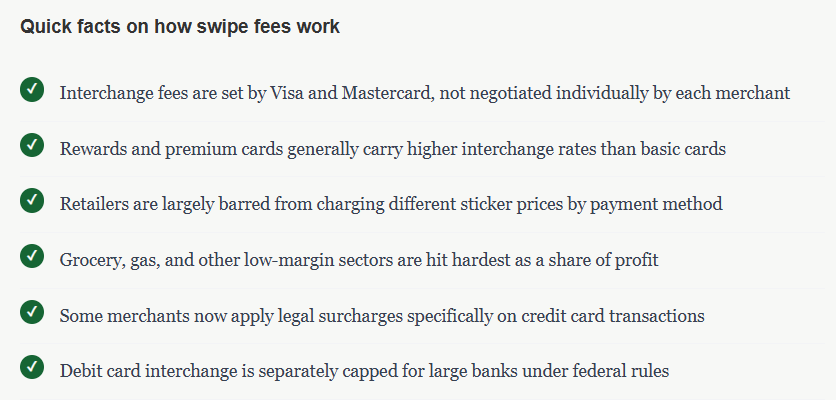
In practice, most retailers do some combination of both, and economic research backs up the idea that the second option dominates over time. A National Bureau of Economic Research study using merchant-level payment data found that because retailers generally charge the same sticker price no matter how a customer pays, shoppers who use cash or basic debit cards end up effectively subsidizing the rewards and perks enjoyed by premium credit card users — a quiet redistribution that happens inside the price of a gallon of milk or a bag of rice, not on any visible line item.
Because merchants generally charge the same price regardless of how a customer pays, shoppers who use cash or debit cards effectively help finance the rewards that credit card users enjoy — a transfer of cost that happens invisibly, inside the sticker price of everyday purchases.
Where the Money Actually Goes
It's worth being precise about who collects a swipe fee, because it's a more layered system than most shoppers realize. The card-issuing bank — the specific financial institution that gave you your card — is typically the primary recipient of an interchange fee. That revenue helps the bank cover the operational cost of running the card program, absorb the risk of customers defaulting on balances, fund fraud-prevention systems, and, notably, pay for the cash-back and travel-point rewards that make premium cards attractive in the first place. The card networks, Visa and Mastercard, take a smaller separate cut for running the actual payment rails that make the transaction possible.
That last detail explains something that puzzles a lot of people: why do rewards credit cards seem to keep getting more generous, even as everyone complains about rising prices? Interchange rates have climbed gradually over the past decade in large part because more Americans have shifted toward premium, rewards-heavy cards, which carry meaningfully higher interchange rates than basic cards. The better the rewards on your card, generally speaking, the higher the fee a merchant pays when you use it — a cost that, again, tends to land on the sticker price paid by every customer, rewards card or not.
The Political Fight Playing Out Over These Fees
Swipe fees haven't escaped notice in Washington. The Credit Card Competition Act, a bipartisan bill that would require large banks to enable card routing over at least two unaffiliated payment networks rather than just Visa or Mastercard, has been pushed for several years as a way to introduce real price competition into a market that critics describe as a duopoly. Supporters, including a coalition of major retail trade groups, argue the legislation could save merchants and consumers more than $17 billion a year by forcing card networks to actually compete on price for the first time.
Not everyone agrees that would help ordinary shoppers, though. Banking industry representatives have pointed to more than a decade of experience with debit card interchange caps under the Durbin Amendment, arguing that regulated price ceilings on that side of the market didn't translate into lower prices for consumers — the savings, in their telling, tended to stay with merchants rather than get passed down the chain. It's a genuinely contested question among economists, and reasonable people disagree about how much of any future savings would actually reach the checkout line versus simply improving retailer margins.
What You Can Actually Do About It
There's no way for an individual shopper to opt out of interchange fees entirely — they're baked into how the whole card payment system operates, whether you personally use a rewards card or not. But there are a few practical things worth knowing. Some merchants, particularly smaller ones, have started applying legal credit card surcharges specifically on card transactions, which at least makes the cost visible rather than hidden inside the price of every item; paying with cash or a basic debit card at those specific businesses can sidestep the surcharge entirely. For everyday grocery shopping at larger chains where prices don't change based on payment method, the fee is baked in regardless of how you pay, which means the more relevant question becomes whether the rewards or cash-back you're earning on a given card are worth more to you personally than the marginal contribution you're making to the overall interchange system — a genuinely personal tradeoff rather than one with a single right answer.
A Few Straightforward Questions
Do I pay less if I use cash instead of a card? At most large grocery chains, no — prices are typically the same regardless of payment method, since interchange costs are usually built into overall pricing rather than isolated to card transactions. At businesses with an explicit card surcharge, cash can avoid that specific added charge.
Is this the same as a "convenience fee" I sometimes see online? Not exactly. A convenience fee is a charge some merchants add for a specific payment channel, like paying a bill by phone. A swipe fee, or interchange fee, is a cost baked into the payment processing system itself and generally isn't disclosed to the customer as a separate line item at all.
Would the Credit Card Competition Act actually lower grocery prices? That's genuinely disputed. Supporters project billions in savings that could flow through to consumers via lower prices; critics point to past debit-fee regulation and argue savings tend to stay with merchants rather than reach shoppers. Reasonable experts land on different sides of this one.
Are swipe fees higher in the US than elsewhere? Generally yes. Several other countries and regions, including the European Union, have regulatory caps on interchange fees that sit well below typical US rates, which is part of why this remains such an active policy debate domestically.
Worth keeping in mind
Interchange rates, total swipe fee volume, and related legislation are all moving targets that get updated regularly by card networks, industry groups, and Congress. Treat the specific figures here as a snapshot of where things stood recently, and this article is general information rather than personal financial advice — a licensed financial advisor can help you weigh card and payment choices for your own situation.