 William BensonVIEW PROFILE →
Twelve Strokes or Freedom: Inside Malaysia's Quiet Battle Over the Future of Judicial Caning
Reforming a death penalty law is supposed to be an unambiguous act of mercy. In Malaysia, it's turned into something more complicated, a legal fix that removed one harsh punishment only to reveal how deeply another one is still wired into the system underneath it.
Reforming a death penalty law is supposed to be an unambiguous act of mercy. In Malaysia, it's turned into something more complicated, a legal fix that removed one harsh punishment only to reveal how deeply another one is still wired into the system underneath it.
In September 2024, a man named Zaidi applied for resentencing under a pair of newly passed Malaysian laws that had just abolished the mandatory death penalty, a genuine milestone in a country that had long been counted among the world's stricter enforcers of capital punishment. He was one of more than a thousand people given the same chance to seek a new sentence. What he, and the more than 350 others who followed the same path, actually received instead of death was 33 years in prison and 12 strokes of the cane, the only alternative sentence Malaysian law currently allows for the offense he was convicted of. There was no third option on the table. The choice, as written into the statute books, was execution or the cane. That outcome has become the unlikely center of a much larger debate now playing out across Malaysia's courts, parliament, mosques, and human rights community. Caning, in various forms, has been part of Malaysian law since British colonial administrators introduced it in the nineteenth century, and it has stubbornly outlived the empire that brought it. It currently applies to more than 60 offenses under civil law, from immigration violations to armed robbery to certain drug crimes, while separate, religiously grounded caning provisions operate through Sharia courts for Muslims accused of offenses under Islamic law. Human rights advocates estimate the practice is carried out on roughly 10,000 people a year, a striking figure for a country that, alongside a shrinking minority of nations worldwide, still hasn't ratified the primary international treaty banning torture. A colonial punishment that reform accidentally exposed The push to abolish the mandatory death penalty, which succeeded in 2023 through a pair of landmark laws, was widely and correctly celebrated as a major human rights victory, giving judges discretion in capital cases for the first time in decades and opening the door for over a thousand existing death row inmates to seek resentencing. What that reform effort didn't fully anticipate was the specific shape of the fallback option it left in place. For a number of the most serious offenses previously carrying a mandatory death sentence, the only legally available alternative is a lengthy prison term combined with a minimum of twelve strokes of the cane, meaning the law traded one absolute mandatory punishment for another one that human rights organizations argue is barely less severe.
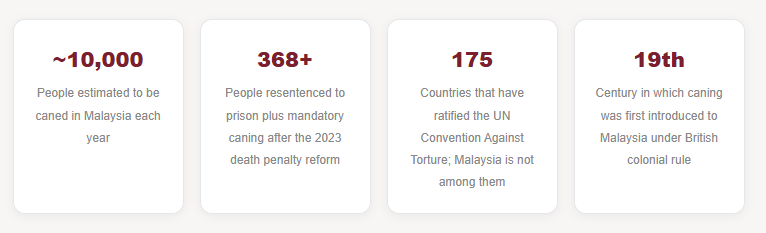
That's the specific gap reform advocates are now trying to close. The argument, made repeatedly by legal groups and human rights organizations since the death penalty reform passed, is straightforward: a genuine, comprehensive reform of Malaysia's most severe punishments can't stop at removing the mandatory death sentence while leaving a mandatory corporal punishment sentence fully intact right behind it.
The case international law makes against it
The central legal argument for abolition rests on Malaysia's relationship with international human rights law. The UN Convention Against Torture defines torture in part as any act intentionally inflicting severe physical or mental pain as punishment, a definition human rights bodies including the UN Special Rapporteur on Torture have explicitly applied to judicial corporal punishment. Malaysia has ratified several related treaties, including the Convention on the Rights of the Child, but has never signed onto the core anti-torture convention itself, leaving it in a small minority of the world's nations that haven't formally committed to that specific prohibition.
What the process actually involves
Human rights organizations that have documented the practice describe a process involving medical evaluation both before and after the punishment is carried out, specifically to determine whether a prisoner is physically fit to be caned and, in some documented cases, to revive someone who has lost consciousness during it. Groups including the International Commission of Jurists and the Malaysian Bar, which represents thousands of the country's lawyers, have both formally called for its complete abolition, arguing that medical staff being required to participate in that process represents a form of institutional complicity in what they classify as cruel and degrading treatment.
We will study this matter thoroughly in the near future.
— Deputy law and institutional reform minister Ramkarpal Singh, responding to a parliamentary call to abolish caning

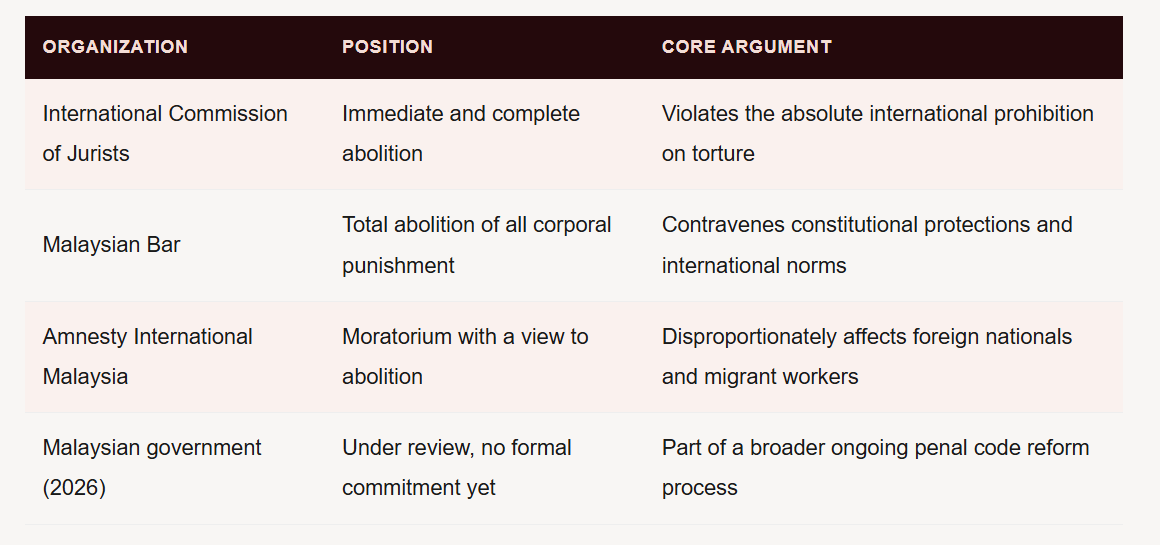
Amnesty International Malaysia has raised a related concern specific to how the punishment is applied in practice: a significant share of those caned each year are foreign nationals, often migrant workers convicted of immigration offenses that in most other countries are treated as administrative violations rather than criminal ones. That pattern has drawn particular attention from foreign governments and regional bodies, with the European Parliament passing a resolution in past years explicitly condemning the practice and calling on Malaysia to bring its laws in line with international human rights standards.
An important distinction worth understanding
Malaysia actually operates two separate caning systems. Civil law caning, ordered by criminal courts for offenses like robbery and drug trafficking, applies to all Malaysians and foreign nationals regardless of religion. Sharia caning, a separate and generally less severe practice, applies only to Muslims for religious offenses through state Sharia courts. The reform debate over mandatory civil caning and the more recent controversy over public Sharia caning are related but legally distinct issues, and conflating them is one of the most common sources of confusion in public discussion of this topic.

The argument for keeping it, and the religious divide underneath it
Support for retaining caning, particularly within its Sharia court context, is far from a fringe position in Malaysia, a majority-Muslim country where religious authority carries real institutional weight. When a Sharia court in the state of Terengganu ordered the first public caning under Islamic law in the state's modern history in early 2025, some religious officials publicly defended it. The Mufti of Pahang endorsed public caning as a legitimate deterrent, and the Mufti of Sabah argued a similar case, drawing on the Islamic legal concept that certain punishments are more effective when carried out visibly. Residents interviewed by regional news outlets after the caning offered similarly direct support, describing it as a necessary lesson for the wider community and an expression of religious values they felt deserved public reinforcement.
That view is genuinely contested even within Malaysia's own religious establishment, not just by secular human rights groups. The Mufti of Perlis, a respected Islamic scholar, publicly rejected the practice on specifically theological grounds, arguing that Islamic law traditionally favors concealing a person's private faults rather than publicly punishing them, and that the strict evidentiary requirements the Quran sets for certain caning-eligible offenses were never intended to make public punishment common or easy to apply. Sabah's state government, despite its own mufti's endorsement of the practice, formally declined to implement public caning at all. That range of positions, running from full-throated religious endorsement to religious objection to political caution, reflects a debate inside Malaysian Islam every bit as unsettled as the human rights debate happening alongside it.
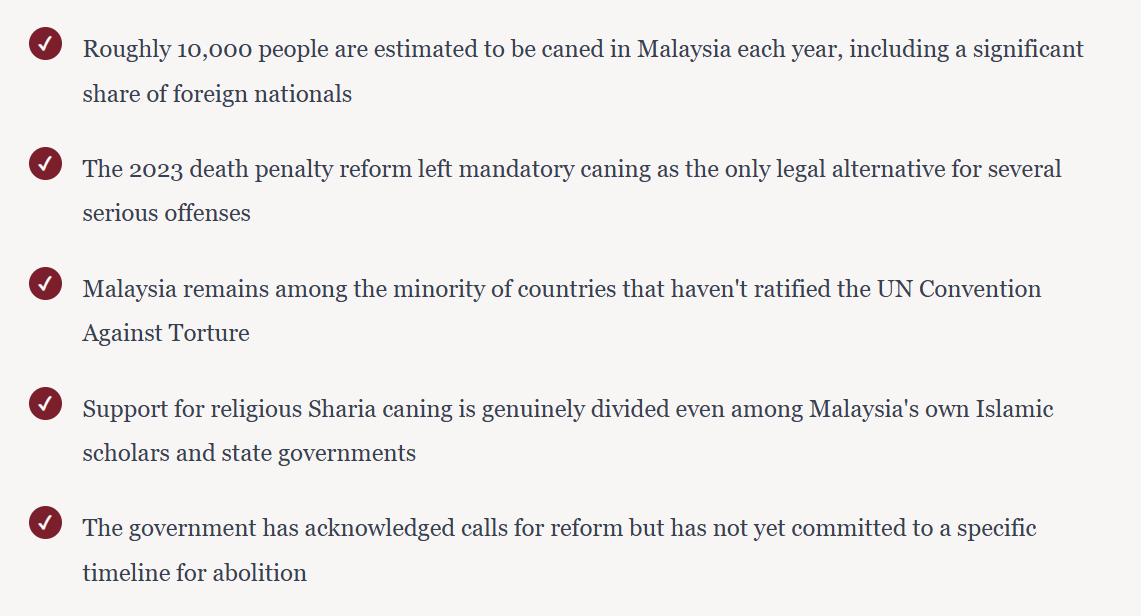
What makes this moment different from previous rounds of the same debate is the specific legal pressure created by the death penalty reform itself. It's one thing to defend caning as a longstanding, if contested, feature of the legal system in the abstract. It's a noticeably harder position to hold once the law has been rewritten to make caning the mandatory floor a court must impose on someone who was, until recently, sentenced to death, with no judicial discretion available to choose anything less. That specific, narrow legal gap, opened unintentionally by an otherwise widely praised reform, is where the current push for change is concentrated.