 William BensonVIEW PROFILE →
Two Controllers, One Couch, No Studio Interested: The Real Story Behind the Death of Split-Screen Gaming
There used to be a very specific kind of argument that happened on living room floors: who gets player one, who gets the top half of the screen, and whether the top half is actually an advantage. That argument has quietly disappeared from most major releases, and it wasn't because anyone stopped wan
There used to be a very specific kind of argument that happened on living room floors: who gets player one, who gets the top half of the screen, and whether the top half is actually an advantage. That argument has quietly disappeared from most major releases, and it wasn't because anyone stopped wanting to have it.
Picture a living room sometime in the 2000s. Two controllers tangled on the carpet, a television split cleanly down the middle, and two people who are technically friends screaming at each other over a rocket launcher one of them just found first. That scene used to be the default way an entire generation played video games together, no headset, no separate account, no internet connection required, just a second controller and a willingness to sit close enough to see your friend's half of the screen without accidentally reading it for an advantage. Ask anyone who grew up with a console in the 2000s what a specific shared game night looked like, and there's a decent chance the memory involves exactly this setup. That setup has become strikingly rare in big-budget releases. Ask for the split-screen option in most modern blockbuster titles and you'll often find it quietly missing, sometimes present in a stripped-down form, occasionally patched in months later after visible community pressure. The technology required to render two views on one screen hasn't gotten harder, modern consoles are dramatically more powerful than the hardware that ran four-player local shooters in the late 1990s. What changed wasn't the engineering. It was the business model sitting underneath the game. It was never really a technical problem The most common excuse offered for dropping split-screen support is that modern games are simply too demanding to render twice on a single console. That explanation doesn't hold up especially well against the actual hardware trajectory of the last two decades. What's genuinely changed is the incentive structure around how a game makes money after launch, and two people sharing one screen and one disc turns out to be a much worse fit for that structure than two people each buying their own copy, their own battle pass, and their own cosmetic bundle.
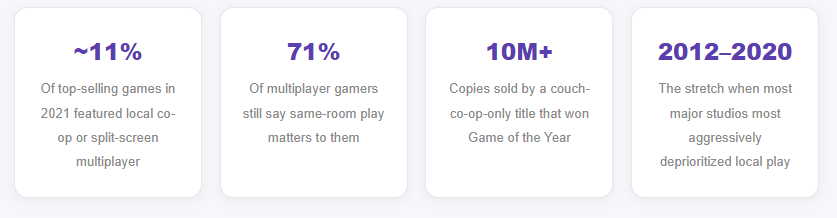
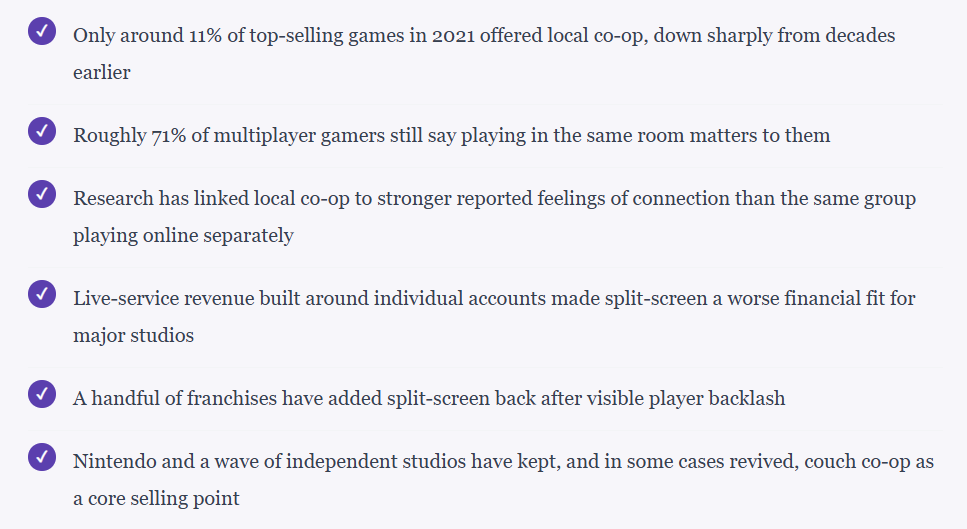
That gap, between how many people say they want it and how few current releases actually offer it, is the clearest sign this was never really about what players wanted. Research comparing shared-screen play against separate-screen online play with the same group of people has found local co-op consistently produces stronger reported feelings of connection between players, exactly the kind of social payoff that made a second controller worth digging out of the drawer in the first place.
Follow the revenue: why one screen became bad for business
Modern game economics run heavily on things a shared local session actively works against: individual accounts, persistent online progression, seasonal battle passes, and cosmetic marketplaces that generate ongoing revenue long after the initial purchase. Two friends splitting one screen usually means one console, one account logged in, and one purchase, a structure that made perfect sense when a game's entire business model was the upfront sale. It makes far less sense once the real money lives in individual player accounts buying skins, passes, and add-ons separately, month after month.
The design cost nobody advertises
There's also a genuine development expense that gets glossed over. Building a split-screen mode well means designing levels, camera systems, and AI behavior that work at half the usual screen real estate, tuning performance so two simultaneous renders don't tank frame rate, and testing an entirely separate mode that a portion of the audience may never even use. For a studio under pressure to ship a live-service game with a content roadmap stretching a year past launch, that's real engineering time being spent on a feature that doesn't generate a recurring revenue stream the way a battle pass does.
Local multiplayer often requires more complex design work and doesn't generate the same ongoing revenue as online-only systems, which is exactly the trade-off that's pushed many major studios to quietly deprioritize it.
— A pattern documented across major franchise design decisions through the 2010s and into 2026

A franchise-by-franchise pattern that's hard to miss
One of the clearest illustrations sits inside a single long-running shooter franchise. Early entries shipped with genuinely robust split-screen multiplayer as a headline feature, something friends built entire evenings around. Over successive releases, that same mode was gradually trimmed down, restricted to fewer players, fewer maps, or lower resolution, before eventually being reduced to something closer to an afterthought as the series leaned harder into expansive, subscription-adjacent online battlefields and seasonal content.
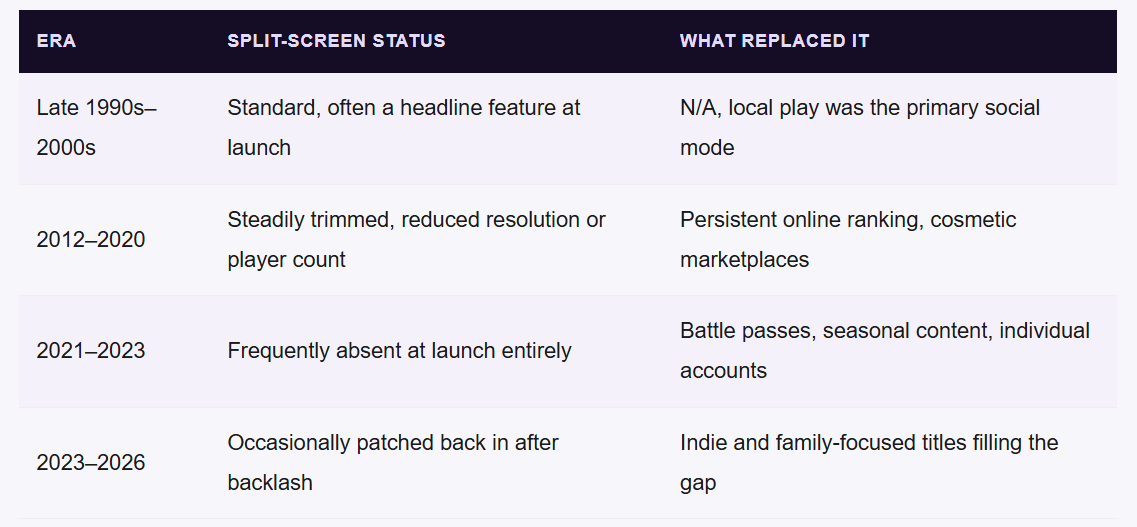
That last row is genuinely encouraging, because it points to something studios are having a harder time ignoring: when a beloved mode disappears, players notice quickly, publicly, and loudly enough that a handful of franchises have walked the decision back after launch, adding split-screen support back in as a post-release patch once the backlash made the cost of leaving it out clear.
Where couch co-op is actually thriving right now
It hasn't vanished, it's just moved. Nintendo's biggest franchises have kept local multiplayer central to their identity throughout this entire shift, and a wave of independent studios, unburdened by live-service revenue targets, have built some of the most celebrated co-op experiences of the last five years specifically around two people on one couch, no separate accounts required.
The quiet revival nobody saw coming
A specific title deserves real credit for shifting the conversation. A cooperative-only adventure built entirely around two players sharing an experience, no solo mode available at all, went on to win Game of the Year and sell more than ten million copies, proving decisively that a couch-co-op-first design could be both critically adored and commercially massive. That success, paired with a broader family-gaming boom built around go-to party and racing franchises, and a steady stream of acclaimed independent titles built specifically for shared screens, has genuinely reversed part of the decline over the past few years, even as the biggest live-service blockbusters mostly stay online-only.
None of this means the biggest studios are likely to reverse course wholesale any time soon, the revenue math that pushed them toward online-only models hasn't changed. What has changed is that players clearly haven't lost the appetite that made a second controller worth untangling from the carpet in the first place, and every time a smaller studio proves that appetite is still commercially real, it makes the argument for bringing it back a little harder for the industry to keep ignoring.