 William BensonVIEW PROFILE →
Underwater: Inside the Rainy Season That Is Drowning Abidjan
Torrential rain, collapsing hillsides, and a city that keeps rebuilding in the same dangerous places , what's really behind Ivory Coast's deadliest flood season in years.
Torrential rain, collapsing hillsides, and a city that keeps rebuilding in the same dangerous places — what's really behind Ivory Coast's deadliest flood season in years.
By the time officials stood up in front of cameras to give the latest number, the figure had already changed twice that week. In Ivory Coast's largest city, the rain doesn't just fall anymore — it decides who gets to keep their home, and sometimes, who doesn't survive the night. Abidjan is a city built on water. Lagoons wrap around it, canals cut through it, and for most of the year that geography is part of its charm — waterfront restaurants, fishing communities, a skyline that seems to float. But for a few brutal weeks every rainy season, that same relationship with water turns hostile. In 2026, it turned deadlier than it had in years.
A Night That Didn't Stop Raining
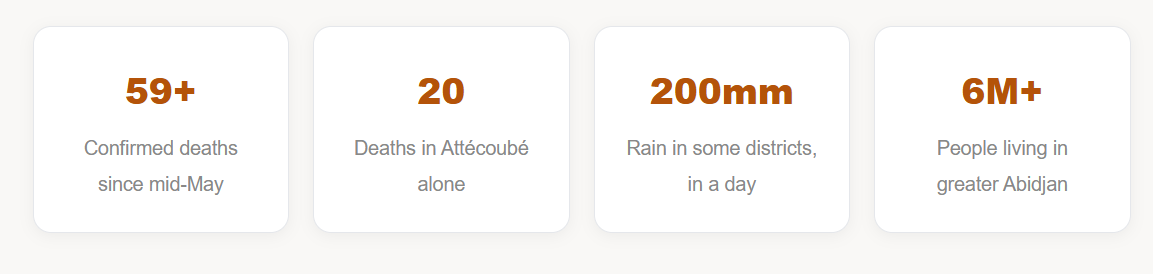
It started, as these disasters usually do, with a forecast nobody quite believed. Meteorologists had been warning for weeks that Ivory Coast's 2026 rainy season would run heavier than usual, with total rainfall for the coastal belt expected to climb toward 1,500 millimetres. Still, when the rain that fell on the night of June 27 didn't let up through the next morning, and then didn't let up the day after that, it caught a city of more than six million people somewhere between prepared and overwhelmed.
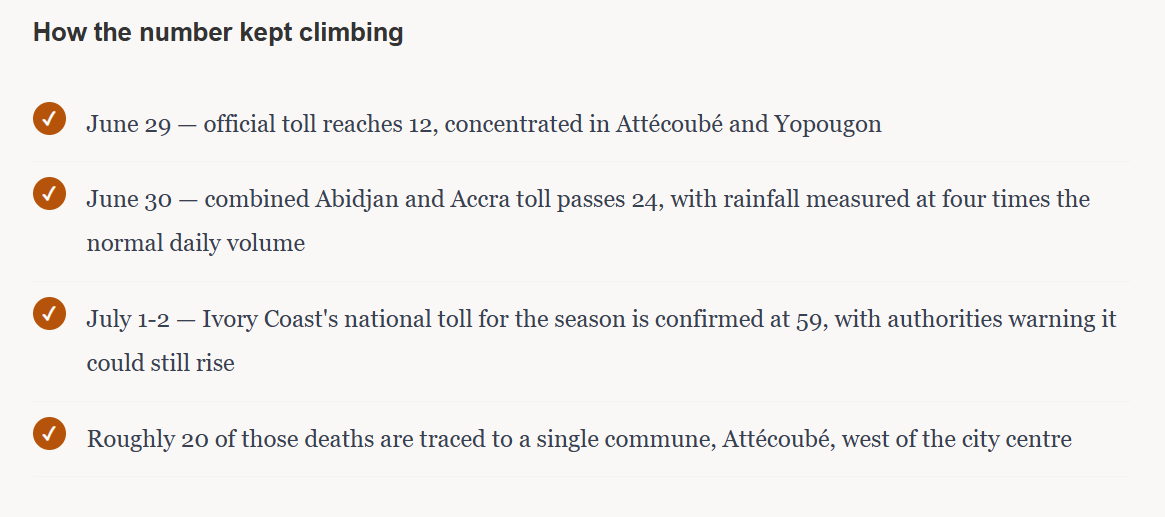
Within forty-eight hours, more than a dozen people were dead. Belmonde Dogo, the country's minister of social cohesion, confirmed the early toll in a public statement, describing a "trail of destruction" spreading across Abidjan and its surrounding communes. The hardest-hit neighbourhoods were ones long familiar to disaster reporters here: Attécoubé and Yopougon, dense, low-income districts built into the hills and valleys that ring the city's lagoon system.
Why the Same Neighbourhoods Keep Flooding
There's a detail in the government's own account of the disaster that says more than any statistic: some of the people who died in Attécoubé were living on land they had already been relocated away from once before. Ivory Coast's government spokesperson, Amadou Coulibaly, acknowledged as much directly, noting that residents had "returned to sites from which they had previously been relocated" after earlier rounds of eviction meant to clear people out of known danger zones.
It's a pattern that shows up in flood-prone cities across the world, but it's especially acute in Abidjan, where explosive, largely informal urban growth has outpaced any government's ability to enforce zoning or build real drainage infrastructure. Homes go up quickly, often without permits, frequently in the exact storm basins and low-lying channels the city's original drainage system was designed to use. When the rain comes, it has nowhere to go except through the houses sitting in its path.
Officials have carried out repeated eviction and demolition campaigns targeting Abidjan's highest-risk informal settlements in recent years. Time and again, some residents have returned — driven back by the same economic pressures, lack of affordable alternatives, and social ties that pulled them there in the first place.
A Disaster That Keeps Repeating Itself
None of this is new to Abidjan, which is part of what makes 2026's numbers so unsettling. The city's rainy season, which typically runs from April through October, brings landslides and flash floods most years — the kind of recurring emergency that barely makes international headlines unless the toll is unusually high. In 2020, a landslide in the suburb of Anyama killed thirteen people after a drainage channel gave way, sweeping away twenty houses in a single morning. Smaller but still fatal flooding events have struck the city almost every year since.
What set the 2026 season apart wasn't a single catastrophic event so much as the cumulative weight of an unusually intense rainy season arriving on top of infrastructure that hadn't meaningfully changed. Meteorological officials pointed to rainfall totals reaching four times the typical daily volume in the hardest-hit districts — more than 200 millimetres, or roughly eight inches, falling in a single day in a city whose storm drains were never built for that kind of load.
The Human Side of a Government Statistic
Behind every number in this story is a household that lost more than a roof. In neighbourhoods like Attécoubé, entire extended families often live in adjoining, hastily built homes along the same slope or drainage line — which means that when the ground gives way, it doesn't take one house, it takes a cluster of them, and often more than one generation of the same family at once. Government officials, speaking after cabinet meetings in Abidjan, have repeatedly framed the rising toll not just as a statistic to manage but as a recurring national tragedy, offering condolences to families while acknowledging that search-and-rescue operations were still ongoing days after the worst rains had passed.
Local civil protection officials have also pointed to a harder truth: much of the damage traces back to decisions made years, sometimes decades, earlier — about where roads would go, where drainage basins would be preserved, and where informal housing would simply be allowed to spread unchecked because enforcing the rules was politically or practically difficult.
Questions People Are Actually Asking
Is Abidjan's flooding connected to climate change, or is this just a normal bad rainy season? Meteorologists in the region have flagged 2026's rainy season as unusually intense, part of a broader pattern of heavier, more erratic rainfall across West Africa in recent years. Scientists are cautious about attributing any single season directly to climate change, but the trend toward more extreme rainfall events fits patterns researchers have been tracking across the region for over a decade.
Why don't people just move away from the danger zones permanently? Many have been relocated before, sometimes more than once, only to return. The pull factors are practical rather than reckless: affordable housing is scarce, resettlement sites are often far from jobs and schools, and social and family networks tend to be rooted in the neighbourhoods people already know, even when those neighbourhoods sit on unstable ground.
Is the death toll likely to be final? Not necessarily. Officials have consistently cautioned, season after season, that early tolls tend to rise as search operations continue and as isolated or hard-to-reach areas are checked. Any single figure should be read as a snapshot rather than a final count.
What Comes Next for a City Built on Water
There's no quick fix waiting in the wings. Rebuilding Abidjan's drainage infrastructure to match its actual population, let alone its projected growth, would take sustained investment over years, not a single emergency response. In the meantime, the same cycle keeps repeating: heavy rain arrives, low-lying and hillside communities take the worst of it, officials announce a toll, and by the time the water recedes, the conversation shifts to prevention right up until the next storm system rolls in.
What makes 2026 worth paying attention to isn't that it introduced a new kind of disaster to Abidjan. It's that it stripped away any remaining ambiguity about how predictable this pattern has become — right down to the specific neighbourhoods, the specific kind of housing, and even, in Attécoubé's case, the specific families who had been moved once already and came back anyway. The rain didn't do anything Abidjan hasn't seen before. It just did it harder, and it did it to a city that still hasn't closed the gap between where people live and where it's actually safe to.
A note on this reporting
Figures in this piece reflect government statements and international wire reporting on Ivory Coast's 2026 rainy season as of early July 2026. Death tolls for ongoing disasters typically shift as search operations continue, and this article notes the most recently confirmed figures available rather than treating any single number as final.