 William BensonVIEW PROFILE →
India's AI Startups Just Had Their Biggest Six Months Ever, and It's Not Slowing Down
Investors just poured four times more money into Indian AI startups than they did a year ago, and Maharashtra isn't waiting around to grab its share. Here's what's actually fueling the surge.
Investors just poured four times more money into Indian AI startups than they did a year ago, and Maharashtra isn't waiting around to grab its share. Here's what's actually fueling the surge.
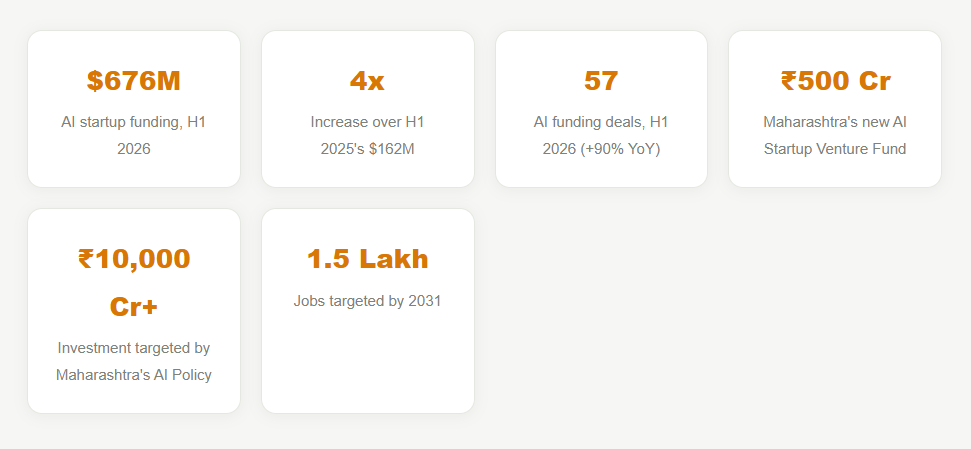
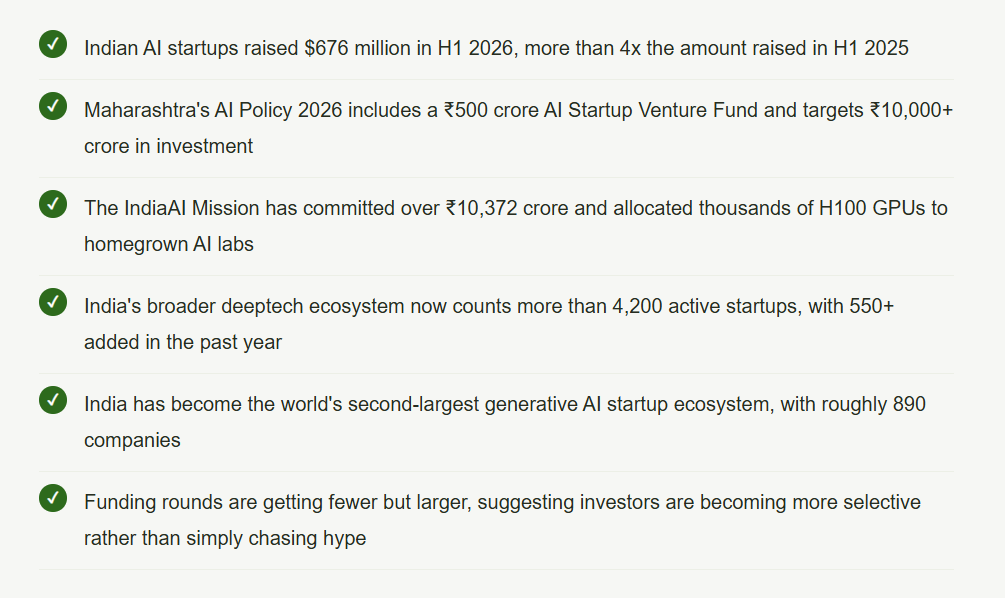
Somewhere between a government summit that pulled in Sam Altman and Sundar Pichai, a fresh state policy backed with real money, and a wave of venture capital that seemed to arrive almost overnight, India's AI startup scene quietly had the best half-year of funding it has ever recorded. If you blinked, you might have missed exactly how fast this happened, investors went from cautious to genuinely aggressive in the space of twelve months, and now Maharashtra is racing to make sure the momentum doesn't drift somewhere else. The Number That Made Everyone in India's Startup Corridors Sit Up Let's start with the figure that's been circulating in every investor WhatsApp group across Bengaluru and Mumbai this year. Indian AI startups raised $676 million in the first six months of 2026, according to Inc42's Indian Tech Startup Funding Report. That's not a modest bump, it's more than four times the $162 million raised across the same period in 2025. The number of actual funding deals climbed just as sharply, jumping 90% year-on-year to a fresh six-month high of 57 deals. For a market that spent 2023 and 2024 in a cautious, wait-and-see funding freeze, this is about as sharp a reversal as you'll find anywhere in global venture capital right now. It gets more interesting once you zoom out to the broader quarter. AI alone accounted for 38% of all Indian startup funding in the first quarter of 2026, with AI startups pulling in $1.48 billion in that quarter by some counts, a share of the funding pie that would have been unthinkable for a single technology category just two or three years earlier. India should have a distinct AI model that embodies the ethos of "Made in India, Made for the World." What's Actually Fueling This Gold Rush None of this happened by accident. Investors surveyed by Inc42 pointed directly to government policy as the driving force, with 66% of institutional investors saying the IndiaAI Mission specifically shaped their investment thinking, and 61% crediting the India Semiconductor Mission with reshaping how they think about deeptech and hardware bets. The IndiaAI Mission, approved with an outlay north of ₹10,372 crore, has become the backbone narrative for why global capital is suddenly taking Indian AI seriously as more than just an outsourcing story. The India AI Impact Summit, held in New Delhi in February 2026, turned into something close to a coming-out party for the whole ecosystem. The event reportedly generated over $200 billion in global investment commitments and drew a genuinely startling guest list for an Indian tech event, Sam Altman, Sundar Pichai, and Anthropic's Dario Amodei all showed up, lending exactly the kind of global credibility that turns cautious institutional money into confident, fast-moving checks.

Maharashtra Wants to Be India's AI Capital, and It's Putting Real Money Behind It
While the national numbers were climbing, Maharashtra decided it wasn't going to just watch from the sidelines. The state cabinet approved its AI Policy 2026, targeting more than ₹10,000 crore in fresh investment and the creation of 1.5 lakh jobs by 2031. The centerpiece for founders specifically is a dedicated AI Startup Venture Fund worth ₹500 crore, with the state government putting up ₹250 crore of that itself, money earmarked to flow directly into early-stage AI companies rather than sitting in a policy document as an aspiration.
The policy doesn't stop at the fund. It proposes 12 AI incubators spread across the state, offering grants of up to ₹1 crore to startups working their way through the earliest, riskiest stage of building a company. Beyond pure startup support, the plan includes a Maharashtra AI Mission, five dedicated AI innovation cities, six sectoral Centres of Excellence, and financial support aimed at helping 5,000 small and medium enterprises actually adopt AI tools in their existing operations, a detail that matters because it signals the state isn't just chasing flashy startup headlines, it's trying to push AI adoption into the unglamorous, high-employment parts of its economy too.
Maharashtra isn't the only state making a move
The competition for AI investment is quickly becoming a state-level race, not just a national one. Goa released its own draft AI policy in May 2026 and opened it for public feedback, a sign that other state governments are watching Maharashtra's playbook closely and don't want to be left without a seat at the table once serious AI capital starts deciding where in India to actually set up shop.
The Deeptech Boom Hiding Inside the AI Boom
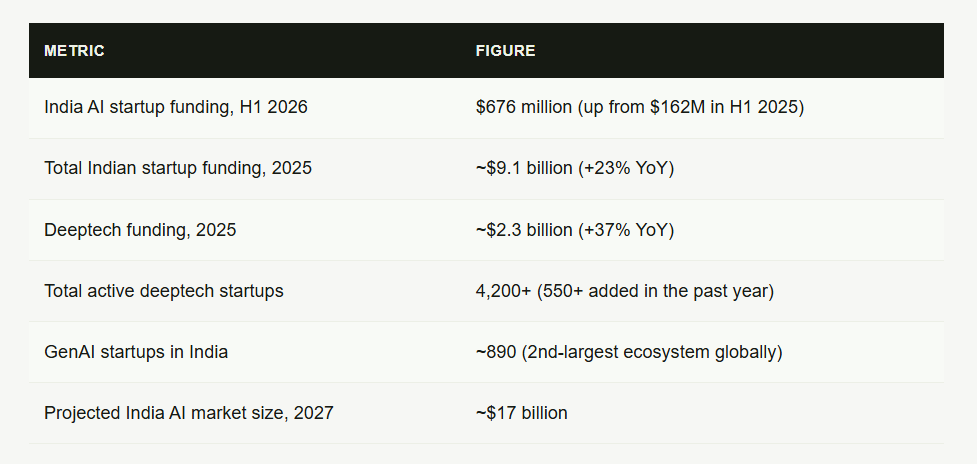
AI startups are getting most of the headlines, but they're really just the most visible part of a much broader deeptech surge running underneath the numbers. India's deeptech ecosystem pulled in a reported $931 million funding surge, spanning not just AI but semiconductors, robotics, and industrial systems, categories that used to be considered niche, research-heavy, and slow to attract venture money. India's startup ecosystem overall raised close to $9.1 billion in 2025, up 23% year-on-year, with deeptech specifically accounting for roughly $2.3 billion of that total, itself up around 37%.
The sheer scale of company formation backs up the funding numbers. India is now home to more than 4,200 deeptech startups, with over 550 new companies added in just the past year. On the generative AI side specifically, India has quietly become the world's second-largest GenAI startup ecosystem, with close to 890 companies building everything from enterprise tools and developer platforms to healthcare applications and industrial software.
The Compute Problem Nobody's Fully Solved Yet
Money alone doesn't build frontier AI, you also need serious computing horsepower, and this is where the government has tried to step in directly rather than leaving it entirely to the market. The IndiaAI Mission selected four homegrown startups, Sarvam AI, Gnani.ai, SoketAI, and Gan.ai, to receive government-backed compute support for building foundational models. Sarvam AI alone was allocated 4,096 Nvidia H100 GPUs, a genuinely significant chunk of high-end compute for a country that has historically had to import essentially all of its advanced AI chip capacity.
Beyond that direct GPU allocation, the government has layered in additional financial firepower: a ₹1,100 crore state-backed venture fund aimed specifically at AI and advanced manufacturing, a ₹1 lakh crore Research, Development and Innovation Fund designed to strengthen broader innovation capacity, and a $1 billion India Deep Tech Alliance announced at Semicon India 2025 to help coordinate institutional funding across the sector. Union IT Minister Ashwini Vaishnaw has pointed out that 80% of India's startups today are considered AI-led in some form, and that the Design Linked Incentive scheme under the India Semiconductor Mission has already supported 23 hardware startups.

The Honest Question: Is Any of This Actually Enough to Compete Globally?
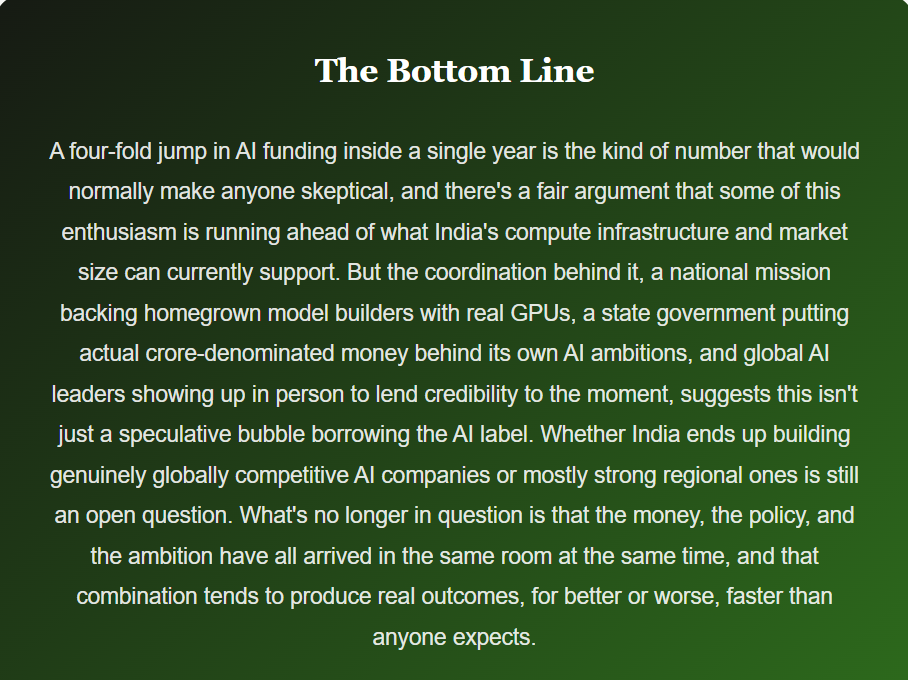
Here's where the enthusiasm needs a reality check, and to its credit, even the industry's own trade press has been asking this question directly. Analysts estimate India's AI market could reach nearly $17 billion by 2027, a genuinely impressive number in isolation, but one that still looks modest next to the scale of capital being deployed by AI leaders in the US and China, where single funding rounds for frontier AI labs can exceed India's entire projected AI market. A four-fold jump in funding is a real inflection point, but it's an inflection point from a relatively small base.
There's also a subtler shift happening in how Indian investors are actually deploying capital. Data from Tracxn shows Indian startups raised $2.57 billion between January 1 and February 17, 2026, only a modest 5% increase over the same window in 2025, while the number of actual funding rounds dropped sharply, from more than 480 down to 240. That combination, flat-to-modest total capital but far fewer, larger deals, points to investors becoming more selective rather than simply throwing money at anything with "AI" in the pitch deck, a genuinely healthier pattern than the frothy, spray-and-pray funding environment of 2021, even if it means many smaller or earlier-stage founders are finding it harder to raise at all.
What this actually means if you're watching from outside India
For global investors and tech watchers, the real signal isn't any single funding number, it's the coordination between government policy, state-level competition, and private capital all pointing in the same direction at the same time. That kind of alignment doesn't guarantee India produces the next globally dominant AI lab, the compute gap and market-size gap with the US and China are real and won't close overnight. But it does mean the country has moved past the experimental phase and into a period where serious, sustained capital is chasing a clearly articulated national strategy, and Maharashtra's willingness to back that strategy with its own state budget suggests the regional competition for AI talent and company formation inside India is only going to get more intense from here.