William BensonVIEW PROFILE →
The US Just Locked Down a Piece of the World's Biggest Oil Reserve. Don't Expect Cheap Gas Overnight, Though
Washington just locked in a 25-year claim on one of the biggest oil reserves on Earth. Here's what's real, what's hype, and what it means at the pump.
Washington just locked in a 25-year claim on one of the biggest oil reserves on Earth. Here's what's real, what's hype, and what it means at the pump.
Every driver in America has felt it — that gut-check moment pulling up to the pump, watching the numbers climb past what you remember paying just a couple years back. So when the White House announced it had struck a deal giving US interests majority control over more than 65 billion barrels of Venezuelan crude, it's no surprise the headlines landed hard. The pitch sounds almost too good: more oil, lower prices, a struggling South American economy getting a lifeline. The reality, once you dig past the press release, is a lot messier and a lot slower than that. How We Actually Got Here To understand this deal, you have to rewind to January 3, 2026, when US forces carried out a military operation in Caracas — codenamed Operation Absolute Resolve — that ended with Venezuelan strongman Nicolás Maduro and his wife, Cilia Flores, captured and flown to New York to face narco-terrorism and drug trafficking charges. More than 150 aircraft were involved in the operation, and Venezuelan officials later said over 100 people were killed in the raid, including Cuban military personnel who Havana said had been assisting Maduro's government. Two days later, Venezuela's vice president, Delcy Rodríguez, was sworn in as interim president in front of the National Assembly. That single event reshuffled the entire geopolitical chessboard around Venezuelan oil. For years, US sanctions had choked off much of the country's crude exports, leaving Venezuela — a nation sitting on the largest proven oil reserves on the planet — pumping a fraction of what it's capable of. With Maduro gone and an interim government eager to rebuild relations with Washington, the door opened for exactly the kind of sweeping energy agreement that got announced this past week.

What's Actually Written Into the Agreement
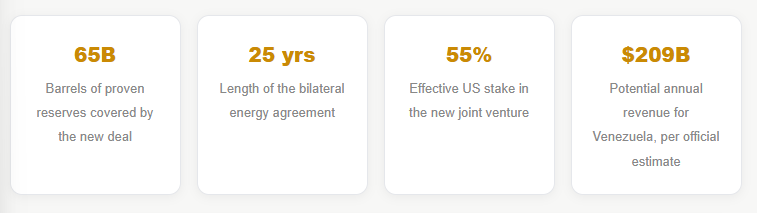
Details of the deal were still being filled in as of this weekend, but the broad strokes are clear. President Trump announced Friday that the US had secured an effective 55 percent share of output from a newly formed private joint venture, negotiated jointly by the State Department and the Pentagon. Interim President Rodríguez granted that venture concessions covering oil fields with proven reserves, running for what officials described as up to 100 years on some individual field leases, nested inside the broader 25-year bilateral framework.
On the ground, the plan centers on developing 17 strategic oilfields with an initial production target of 1.5 million barrels per day, alongside eight additional greenfield oil blocks as part of a wider expansion of the country's energy sector. Chevron, which already maintained a limited presence in Venezuela even through the sanctions years, is reportedly among the companies finalizing talks to fold its existing joint ventures into this new framework. Secretary of State Marco Rubio, who helped negotiate the deal alongside Defense Secretary Pete Hegseth, called it a win for both sides, saying it would bring close to $100 billion in private investment and support thousands of well-paying jobs as part of the broader reconstruction of Venezuela's economy.
Under the arrangement, roughly $19 from every barrel of oil produced and sold flows directly back to the Venezuelan government — a structure officials say could be worth up to $209 billion a year to Caracas, depending on how oil prices move.
Why Washington Is Framing This as a Win for Your Wallet
The timing here isn't an accident. Gas prices have been a persistent political headache heading into the November midterms, and the administration has been eager to point to any development that might ease pressure at the pump. Trump himself described the arrangement as coming "at no cost to the American taxpayer" and predicted it would more than double US oil reserve access while substantially lowering gasoline prices for drivers.
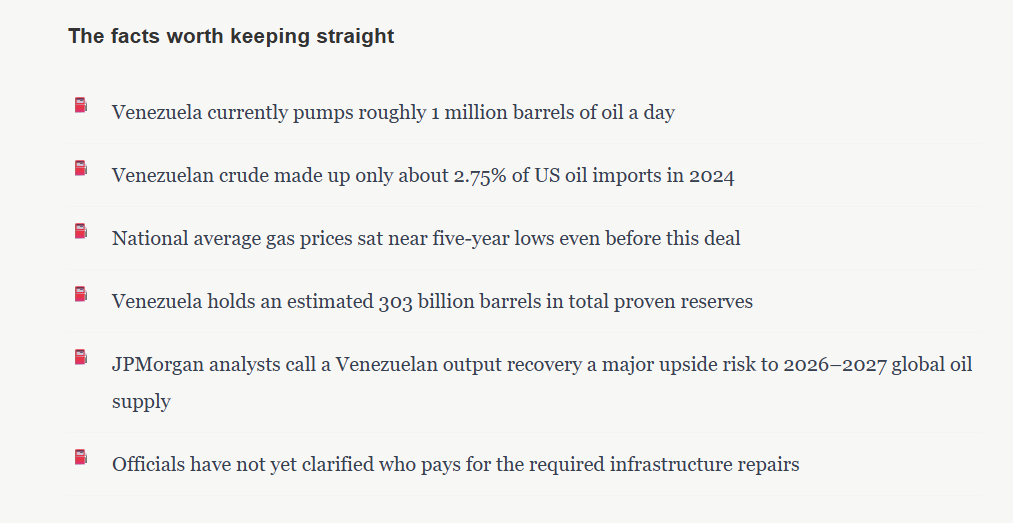
There's a real, if narrow, logic behind that argument. Venezuela currently produces just over a million barrels of oil per day, a steep drop from the 1 to 1.8 million barrels a day it was shipping to the US alone back in the late 1990s and early 2000s. Even a partial recovery toward those historic output levels would meaningfully add to global crude supply, and basic economics says more supply generally puts downward pressure on prices. Some officials involved have also pointed out that a portion of the at-cost oil produced under the deal is earmarked to help refill the US Strategic Petroleum Reserve, which would give Washington additional flexibility during future supply shocks.
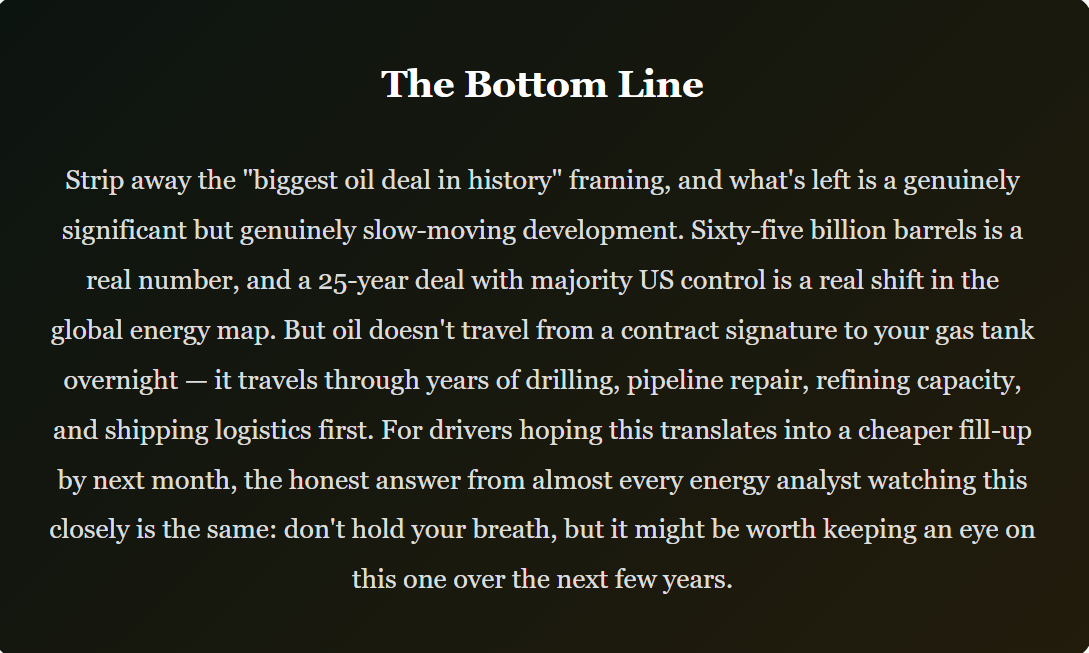
Why Most Energy Analysts Are Telling Drivers Not to Get Excited Yet Here's where the optimistic framing runs into some hard math. Patrick De Haan, head of petroleum analysis at GasBuddy, has been consistently blunt about the timeline, pointing out that Venezuela's oil infrastructure has been so degraded by years of underinvestment and sanctions that meaningfully raising output would take years and billions of dollars in repairs, not months. He's also flagged that US refining capacity is already fairly constrained, which limits how much even a genuine increase in crude supply would actually translate into cheaper gasoline at the pump, since crude has to be refined, transported, and distributed before it ever reaches a nozzle. Amy Myers Jaffe, who directs the Energy, Climate Justice and Sustainability Lab at NYU, put it in blunter terms still, noting the deal could be genuinely useful over the long run but wouldn't move the needle on pump prices anytime soon — certainly not by the kind of near-term windows political messaging often implies. Energy consultant Alessandro Galimberti echoed that timeline concern, explaining that the realistic gap between initial investment and actual barrels reaching the market typically spans several quarters at minimum, and in plenty of cases stretches into years. If the goal is genuinely cheaper gas in the short term, he argues, boosting flows from the Middle East would be a far faster lever to pull than rebuilding Venezuela's oil sector from a standing start.
The Sovereignty Question Nobody's Fully Answered
Not everyone is convinced this deal is the clean win the administration is describing. Ricardo Hausmann, a Harvard economist and former Venezuelan planning minister now living in exile, publicly challenged the legitimacy of the interim government's authority to strike an agreement of this scale, arguing it was negotiated under what he called an illegitimate hydrocarbons framework and predicting the arrangement would end up "a fiasco for all involved." His core objection cuts to a genuinely unresolved legal question: can a government installed in the aftermath of a foreign military operation legitimately sign away control of a sovereign nation's natural resources for a quarter-century or longer?
Interim President Rodríguez has pushed back hard against that framing. In her own televised address, she insisted the deal preserves Venezuela's "ownership of and sovereignty" over its natural resources, describing it as a partnership that leverages foreign capital, technology, and operational expertise to revive an industry battered by years of sanctions, rather than a straightforward handover of national assets. Whether that framing holds up under international legal scrutiny remains an open and contested question — one that's likely to follow this deal for years, regardless of how the oil production numbers eventually shake out.
What This Actually Means for Venezuela's Own Economy
It's worth remembering that this deal isn't happening in a vacuum for ordinary Venezuelans. The country has spent years mired in economic crisis, and this past June it was hit by two powerful back-to-back earthquakes that left more than 6,000 people dead, adding a fresh humanitarian dimension to an already fragile situation. For a government trying to rebuild basic state capacity while managing that kind of disaster recovery, the promised inflow of investment and oil revenue represents a genuinely significant fiscal lifeline, separate from whatever benefit eventually reaches American drivers.
Whether that revenue actually reaches ordinary Venezuelans in the form of better public services, infrastructure, or economic stability, rather than simply propping up whichever political faction controls the interim government, is a separate and much harder question to answer this early. Agreements of this scale tend to be judged less by their signing ceremony and more by how the money actually flows once the ink dries — and on that front, both supporters and skeptics agree it's simply too soon to say.
A Few Straightforward Questions
Will gas prices actually drop because of this deal? Not immediately, according to most independent energy analysts. Any meaningful supply increase would take years of infrastructure investment, and gasoline prices generally lag behind crude price movements even once supply does increase.
Is this deal final and legally settled? Not entirely. Venezuelan officials say they're finalizing agreements with individual companies including Chevron in the coming week, and legal questions about the interim government's authority to grant century-long resource concessions remain unresolved and contested by critics like Ricardo Hausmann.
How much Venezuelan oil does the US currently import? Relatively little by historical standards — Venezuelan crude made up only about 2.75 percent of total US oil imports in 2024, a steep decline from the roughly 8 percent share it held before 2019 sanctions took effect.
Why is gas already near a five-year low if this deal just happened? Gas prices had already been falling for months before this announcement, driven by lower global oil prices and strong existing US crude production — a trend separate from, and preceding, the Venezuela agreement itself.
Worth keeping in mind
This is a fast-developing story, and specific terms of the deal, company agreements, and production timelines were still being finalized as of this weekend. Treat the figures here as reflecting the most recent public statements from US and Venezuelan officials, and check current reporting from outlets like Reuters, the AP, or the Department of Energy for the latest developments as they emerge.