 William BensonVIEW PROFILE →
Trump Just Declared a National Emergency Over America's Power Grid. Here's What That Actually Means for You.
Foreign-made equipment, AI data centers draining the grid, and a new executive order giving Washington power it hasn't used quite like this before.
Foreign-made equipment, AI data centers draining the grid, and a new executive order giving Washington power it hasn't used quite like this before.
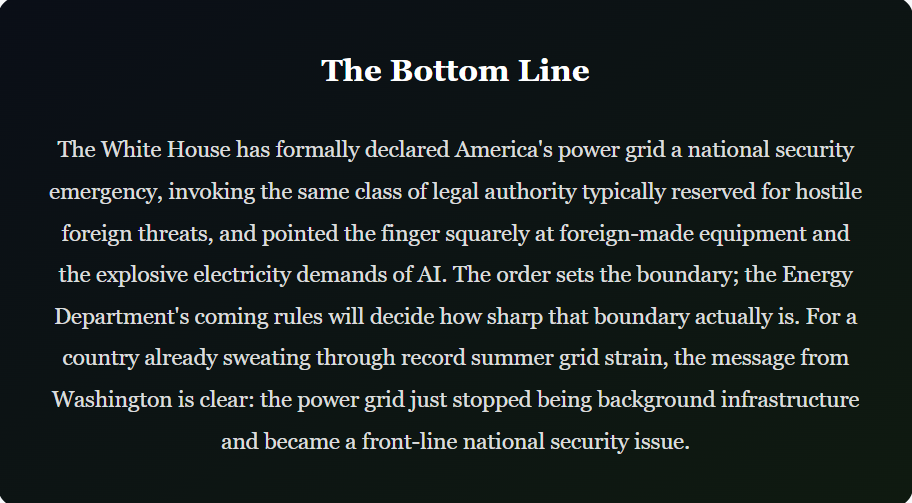
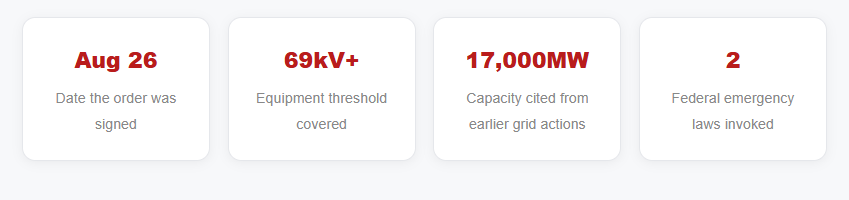
Means for You. Right in the middle of one of the hottest summers on record, with Texas and California already sweating through rolling grid strain warnings, the White House made a move that had been building for months: it declared a national emergency over the very infrastructure keeping America's lights on, its hospitals running, and its AI boom powered up. This isn't a symbolic gesture. Executive Order 14420, signed on August 26, 2026, invokes some of the same emergency legal powers the federal government has used to freeze the assets of hostile foreign regimes. Except this time, the target isn't a bank account. It's the transformers, relays, and control systems that make the American power grid actually run.
What the Order Actually Says
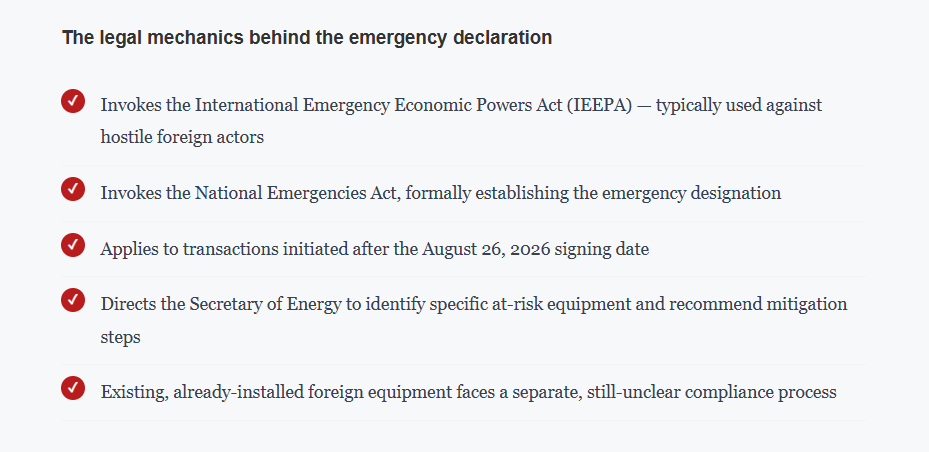
Strip away the political framing and the core of Executive Order 14420 is fairly specific. It declares what the administration calls an "unusual and extraordinary foreign threat" to the U.S. bulk-power system, the network of high-voltage lines, substations, and generation equipment that moves electricity across state lines and keeps the broader grid stable. The order generally prohibits certain foreign-produced bulk-power equipment, along with its associated software, firmware, and digital control capabilities, from being purchased or installed anywhere in the country going forward.
The equipment covered isn't vague, either. Officials specified critical infrastructure components rated at 69 kilovolts or higher, including substation transformers, reactors, capacitors, grid-connected inverters, battery energy storage systems, generators of all sizes, industrial control systems, and protective relays, essentially, the nervous system of the American electric grid.
Why Now? The AI Data Center Factor
The timing here isn't accidental, and the administration hasn't pretended otherwise. The order's own text points directly at what's changed: "the rapid growth of advanced manufacturing, data centers, artificial intelligence, and defense production has increased the nation's dependence on abundant, reliable electricity and magnified the consequences of a successful attack or supply disruption on the bulk-power system."
That's a real, measurable shift, not just political language. AI data centers draw enormous, constant loads of electricity, far beyond what a typical office building or factory needs, and they've been popping up across the country at a pace that's forced utilities to rethink capacity planning years ahead of previous projections. Layer that onto a grid already straining through extreme summer heat in states like Texas and California, and you get an infrastructure system with less margin for error than it's had in decades, precisely the kind of environment where a successful cyberattack or equipment failure could cause outsized damage.
The FBI's Cyber Division has been explicit about part of the threat picture: Iranian cyber actors, according to Assistant Director Brett Leatherman, "continue to target U.S. critical infrastructure," with the bureau describing its mission as identifying, disrupting, and imposing costs on those responsible.
This Didn't Come Out of Nowhere Anyone tracking this administration's approach to infrastructure and supply chains will recognize the pattern. This is at least the fourth major executive action in roughly sixteen months aimed at some layer of America's critical infrastructure and its foreign dependencies. In April 2025, an earlier grid-focused order gave the Energy Secretary emergency authority to keep aging power plants online rather than let them retire, an action the administration credits with preventing roughly 17,000 megawatts of generating capacity, enough to power an estimated 12.75 million homes, from going offline. From there, the administration kept building. In June 2026, it signed an order aimed at advancing American AI innovation while strengthening cybersecurity protections for critical infrastructure. In July 2026, it targeted the supply chains behind advanced defense manufacturing. In August, just weeks before the grid order, it issued a separate proclamation addressing drone imports and components. Taken together, officials describe the new grid order as the "enforcement teeth" that earlier, more general guidance was missing, moving from broad policy language into actual transaction-blocking authority. What Happens Next The order itself sets the boundary. The details that will actually determine cost, compliance timelines, and enforcement scope haven't been written yet. That job falls to the Department of Energy, which the order directs to identify specific categories of at-risk equipment, in consultation with other cabinet agencies, and develop implementing regulations. Industry analysts tracking the order expect those rules before the end of 2026, and utilities, grid operators, and equipment manufacturers are widely expected to spend the intervening months lobbying over exactly how strict, and how fast, that rollout ends up being. For everyday households, the honest answer is that the near-term impact is more about supply chains than your electric bill arriving different next month. Utilities that rely on certain foreign-manufactured grid components may need to shift suppliers, a process that historically takes time and can add cost, cost that, in some cases, eventually flows through to ratepayers. The bigger, slower-moving story is a U.S. push toward domestically manufactured energy infrastructure, a shift the order explicitly encourages alongside its restrictions. Questions People Are Actually Asking Does this mean my power could get shut off or rationed? No, the order itself doesn't ration electricity or shut anything down. It restricts future purchases and installations of certain foreign-made grid equipment going forward; it doesn't touch how power gets distributed to homes today. Will this actually raise my electric bill? Possibly, but not immediately, and not directly from the order itself. If utilities have to source pricier alternatives to previously used foreign equipment, or accelerate domestic manufacturing that isn't yet at full scale, some of that cost could eventually show up in electricity rates. That's a multi-year process, not something ratepayers would see reflected this billing cycle. Is this only about equipment already installed, or future purchases too? The order specifically applies to transactions initiated after the August 26, 2026 signing date. Equipment already installed in the grid falls under a separate compliance framework that officials have described as still unclear, with more detail expected once the Energy Department publishes its implementing rules. The Bigger Picture Here It's tempting to read this as one more executive order in a fast-moving news cycle and move on. But the underlying tension it's responding to isn't going away anytime soon. America's electricity demand is climbing at a pace utilities haven't had to plan for in generations, driven by AI infrastructure that didn't meaningfully exist in its current form a few years ago, layered onto a grid that summer after summer keeps getting pushed closer to its limits by extreme heat. Meanwhile, the equipment running that grid has, for years, included components sourced from countries the U.S. government now explicitly names as security risks. Whether this specific order meaningfully closes that gap depends almost entirely on the rules the Energy Department writes next, and how quickly utilities can actually shift their supply chains without compromising the reliability the order is supposedly trying to protect. What's not in question is the direction: energy security has officially moved from a background policy concern to a declared national emergency, and that status doesn't get walked back quietly. A note on this reporting Details in this piece reflect the official text of Executive Order 14420, the White House's accompanying fact sheet, and reporting from Daily Energy Insider, HSToday, The Epoch Times, and Yahoo News current as of late August 2026. Implementing regulations from the Department of Energy had not yet been published as of this writing.