 William BensonVIEW PROFILE →
No More Bottomless Pharmacy Bills: What America's New Prescription Drug Caps Actually Mean for Your Wallet
For years, a bad diagnosis could mean an unlimited pharmacy bill. That's not true anymore, and here's exactly what changed.
For years, a bad diagnosis could mean an unlimited pharmacy bill. That's not true anymore, and here's exactly what changed.
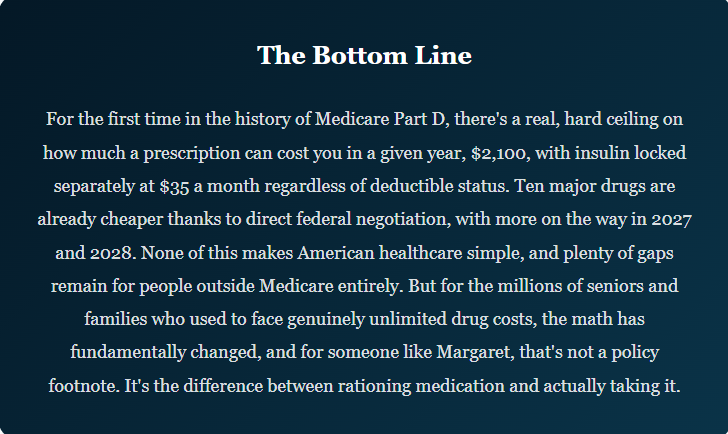
Picture Margaret, a 72-year-old retired teacher from Ohio. Last year, between her insulin, a blood thinner, and a specialty drug for rheumatoid arthritis, she spent more than $6,400 out of pocket just on prescriptions, some months forced to choose between filling a refill and covering another bill. That kind of story used to be depressingly common in American healthcare. It's a big part of why the new hard cap on Medicare drug costs, one of the most significant changes to prescription coverage in two decades, is landing as genuine, real relief for millions of people just like her. The Headline Number: $2,100 a Year, Full Stop Here's the change that matters most, in plain terms. As of 2026, Medicare Part D enrollees face a hard annual cap of $2,100 on out-of-pocket prescription drug costs, up slightly from $2,000 in 2025, the year this protection first took effect. Once you hit that number, you pay nothing more for covered Part D medications for the rest of the calendar year, no matter how expensive your prescriptions get after that point. To understand why this is such a big deal, it helps to remember what things looked like before. Prior to this reform, there was no ceiling at all on Part D out-of-pocket spending. Beneficiaries dealing with expensive chronic conditions, cancer treatments, autoimmune disorders, certain heart medications, could easily rack up $10,000 to $15,000 a year in drug costs with no limit in sight. The cap didn't just lower costs at the margins. It replaced an open-ended financial risk with a number people can actually plan around.
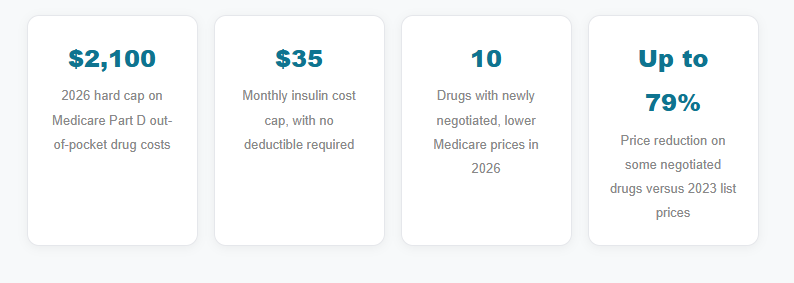
The Insulin Cap: The Reform That Started It All Long before the broader $2,100 cap existed, insulin had its own dedicated fix, and it remains one of the clearest, most tangible wins to come out of this whole reform push. Since January 2023, Medicare has capped insulin costs at $35 for a month's supply, with absolutely no deductible required, meaning you pay that $35 or less starting with your very first prescription of the year, regardless of which brand or plan you're on. That cap stayed fully intact heading into 2026, and it now applies whether your insulin comes through Part D or, for insulin used in a pump, through Part B. The real-world impact showed up almost immediately. In the first four months after the insulin cap took effect, Part D enrollees between ages 65 and 74 filled nearly 4,000 more prescriptions per month compared to the months right before the cap, a clear signal that people had genuinely been rationing or skipping doses when the cost was higher. For some negotiated insulins specifically, like NovoLog, the math works out even better: enrollees now pay whichever is lower, $35 or 25 percent of the newly negotiated price, which can bring the actual cost down closer to $30. The Ten Drugs Now Cheaper Thanks to Direct Negotiation Alongside the out-of-pocket cap, 2026 marks the first year Americans are actually feeling the effects of Medicare directly negotiating prices with drug manufacturers, a power created by the Inflation Reduction Act. Ten widely used, high-cost drugs now carry lower, federally negotiated Maximum Fair Prices: Eliquis, Jardiance, Xarelto, Januvia, Farxiga, Entresto, Enbrel, Imbruvica, Stelara, and the insulin products Fiasp and NovoLog. Discounts on these medications range from roughly 38 percent to as much as 79 percent off their 2023 list prices, depending on the specific drug. You don't have to do anything to receive this benefit if you're enrolled in Medicare Part D, it's built directly into how your plan prices these medications now. Millions of Part D beneficiaries are expected to save more than $1 billion combined on medications this year because of it. And the negotiation process isn't a one-time event: a second round covering 15 additional drugs is set to take effect in 2027, projected to save Part D enrollees another $8.5 billion to $12 billion annually, with a third round covering up to 15 more drugs following in 2028.
The Monthly Payment Option Nobody Talks About Enough
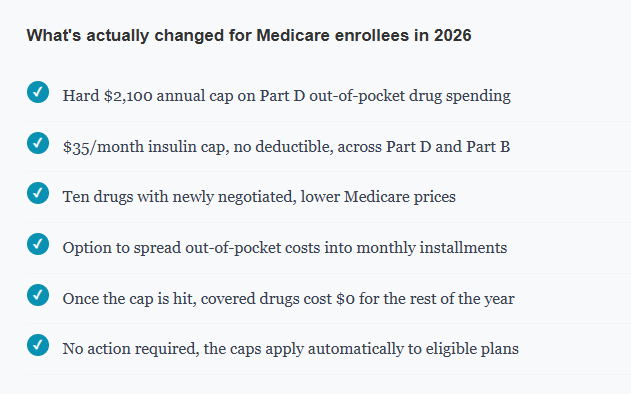
One quieter feature of this reform deserves more attention than it usually gets. The redesigned Part D program now includes the Medicare Prescription Payment Plan, a voluntary option that lets beneficiaries with high drug costs spread their deductible and copay expenses into predictable monthly installments throughout the year, rather than facing one massive bill at the pharmacy counter in January or February. For someone managing a specialty drug that needs to be filled early in the year, this alone can be the difference between an affordable plan and a genuinely frightening bill.
Advocates who work directly with Medicare beneficiaries describe the shift in blunt terms: this brought Part D in line with the kind of annual out-of-pocket protection Medicare Advantage plans and most private insurance have offered for years, closing a gap that had left traditional Medicare enrollees uniquely exposed to catastrophic drug costs.
Who Actually Benefits Most From These Changes
The people feeling this most directly are Medicare beneficiaries managing multiple chronic conditions at once, exactly the population these reforms were built around. Someone juggling a blood thinner, a diabetes medication, and a specialty drug for an autoimmune condition, the kind of combination that used to produce those $10,000-plus annual drug bills, is precisely who the $2,100 cap protects most. Lower-income beneficiaries who previously had to make genuinely painful choices between medications and other essentials are seeing some of the most meaningful relief.
It's worth being clear about the boundaries here too. This cap applies specifically to out-of-pocket costs for covered Part D drugs, not to your monthly Part D premium, which is a separate expense that isn't included in the $2,100 figure. And these protections are specific to Medicare, commercial and employer-sponsored health plans don't have an equivalent federal cap, though more than 30 states have enacted their own insulin price limits for state-regulated plans, extending similar protection to a meaningful share of non-Medicare patients as well.
A Few Honest Questions People Are Actually Asking
Do I need to sign up for something to get the $2,100 cap? No. If you're enrolled in a Medicare Part D plan, the cap applies automatically. You don't need to file paperwork or opt in for the annual limit itself to take effect.
Does the insulin cap cover every type of insulin, including the brand I use? Yes, the $35 monthly cap applies to all covered insulin products under Part D and Part B, regardless of brand, though your plan's specific formulary tier can affect other details, so checking your Annual Notice of Change is still worth doing.
What if I'm not on Medicare, does any of this help me? Not directly through federal law, since these specific caps apply to Medicare Part D. If you're on a commercial plan, check whether your state is among the 30-plus that have passed their own insulin cost caps, since state-level protections vary significantly.
What's Still Ahead
This isn't a one-and-done reform that's finished evolving. The $2,100 cap itself is indexed to inflation and national drug spending trends, meaning it will likely tick up slightly again for 2027 and beyond, the same way it moved from $2,000 to $2,100 this year. The next round of Medicare drug price negotiations, covering 15 more medications, takes effect in 2027, with a further expansion to up to 20 drugs possible by 2029. If future negotiations expand to cover additional insulin products or other high-cost drug categories, those changes would typically be announced through the Federal Register well ahead of taking effect, giving beneficiaries time to understand how their own prescriptions might be affected.
For families like Margaret's, the practical shift is less about any single number and more about a fundamental change in how much financial uncertainty a serious diagnosis now carries. A $2,100 ceiling, however imperfect, is something you can actually plan a budget around. An unlimited bill never was.
A note on this reporting
Figures and program details in this piece reflect Medicare Part D rules and CMS guidance as of August 2026, drawn from AARP, the Medicare Rights Center, and CMS itself. Individual plan details, including formulary tiers and specific copays, vary, so reviewing your plan's Annual Notice of Change or contacting Medicare directly is the best way to confirm how these caps apply to your specific coverage.