 William BensonVIEW PROFILE →
America Finally Caught Soccer Fever, and One Guy From Argentina Is Basically the Whole Reason Why
America wasn't supposed to care this much about soccer. Nobody told Lionel Messi and the 75,000 fans packing NFL stadiums to watch him play.
America wasn't supposed to care this much about soccer. Nobody told Lionel Messi and the 75,000 fans packing NFL stadiums to watch him play.
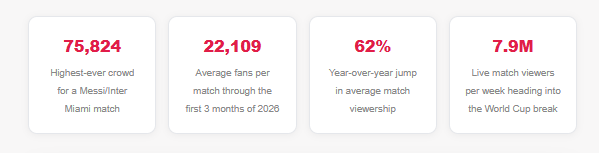
Ask anyone who grew up watching American sports and they'll tell you the same old line: soccer just doesn't sell here. Football, basketball, baseball — sure. Soccer was always the sport America was supposedly going to "discover" any decade now, and never quite did. Well, somebody forgot to tell the 75,824 people who packed a Denver Broncos stadium on a random Saturday this spring just to watch a 38-year-old Argentine guy play 90 minutes of soccer. That's not a fluke. That's the new normal in Major League Soccer, and it's not slowing down anytime soon. The Numbers Don't Lie: MLS Is Having an Actual Moment Let's get straight to the receipts, because the stats here are honestly kind of wild for a league that spent decades scrapping for relevance against the NFL, NBA, and MLB. MLS is averaging 22,109 fans per match through the first three months of the 2026 season, the league's second-best mark ever through that point in a year, with more than 4.8 million total fans coming through the turnstiles in that same stretch. On the broadcast side, things look even crazier — matches have averaged 62 percent more viewers compared to last year, with the league pulling in roughly 7.9 million live match viewers per week heading into its World Cup break, once you count international distribution and linear TV partners on top of streaming. And here's the thing — this growth isn't some one-off spike tied to a single viral moment. It's showing up across basically every metric the league tracks. MLS and its club social media accounts now reach almost 113 million followers worldwide, up 14 percent year over year, and generated 5.71 billion social impressions through May alone, the highest number the league has posted since 2021.

Every Time Messi Shows Up, Another Record Falls
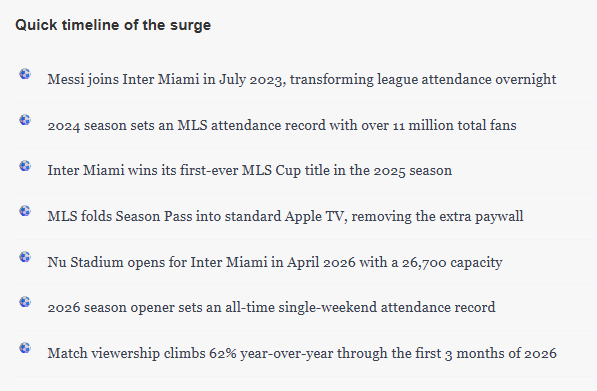
Here's what makes this whole thing even wilder: Inter Miami doesn't even play most of its biggest games at home. The team's actual home venue, Nu Stadium, which opened back in April 2026, holds just 26,700 fans — a pretty normal soccer-specific stadium capacity. But whenever Messi and the Herons hit the road, opposing clubs have started making a habit of relocating games out of their usual soccer stadiums and into massive NFL venues just to cash in on the demand.
The 2026 season opener alone tells the story. LAFC moved their home opener against Inter Miami out of their regular BMO Stadium and into the LA Memorial Coliseum, pulling a sellout crowd of 75,673 — at the time, the largest crowd ever for an MLS season opener, and part of a combined 387,271 fans across all 15 Matchday 1 games, the biggest single-weekend attendance total in league history. A couple weeks later, D.C. United hosted Inter Miami at M&T Bank Stadium, home of the Baltimore Ravens, and drew 72,026 fans — a crowd that actually broke a stadium attendance record that had stood since a 2012 Ravens playoff game. Then in April, the Colorado Rapids topped even that, pulling 75,824 fans to Empower Field at Mile High for a match where Messi scored a brace and set up another goal, making it the second-highest attendance in MLS history, trailing only a 2023 LA Galaxy–LAFC clash at the Rose Bowl.
Inter Miami has drawn the two highest-attended sporting events in the United States so far in 2026 — beating out Super Bowl 60 between the Seahawks and Patriots, which topped out around 70,823 fans on gameday.
This Isn't Just a Miami Story Anymore
It'd be easy to write this whole thing off as "well, of course, it's Messi, the greatest player who's ever lived, obviously people show up for that." And sure, that's a huge part of it. But the league has been smart about riding that wave rather than just standing next to it. Son Heung-min, one of the most recognizable players in world soccer, joined LAFC in the summer of 2025, and the league made sure to schedule his first meeting against Messi as the marquee opening weekend fixture. Thomas Müller, a World Cup winner with Germany, landed at Vancouver Whitecaps. James Rodríguez, another global name, is playing in Minnesota. The 2026 season roster reads less like a mid-tier domestic league and more like a legitimate showcase of international talent that, a decade ago, nobody would've expected to end up playing regular-season games in Colorado and Minnesota.

The Streaming Deal That Quietly Changed Everything
Here's a piece of the puzzle that doesn't get talked about enough: how you actually watch MLS games completely changed this year, and it mattered a ton. For the first few seasons of the league's partnership with Apple, fans had to pay for a separate MLS Season Pass subscription on top of whatever else they were already paying for — a real barrier for casual fans who might've tuned in out of curiosity but weren't ready to commit to another monthly bill. That changed in 2026, when MLS folded all of its games directly into the standard Apple TV service, meaning anyone with a regular Apple TV subscription can now watch every match without paying extra.
MLS executive Seth Bacon pointed to that shift as a genuinely huge driver of the viewership numbers this year, on top of growth the league was already seeing across every other platform. It's a pretty simple idea once you think about it: when you remove the extra paywall, you naturally pick up viewers who were curious but never quite motivated enough to pay separately just to check it out — and once they're in, a chunk of them stick around.
The World Cup Effect Nobody Should Sleep On
There's another piece of context that's impossible to ignore here: the United States is co-hosting the 2026 FIFA World Cup alongside Canada and Mexico this summer, and that's casting a long shadow over everything happening in MLS right now. A home World Cup has historically been one of the single biggest catalysts for soccer interest in a host country, and MLS is clearly positioning itself to catch as much of that wave as possible — both in the lead-up to the tournament and in whatever momentum carries over once it wraps.
MLS fans also skew notably young compared to other major US sports leagues, with an average fan age of 39.6 — the youngest audience among the major North American men's professional sports leagues. That's a meaningful data point for a league thinking about long-term growth rather than just chasing one big spike tied to a single superstar or a single tournament. A younger average fan base generally means more years of built-in loyalty ahead, which matters a lot when you're trying to build something that outlasts any one player's career.
What Happens When Messi Eventually Isn't the Story Anymore
It's a fair question, and one that even some analysts covering the league have raised carefully: how much of this surge is actually about MLS as a league, versus just being about Messi and a handful of other global superstars specifically? It's genuinely hard to fully untangle. The 2026 season opener between Messi's Inter Miami and Son's LAFC was, by a wide margin, the single most marketable regular-season matchup the league could've scheduled — so some of that specific spike in attendance and viewership almost certainly reflects star power more than a broad, league-wide shift in how Americans feel about soccer as a whole.
That said, dismissing this as purely a Messi bubble misses a lot of what's actually happening underneath the headline numbers. Attendance and viewership have been trending upward across seasons, not just spiking around individual marquee matchups. Inter Miami's owner, Jorge Mas, has publicly defended Messi's roughly $70 to $80 million annual compensation as money well spent for the club, and given the attendance and subscription numbers tied directly to his presence, it's honestly hard to argue with that math from a pure business standpoint. Whether the league can sustain this level of interest once Messi eventually retires is a real, open question — but a league that's spent this run adding names like Son, Müller, and Rodríguez to its roster is clearly trying to build a foundation that doesn't collapse the moment one player walks away.
A Few Straightforward Questions
Is MLS actually more popular than the NFL now? No, not overall — the NFL remains dominant in national ratings by a wide margin. What's changed is that individual MLS matches, particularly ones involving Messi, can now draw crowds that rival or exceed marquee events like the Super Bowl, which was essentially unthinkable for the league a decade ago.
Why do some MLS teams move games to NFL stadiums? Simple economics — when demand for a match like Messi's Inter Miami visiting your city vastly exceeds what your regular soccer-specific stadium can hold, moving to a larger NFL venue lets the club capture that demand and the extra ticket revenue that comes with it.
How do I actually watch MLS games now? As of 2026, every MLS match is available through the standard Apple TV app, without needing a separate MLS Season Pass subscription — a change from prior seasons when Season Pass was billed separately.
Will this attendance boom last after Messi retires? That's genuinely uncertain. The league has been actively recruiting other global stars and investing in stadium and streaming infrastructure specifically to build momentum that outlasts any single player, but how much of the current surge is sustainable long-term remains to be seen.
Worth keeping in mind
Attendance figures, viewership numbers, and subscriber counts referenced here reflect league and media reporting available as of mid-2026 and can shift as the season progresses, especially with the World Cup taking place this summer. Check current reporting from MLSsoccer.com or major sports outlets for the latest numbers.