 William BensonVIEW PROFILE →
Inside the Scholarship That Turned a Billionaire's Childhood Struggle Into Singapore's Largest Youth Sports Fund
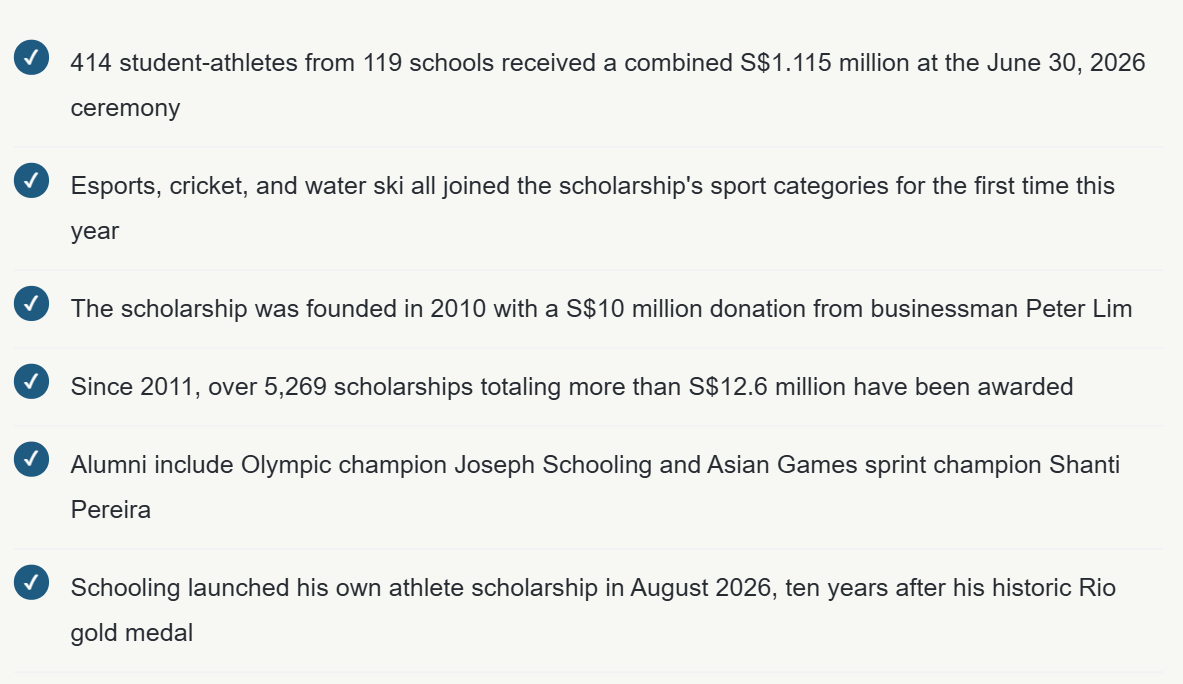
A billionaire who grew up sharing a two-bedroom flat with ten siblings just handed out $1.1 million to 414 young athletes. Two of them are the first-ever recipients in sports nobody expected to see on this list.
A billionaire who grew up sharing a two-bedroom flat with ten siblings just handed out $1.1 million to 414 young athletes. Two of them are the first-ever recipients in sports nobody expected to see on this list.
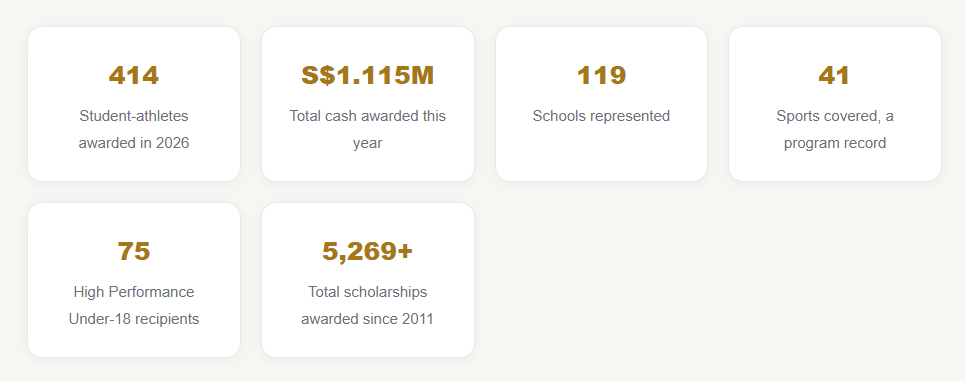
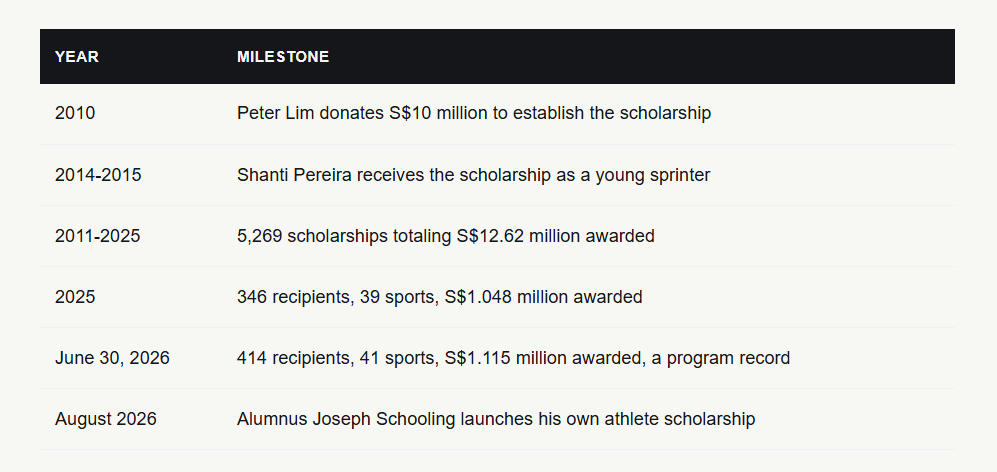
There's a specific kind of credibility that only comes from having actually lived through hardship, not just read about it. Peter Lim, the Singaporean businessman behind Valencia CF and a fortune estimated in the billions, grew up in a two-bedroom flat in Bukit Ho Swee with ten siblings, the son of a fishmonger who could barely keep the family fed. Sixteen years ago, he decided to put a meaningful chunk of that fortune toward making sure no talented young athlete in Singapore had to choose between chasing a medal and paying for textbooks. This summer, that decision turned into its biggest and most diverse edition yet. A Ceremony That Quietly Made History On June 30, 2026, 414 student-athletes from 119 schools across the island gathered at the Tay Eng Soon Convention Centre at ITE Headquarters to collect a combined S$1.115 million in scholarship funds. On paper, that's just another number in a program that's been running since 2010. Dig one layer deeper, though, and this particular ceremony marked something genuinely new: three sports appeared on the scholarship roster for the very first time in the program's history. Esports joined the tertiary category. Cricket and water ski both entered the High Performance Under-18 bracket. For a scholarship built around traditional Olympic disciplines, opening the door to esports specifically is a fairly bold signal about where competitive youth sport in Singapore is actually heading. Of the 414 recipients, 75 fell into the High Performance Under-18 category, the most competitive tier reserved for young athletes already representing Singapore internationally. The event drew Acting Minister for Culture, Community and Youth David Neo as guest of honour, alongside Singapore National Olympic Council figures including SOF chairman Ng Ser Miang. Also in the room was Veronica Shanti Pereira, Singapore's Asian Games sprint champion, herself a scholarship recipient back in 2014 and 2015, now returning as living proof of exactly what this kind of early support can eventually produce. A scholarship program is really only as credible as the people who came through it and made good. When your guest speaker is a national sprint champion who received this exact award as a teenager, that's not just a nice photo opportunity. That's the entire pitch for the program, standing on stage in front of the next 414 kids hoping for the same shot. The Man Behind the Money, and Why His Backstory Actually Matters Here It would be easy to write Peter Lim off as just another wealthy donor writing a check for good publicity. The details of his own life make that read considerably harder to sustain. Born in 1953, Lim grew up genuinely poor, in public housing so cramped that eleven people shared two bedrooms. He funded his own accountancy degree at the University of Western Australia by working as a taxi driver, a cook, and a waiter, jobs that don't exactly scream future billionaire. His breakthrough came as a stockbroker in the 1980s, where he earned the nickname "the Remisier King" for his uncanny success, before a well-timed 2010 exit from his stake in palm oil giant Wilmar International, sold for roughly US$1.5 billion, cemented his fortune for good. That same year, 2010, Lim made the initial S$10 million donation that created the Singapore Olympic Foundation-Peter Lim Scholarship. It's worth sitting with that timing for a second. The year he cashed out one of the biggest paydays of his career is the exact same year he chose to fund a program explicitly designed to help kids from financially disadvantaged backgrounds, kids who, in a lot of ways, resembled the boy he'd once been himself.
The Alumnus Whose Name Everyone in the Room Already Knew
No single name looms larger over this scholarship's history than Joseph Schooling. Long before he became Singapore's first and, to date, only Olympic gold medallist, beating his childhood idol Michael Phelps in the 100m butterfly at the 2016 Rio Games, Schooling was a young swimmer whose family needed exactly the kind of support this program was built to provide. He went on to become a genuine national icon, a multi-time NCAA champion at the University of Texas, and, for 50.39 unforgettable seconds, the reason an entire country stopped what it was doing to watch a pool in Brazil.
Schooling retired from competitive swimming in April 2024. What happened this August adds a genuinely satisfying coda to his connection with this whole story. Exactly ten years after his gold medal moment, Schooling launched his own initiative, the Joseph Schooling Award, explicitly designed to support the next generation of Singaporean swimmers. In his own words, announcing the award, he described wanting to build a legacy he could be proud of, one that would give future recipients the same kind of belief in themselves that helped carry him to Rio. It's hard to imagine a cleaner illustration of how this whole ecosystem is supposed to work: a struggling family gets help, a kid becomes a champion, and the champion turns around and builds the next rung of the same ladder.
The Asian Games detail that quietly validates the whole program
At the 2022 Hangzhou Asian Games, five separate medal-winning Singaporean athletes had all come through this scholarship at some point earlier in their careers. That's not a coincidence built on a handful of lucky cases. That's a genuine pipeline, one small financial bridge at a time, from a struggling household to an Asian Games podium.
Why Esports, Cricket, and Water Ski Just Joined the List
The decision to add three brand-new sports this year says something worth unpacking about how the scholarship's organizers are thinking about the future of competitive youth activity in Singapore. Esports entering the tertiary category specifically acknowledges what's already an enormous, if sometimes culturally underappreciated, competitive scene among Singaporean students, one that demands the same discipline, structured training, and time commitment as any traditional sport, even if it doesn't involve breaking a sweat on a track or in a pool.
Cricket and water ski joining the High Performance Under-18 bracket, meanwhile, reflect a broader push to widen the definition of what counts as elite youth sport in a country that's historically concentrated its sporting identity around swimming, table tennis, badminton, and track and field. Alexavier Koh, a Singapore Polytechnic student, made history this cycle as the first-ever kickboxing recipient in an earlier edition, and roller skater Keenan Brunkard became the first High Performance awardee in his discipline the same year. This year's additions continue that same pattern of quietly expanding what a "Singaporean athlete" is allowed to look like.
What the money is actually meant to cover
It's worth being concrete about what these scholarships actually pay for, because the program isn't handing out prize money for winning. The funding is explicitly earmarked to help with sports-related and school-related expenses, things like coaching fees, equipment, travel to competitions, and everyday academic costs that can quietly pile up for a family trying to support a child chasing something as expensive as elite-level sport. The scholarship comes in four separate categories, with the exact criteria weighing a mix of financial need and sporting performance or potential, depending on which tier an applicant falls into.
The Numbers That Show This Isn't Slowing Down
Look at the trajectory over just the past few editions and a clear pattern emerges. In 2024, 404 recipients across 34 sports shared S$1.1 million. In 2025, that shifted slightly to 346 recipients across 39 sports and roughly S$1.048 million, described at the time as the scholarship's largest annual payout and the country's biggest private donation specifically for youth sports development. This year's 414 recipients across a record 41 sports, sharing S$1.115 million, pushes that record further still. Since the program's founding, the cumulative total has now crossed roughly S$12.6 million distributed to over 5,200 young athletes, a figure that, sport by sport and school by school, represents an enormous, largely invisible investment in Singapore's next generation of competitive talent.
What this actually means beyond the ceremony
It's tempting to treat a scholarship ceremony as a nice but ultimately minor news story, a photo op with a big check and some smiling teenagers. The longer arc tells a different story. This is a program that's directly funded Olympic and Asian Games medals, quietly reshaped which sports Singaporean families feel comfortable letting their kids pursue seriously, and, in Schooling's case, come full circle into a self-sustaining cycle where former recipients start giving back on their own terms. For a country of under six million people competing on a global sporting stage against nations with vastly larger talent pools, that kind of targeted, sustained private investment in kids who'd otherwise be priced out of elite competition isn't a small thing. It's arguably one of the more effective, least flashy tools Singapore has for actually producing the next Joseph Schooling or Shanti Pereira.