William BensonVIEW PROFILE →
Lionel Messi Is Done With Argentina, and Football Just Lost the Story It Never Wanted to End
Twenty years, one World Cup, and a goodbye written the night after the hardest final of his life. This is the end of an era nobody was ever really ready for.
Twenty years, one World Cup, and a goodbye written the night after the hardest final of his life. This is the end of an era nobody was ever really ready for.
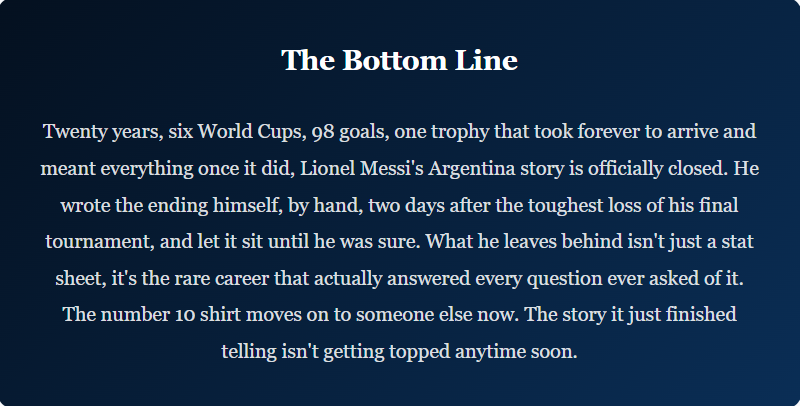
There's a version of this story where Lionel Messi walks away from the national team quietly, no letter, no fuss, just fading out the way plenty of aging stars do. That's not what happened. On Monday, the 39-year-old sat down and wrote out, by hand, exactly why he was done wearing the Argentina shirt, and posted it for the whole world to read. If you grew up watching this man carry a country's hopes on his back for two decades, today's the day you finally have to accept the number 10 isn't walking back out for Argentina again. The Announcement That Broke the Internet on a Monday Morning Messi confirmed his retirement from international football on Instagram, and he didn't do it with some quick statement drafted by a PR team. He posted a photo of a handwritten note, in Spanish, laying out a decision he'd clearly been sitting with for weeks. "After all this time since the final, and after thinking about it a lot, I want to tell everyone that I'm retiring from the national team," he wrote. "It was a decision that hurt — and still hurts — deep inside, but I understand that this is the right moment." He was careful to make one thing crystal clear, though: this wasn't him second-guessing everything he'd given the badge. "I swear to you that I always gave it my all — not just in these last few years when we won everything, but before that too. I always fought and left everything on the field for this jersey, to bring you joy and make you feel proud to be Argentine through football." That's not the language of a guy walking away with regrets. It's someone closing a chapter on his own terms, even if the terms still hurt.
Why He Picked This Exact Moment to Say Goodbye
The timing here isn't random, and it's genuinely one of the more emotional parts of the whole story. Messi revealed he actually wrote the retirement letter just two days after Argentina's heartbreaking loss to Spain in this past July's World Cup final, which went to extra time in New Jersey. He sat on it for weeks before posting, and by the time he finally did, he said the feeling had only gotten stronger. "I'm more convinced than ever" that it was time, he wrote, even describing the process as one that came "deep in the soul."
There's another layer to this too, and it's a heavy one. Messi has been quietly dealing with the death of his father, Jorge, in the weeks leading up to this decision, and he'd already spoken publicly about really struggling with the loss. Jorge wasn't just his dad, he managed Messi's early career and stood by his side through the entire journey from a kid at Barcelona's La Masia academy to the most decorated player in the sport's history. Losing him right as he was already weighing the biggest decision of his football life adds a whole different kind of weight to why this goodbye landed the way it did.
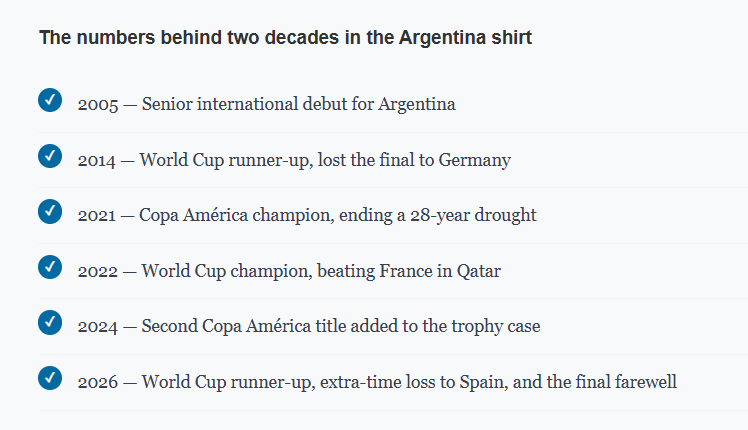
The Career Arc Nobody Could've Scripted Better Here's the thing about Messi's Argentina story that makes it genuinely special, and not just for the highlight reels. For most of his career, the international stage was where his brilliance got questioned, over and over, even as he was rewriting Barcelona's record books at club level. He debuted for the senior national team back in 2005, and for years the narrative followed him everywhere: unbelievable for Barcelona, somehow not quite enough for Argentina. That frustration boiled over more than once, most painfully in the 2014 World Cup final loss to Germany in extra time. Then everything flipped. Messi finally broke through with the 2021 Copa América title, ending a brutal 28-year trophy drought for the national team, and it was like a floodgate opened. He followed that up by captaining Argentina to the 2022 World Cup in Qatar, beating France in a final that's already being talked about as one of the greatest ever played, then added a second Copa América in 2024 for good measure. This past summer, he led the team all the way back to another World Cup final on home turf in North America, only to fall just short against Spain. Losing that final clearly hurt. But it also meant his international career ended not with unanswered questions, but with a résumé that silenced basically every doubt that used to follow him.
The GOAT Debate Just Got Its Final Chapter
Any time Messi does anything significant, the greatest-of-all-time conversation reignites almost instantly, and this is no different. What actually separates his case from Cristiano Ronaldo's, and it's the argument you'll hear from pretty much every corner of the football world today, is that World Cup. Ronaldo, for all his club-level dominance and goal-scoring records, never got his hands on the one trophy that's historically defined the sport's biggest names. Messi has it, plus two Copa Américas, plus seven Ballon d'Or awards, plus four Champions League titles and ten La Liga crowns from his Barcelona days, where he came up through the club's famous youth academy and became its all-time leading scorer.
That combination is exactly why so many people now put him in the same breath as Diego Maradona and Pelé rather than just his own generation. Maradona also delivered Argentina a World Cup, in 1986, and there's something poetic about Messi finally joining him in that specific club after years of being told he couldn't quite get there. Whether you personally land on Messi or Ronaldo in that debate, today's announcement basically closes the book on new evidence either way. What's on the record is on the record now.
"I leave with the peace of mind and pride of having given you, together with my teammates, moments we'd only dreamed of," Messi wrote, closing out the statement that's already being replayed across every football broadcast on the planet.
This Isn't Retirement, Just a Very Specific Goodbye
Here's the part worth being clear about, because it's easy to read "Messi retires" and assume he's done with football entirely. He's not. This announcement is specifically about international duty, the Argentina shirt, the World Cups, the Copa Américas. He's still very much active at club level with Inter Miami in Major League Soccer, and he didn't exactly ease off the gas leading into this announcement, scoring four goals in a 7-1 win over CF Montreal just days before making it official. In his farewell letter, Messi didn't put a firm date on when his club career might eventually wind down either, leaving that chapter open.
What He Actually Said to the Fans One of the more genuinely touching parts of the whole statement was how directly Messi addressed the people who'd supported him through all of it, the highs and the years of frustration both. "Thank you for all the love these past 20 years," he wrote. "I'm going to miss hearing you all from the inside so much. Now I'm going to be one of you, cheering and supporting you from the outside, through thick and thin, even more so." It's a small detail, but it says a lot about how he sees the relationship between himself and the fans who've followed every step of this journey, not as a superstar above the crowd, but as someone stepping down to join it. A Few Honest Questions People Are Actually Asking Did Messi actually say why now specifically, rather than after the 2022 World Cup win? Yes, and it's tied directly to this year's World Cup final loss to Spain. He wrote the retirement letter two days after that match, then sat with the decision for weeks before making it public, saying he grew more certain over time rather than less. Is Messi still going to play club football? Yes. He remains an active player for Inter Miami in MLS, and the retirement announcement applies specifically to his international career with Argentina, not his club career, which he didn't give a timeline for ending. How does his Argentina scoring record compare to the sport's other legends? Messi finishes with 98 goals and 38 assists across 142 appearances for Argentina, and he became the all-time leading scorer in World Cup history during this year's tournament with 21 goals, a record briefly held before France's Kylian Mbappé edged ahead with 22. Why This Moment Actually Matters Beyond the Stat Sheet It's tempting to reduce a story like this to trophy counts and goal totals, and those numbers genuinely are extraordinary. But what's actually driving the emotional weight of today's news is the arc underneath them. This is a player who spent the first fifteen years of his international career being told, fairly or not, that he hadn't proven himself on the biggest stage, only to spend the last five completely rewriting that narrative from the ground up. He did it while dealing with real personal loss in these final weeks, and he chose to close the book with a handwritten letter rather than a press conference, which tells you something about how personally he's always taken that blue-and-white jersey. Football moves on fast, it always does, and a new generation of Argentina players will step into that number 10 shirt eventually. But there's a specific kind of career arc, frustration turning into redemption turning into genuine glory, that doesn't come around often, and it rarely gets closed out this cleanly. Whatever side of the GOAT debate you land on, today marks the actual, final full stop on one of the most complete international careers the sport has ever seen. A note on this coverage Details and quotes in this piece are drawn from Messi's own Instagram statement and reporting from NPR, NBC News, CBS Sports, and the Washington Post as of August 31, 2026. Messi has not given a timeline for any future decisions regarding his club career with Inter Miami.