 William BensonVIEW PROFILE →
Europe Just Told Social Media: Prove It's Safe for Kids, or Keep Them Out
A landmark expert report just landed in Brussels, and it's forcing every platform from TikTok to AI chatbots to answer one question they've spent years avoiding.
A landmark expert report just landed in Brussels, and it's forcing every platform from TikTok to AI chatbots to answer one question they've spent years avoiding.
For years, the burden of proof in the fight over kids and social media has sat almost entirely with parents. Set the screen time limits. Read the fine print. Hope the algorithm behaves. A report released in Brussels this summer flips that arrangement on its head, and the language European Commission President Ursula von der Leyen used to explain it says almost everything you need to know: "It is not about whether children can access social media. It is about whether and when social media can access our children." That single sentence reframes an entire debate that's been simmering across Europe for more than a year, and it's backed by a document with real teeth: a formal recommendation, from a panel of medical and child-development experts convened by the Commission itself, that children under 13 shouldn't be on social media at all until platforms can actually prove their services are safe.
Who's Actually Behind This Report
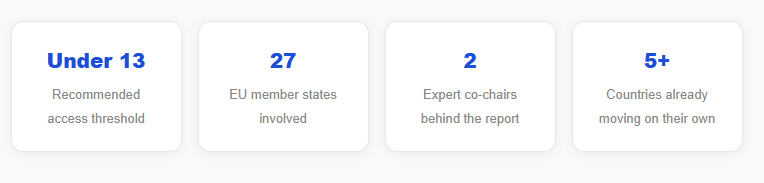
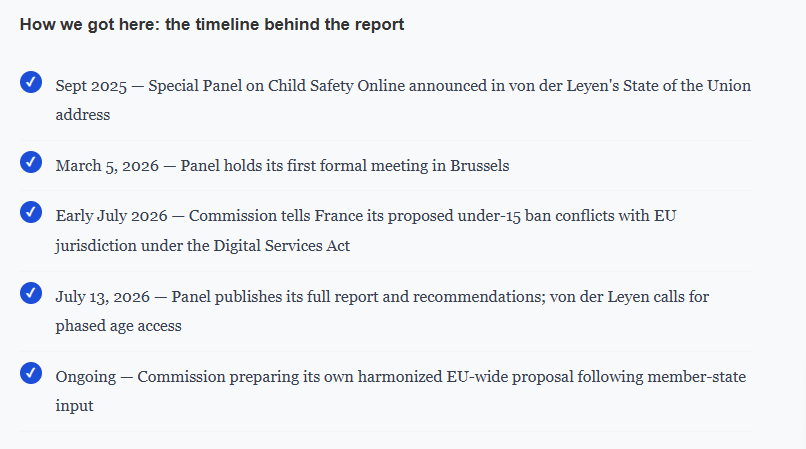
This wasn't a political stunt dreamed up overnight. The Special Panel on Child Safety Online was announced back in von der Leyen's 2025 State of the Union address and held its first working session in Brussels on March 5, 2026. It was co-chaired by two people with genuine credentials in the space: child psychiatrist Jörg Fegert and epidemiologist Maria Melchior, both tasked with translating a genuinely messy, fast-moving public health question into something resembling policy.
Von der Leyen, notably a doctor by training herself, didn't hold back when laying out the panel's findings on July 13. Her list of recommendations moved by age bracket, starting from the very beginning of childhood: no screen exposure at all for children under three, "age-appropriate" and closely supervised use for kids between three and twelve, guided by parents or teachers, and only for children between 13 and 18 would something resembling independent access be considered appropriate, and even then, only on platforms built with real safety features baked in.
What Counts as "Social Media" Just Got a Lot Bigger
One of the more consequential parts of the report is easy to miss if you only skim the headlines: it doesn't stop at Instagram and TikTok. The panel introduced a broader category it calls "social media plus," a label meant to capture any digital service built around age-inappropriate or addictive design features, not just the platforms people traditionally think of as social networks.
Under the panel's proposed framework, "social media plus" would cover gaming platforms, messaging apps, and AI companion services alongside the usual suspects, meaning the same scrutiny currently aimed at Facebook, Instagram, TikTok, YouTube, and Snapchat could soon extend to chat-based AI tools and multiplayer games kids spend hours inside of.
That's a meaningful expansion, and it reflects something researchers have been flagging for a while: kids don't experience "screen time" as neatly separated categories. A teenager scrolling TikTok, chatting with friends on Discord, and talking to an AI companion app are, from a developmental and attention-hijacking standpoint, often triggering very similar psychological mechanisms, regardless of what the app is technically called.
Twenty-Seven Countries, One Very Messy Negotiation
Here's where the story gets genuinely complicated, and where a lot of coverage tends to gloss over the real difficulty: von der Leyen and the panel are trying to build one unified policy across 27 countries that already disagree, sometimes sharply, about where the line should sit.
Spain wants a full ban for anyone under 16. France has been pushing to prohibit access for kids 15 and under, and ran directly into a wall doing it, the European Commission told Paris in early July that its national bill conflicted with the EU's Digital Services Act, because enforcing platform-wide age limits is treated as EU jurisdiction, not something individual member states can legislate on their own. Meanwhile, Estonia has pushed back against the idea of a ban altogether. And within the European Parliament itself, lawmaker Christel Schaldemose has publicly argued the panel's recommended cutoff of 13 doesn't go far enough: "I still believe the age should be 15, not 13," she said following the report's release, noting that 13 is already the floor most major platforms already claim to enforce.
The Australia Problem
It would be easy to assume Europe is simply copying Australia's playbook, since Canberra's under-16 social media ban, which took effect in December 2025, has become the most-cited reference point in this entire global conversation. But the panel's own findings complicate that comparison in an important way: researchers found that children in Australia were finding workarounds to the restrictions almost as fast as they went into effect, forcing EU policymakers to reconsider how much a hard age wall alone can actually accomplish without additional enforcement mechanisms behind it.
That's part of why the panel's recommendations lean so heavily on platform design changes rather than age limits alone. Its report specifically calls for restricting or removing features like autoplay, infinite scroll, and push notifications, the mechanics researchers increasingly link to compulsive use, regardless of how old the person scrolling happens to be.
Questions People Are Actually Asking
Is this an actual law now, or just a recommendation? Right now, it's a report and a policy direction, not binding legislation. The European Commission has said it's preparing its own formal proposal to harmonize the approach across member states, but any EU-wide rule would still need to go through negotiations between the European Parliament and individual governments before becoming enforceable law.
How would platforms actually verify a child's age? The Commission has already been developing the technical groundwork separately, including an age-verification app intended to create a reliable way to confirm a user's age without necessarily requiring platforms to collect and store sensitive identity documents themselves.
Does this mean kids under 13 currently on Instagram or TikTok will get kicked off? Not immediately. Most major platforms already technically require users to be at least 13, partly due to existing EU privacy rules like GDPR that restrict data processing for younger children. What's new here is the push toward "safe by design" proof and stronger enforcement, not the baseline age itself, which several lawmakers argue is already too low regardless.
What This Actually Signals
Strip away the political back-and-forth over exact ages, and there's a genuine shift happening underneath this story: European regulators are moving away from treating child online safety as something parents alone are responsible for managing, and toward making platforms legally accountable for proving their products don't cause harm before kids ever get access. Von der Leyen put that shift in blunt terms of her own: "Platforms must prove that their services do no harm. In Europe, whoever develops a product is responsible for its safety."
Whether that principle survives intact through the messy process of turning an expert panel's recommendations into actual EU-wide law is genuinely an open question, and one that will likely take months, if not longer, of negotiation between Brussels, national governments, and the platforms themselves to resolve. But the direction of travel is now unmistakable, and for the tech companies whose entire business models depend on engagement from every age group, that alone is the headline that matters most.
A note on this reporting
Details in this piece reflect the European Commission's Special Panel on Child Safety Online report, published July 13, 2026, along with reporting and direct statements sourced from TechPolicy.Press, JURIST, Brussels Signal, and TechXplore current as of late July 2026. Any final EU-wide legislation remains subject to further negotiation between the European Parliament and member states.