 William BensonVIEW PROFILE →
Nobody Told the Farmers the Chocolate Boom Was Happening Without Them
Cocoa prices just pulled off one of the wildest boom-to-bust rides any commodity has ever seen, and the farmers who actually grow it got the short end of both halves of that ride.
Cocoa prices just pulled off one of the wildest boom-to-bust rides any commodity has ever seen, and the farmers who actually grow it got the short end of both halves of that ride.
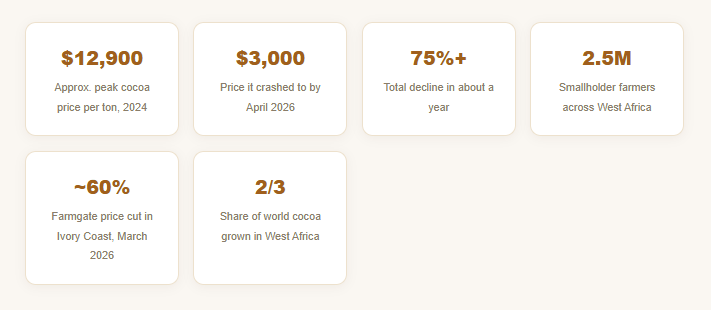
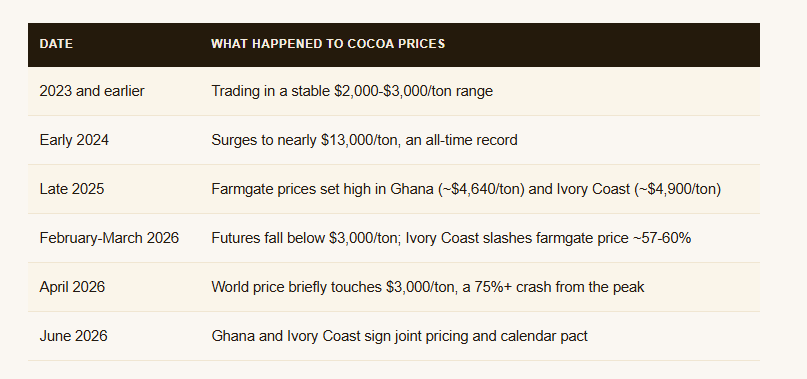
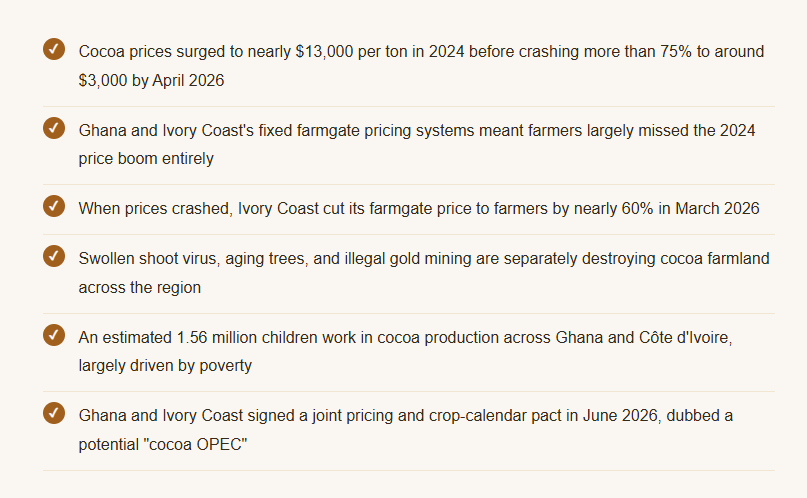
Here's a number that should stop you mid-bite the next time you unwrap a candy bar: the raw cocoa inside it was, at one point not long ago, worth more per ton than copper. Then, in a stretch of time shorter than it takes most people to finish a mortgage refinance, that same ton of cocoa lost three-quarters of its value. Somewhere in the middle of that entire wild ride sat roughly 2.5 million smallholder farmers across West Africa, the actual human beings growing the beans that make chocolate possible, and depending on who you ask, they either barely felt the boom at all or got flattened by the bust twice as hard as everyone else. Both are true, and once you understand why, the whole story of your chocolate bar looks a lot different. A Price Chart That Looks Like a Heart Attack Let's get the numbers on the table first, because they're genuinely wild. Cocoa futures spent most of the 2010s and early 2020s trading in a fairly boring range, usually somewhere between $2,000 and $3,000 a metric ton. Then, starting in late 2023, prices took off like nothing the market had seen in its history, climbing all the way to nearly $13,000 per ton by early 2024. Analysts, traders, and journalists scrambled for comparisons, and more than a few landed on the same one: cocoa, pound for pound, had briefly become worth more than copper, a genuinely strange thing for a tropical crop grown mostly by farmers working a few acres of land with hand tools. The comedown was just as dramatic as the climb. By early April 2026, the world market price had cratered to around $3,000 a ton, a decline of more than 75% from the 2024 peak in a little over a year. Trading Economics data shows futures repeatedly testing lows not seen since May 2023, essentially wiping out the entire historic surge and landing right back near where prices had started before the whole rollercoaster began. Farmers are being left to die in poverty. Here's the Part That Doesn't Add Up, Until It Does If you're picturing cocoa farmers pulling in life-changing money during that 2024 spike, you'd be picturing something that mostly didn't happen. West Africa, which grows roughly two-thirds of the entire world's cocoa supply, doesn't sell cocoa the way you'd sell stock or Bitcoin. In Ghana, a government body called COCOBOD sets a single guaranteed price for the entire season before harvest even starts. In neighboring Côte d'Ivoire, a similar authority called the Conseil du Café-Cacao fixes minimum farmgate prices and controls how sales actually happen. Those prices get locked in months ahead of time and stay "sticky" on purpose, designed to give farmers predictable income rather than exposing them to the wild swings happening on international futures markets. That system sounds reasonable in theory, and it does protect farmers from sudden crashes. But it also means that when cocoa futures rocketed past $10,000 a ton in 2024 and 2025, the actual price paid to a farmer standing in his own field had already been fixed months earlier and simply didn't move. The windfall everyone assumed farmers were cashing in on largely stayed upstream, with exporters, traders, and chocolate manufacturers, never trickling down to the people actually climbing the trees to harvest the pods.
Then the Crash Hit, and This Time Farmers Got the Full Blow
Here's where that same fixed-pricing system flips from protective to brutal. When global futures prices collapsed through late 2025 and into 2026, Ivory Coast and Ghana found themselves stuck holding farmgate prices that were now sitting well above what the actual world market would pay. Buyers, unsurprisingly, balked. Reporting from CNBC Africa detailed how both countries struggled to actually sell their harvests and pay farmers on time in 2026, as chocolate makers pulled back demand and large volumes of cocoa sat unsold in warehouses.
Ivory Coast's government response was blunt: cut the price paid to farmers, hard. Reports in early March 2026 described the country slashing its farmgate price by nearly 60%, an eye-watering drop delivered directly to farmers who'd already planted, tended, and harvested a crop under the old, higher price expectation. In Ghana, the pain took a different shape, farmers describing delayed payments as middlemen and buyers pulled back from purchasing crops altogether, leaving beans sitting in storage while bills at home kept coming due.
The crisis farmers were already fighting before prices even crashed
Falling prices are only one front in a much longer war these farmers have been losing for years. A brutal plant disease called swollen shoot virus, spread by tiny mealybugs, has been chewing through cocoa trees across Ghana and Côte d'Ivoire, killing infected trees within a few years and forcing farmers to cut down and burn anything showing symptoms. One Ghanaian farmer told reporters that 60% of his 20-acre farm had been ravaged by the virus, describing himself as "a young man starting life again" after losing most of his livelihood. Layer in aging cocoa trees planted decades ago that simply don't produce like they used to, plus illegal gold mining, known locally as galamsey, physically destroying farmland in parts of Ghana, and you get a farming population that was already stretched thin before the price collapse ever hit.
The Human Cost That Never Shows Up on a Trading Chart
Behind every one of those price swings is a level of poverty that's genuinely hard to sit with. Research commissioned by the U.S. Department of Labor has put the number of children working in cocoa production across Ghana and Côte d'Ivoire at roughly 1.56 million, with the overwhelming majority exposed to hazardous tasks. It's not a mystery why. Over 23% of Ghana's population lives at or below the poverty line, and in Côte d'Ivoire, that figure surpasses 46%. When a farming household is barely scraping by, kids end up working the family plot instead of sitting in a classroom, not because anyone wants that outcome, but because unsustainably low prices leave families with painfully few other options.
Hired farm labor tells its own grim version of the same story. Field research from the Corporate Accountability Lab found that workers hired to help on cocoa farms, often the most vulnerable people in this entire supply chain, earn just over $1 a day, paid out by farmers who themselves are barely earning a living income. Advocacy groups have called on chocolate companies to guarantee farmers at minimum $3,166 per metric ton in Côte d'Ivoire and $3,116 in Ghana just to reach something resembling a genuine living income, figures that, notably, sit well above where the crashed market price landed by early 2026.
Can a "Cocoa OPEC" Actually Turn This Around?
Faced with a market that seems to reward everyone except the people actually growing the crop, Ghana and Ivory Coast decided to try something they'd never fully committed to before: coordinating directly with each other. On June 16, 2026, the presidents of both countries signed a joint declaration to harmonize their farmgate prices in dollar terms and align their crop calendars starting with the 2026/27 season, both running September 1 to August 31 for the first time. Ivory Coast even invited Cameroon and Nigeria to join the arrangement, and global markets immediately started drawing comparisons to OPEC, the oil cartel that's spent decades coordinating production among major exporting nations to influence world prices.
The skepticism arrived almost as fast as the headlines. Despite still producing more than half the world's cocoa combined, Ivory Coast and Ghana aren't nearly as dominant as they once were, output has been rising in other producing countries that aren't part of this new pact at all, which limits exactly how much leverage the two nations actually have to move global prices through coordination alone. It's a genuinely interesting idea, using shared bargaining power to capture more value from a crop the region has always been forced to sell cheap and watch others profit from downstream. Whether it actually works is a very different question, and one the 2026/27 season will start answering for real.
What this actually means for your candy bar
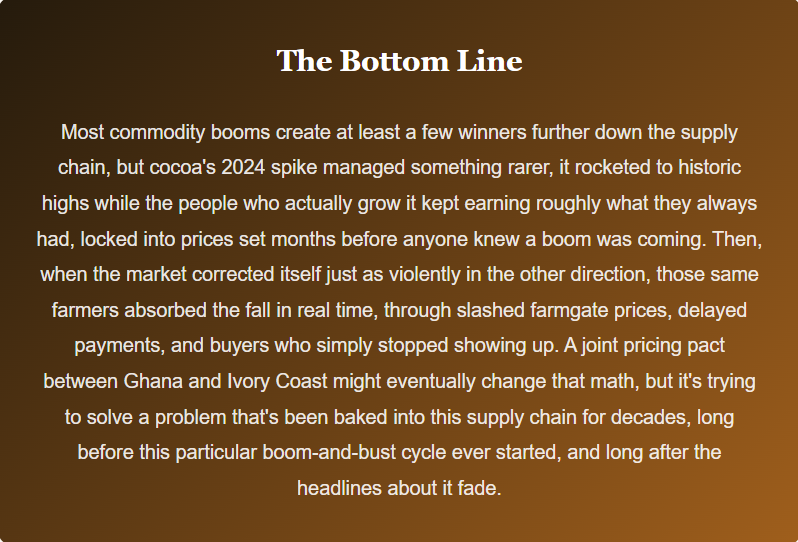
For chocolate lovers, this entire saga has already shown up at the checkout counter, plenty of major chocolate makers raised prices or shrank bar sizes during the 2024 price spike, and some, like Barry Callebaut, have flagged continued softness in sales as elevated prices work their way through the system even as raw cocoa costs have come back down. The uncomfortable truth sitting underneath all of it is that neither the boom nor the bust actually delivered a fair, stable outcome for the millions of farmers whose labor makes the entire industry possible in the first place. A record price spike came and went without meaningfully lifting them, and the crash that followed hit their household budgets directly and immediately. Whatever a "cocoa OPEC" eventually manages to accomplish, it's trying to fix a problem that both the good years and the bad years, in their own separate ways, made unmistakably clear.