 William BensonVIEW PROFILE →
One Week After the Berlin Attack, Nobody Expected Numbers Like These
A van. A machete. One woman dead. Seven days later, Europe answered with the biggest Pride crowds some cities have ever seen.
A van. A machete. One woman dead. Seven days later, Europe answered with the biggest Pride crowds some cities have ever seen.
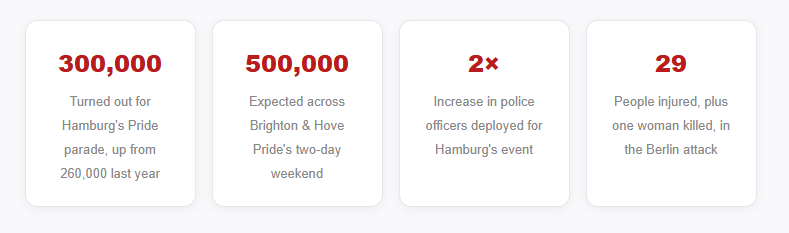
Here's a number that stopped a lot of people cold this week: 300,000. That's how many showed up in Hamburg for Pride, just seven days after a man drove a van into a crowd at Berlin's own Pride celebration and then started swinging a machete. If the plan was to scare people off the streets, it didn't work, not even close. What actually happened across Germany, the UK, and the rest of Europe this past weekend is one of those stories where the numbers alone tell you almost everything you need to know. What Actually Happened in Berlin Late on the night of July 25, a 21-year-old man drove a van into a crowd just a few hundred meters from the closing party of Berlin's Christopher Street Day festival, then got out and started attacking people with what appears to have been a machete. One woman was killed. Twenty-nine other people were hurt. The attacker, identified as Abdul Ballout, was on the run for close to 24 hours before police finally caught up with him and shot him dead during the confrontation. What came out afterward made the whole thing land even harder. Investigators found video where someone believed to be Ballout claimed responsibility and pledged allegiance to the Islamic State group. He'd been born in Germany, had Lebanese family roots, and had actually been arrested at Berlin's airport back in 2025 on terrorism suspicion after returning from Lebanon. He was released from pre-trial detention in May 2026, just two months before the attack, and had been placed in a deradicalization program. That detail alone has already sparked serious political fallout in Germany over whether the system let something slip through that shouldn't have.
Hamburg Didn't Just Show Up. It Showed Up Bigger.
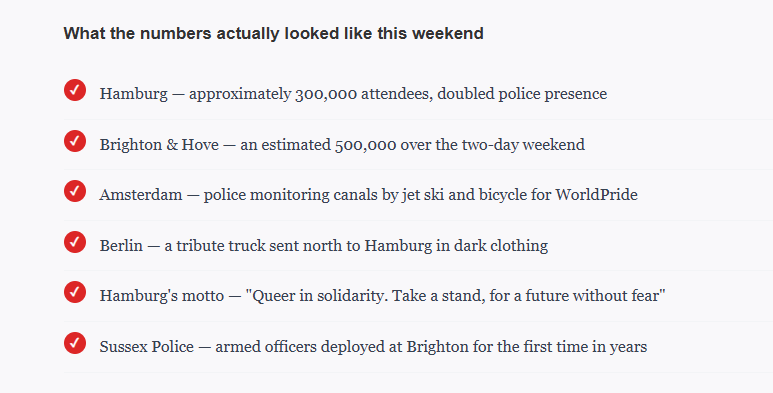
Hamburg's Pride parade is already one of the biggest in Germany on a normal year, and this wasn't a normal year. Police and organizers confirmed roughly 300,000 people packed the port city's streets on Saturday, actually up from around 260,000 the year before, according to the German news agency dpa. That's not a crowd that shrank out of fear. It's a crowd that grew.
The security response matched the moment. Hamburg's police chief had announced days ahead of time that officers would be roughly doubled compared to last year's deployment. And in a detail that landed hard with anyone paying attention, one of the dozens of parade trucks was a late addition representing Berlin's own Pride event, its riders dressed in dark clothing as a quiet, deliberate mark of respect for the people hurt and killed a week earlier. Manuel Opitz, one of the CSD organizers, put the mood in Hamburg about as honestly as anyone could. "When you look at the atmosphere here, you can see that there's still joy," he said. "I think we carry the grief in our hearts, and Berlin in our hearts too, but we're bringing our pride out onto the streets, and you can see that."
Why Brighton Brought Out the Armed Police
Across the Channel, the UK's response carried its own weight. Brighton and Hove Pride, widely considered the country's biggest Pride event and typically drawing around half a million people over its weekend, saw Sussex Police confirm something rare for the event: armed officers patrolling alongside uniformed and plain-clothed teams. A police spokesperson didn't dance around why. "As we look ahead to Brighton and Hove Pride, I want to reassure those attending, as well as residents, businesses and visitors across the city, that their safety remains our top priority," the force said, describing the extra security as part of a comprehensive plan built up over months, not thrown together at the last minute.
UK Health Secretary Wes Streeting weighed in publicly too, calling the Berlin attack "absolutely horrific" while making a point of noting that Pride events in Britain are "always well policed," and arguing that the attack was itself proof of exactly why these celebrations still needed to happen. That's a fairly blunt political statement, and it captures the tone running through a lot of the official response across the UK this week: acknowledge the fear honestly, then show up anyway.
Brighton and Hove City Council leader Bella Sankey said she was "deeply saddened" by what happened in Berlin, adding: "We stand in solidarity with the LGBTQI+ community... we want to reassure all those attending that we are working closely with Brighton and Hove Pride, Sussex Police and our other partners to keep everyone safe."
Amsterdam's Canals Got Watched From the Water
Amsterdam took its own distinctive approach to the moment, leaning into the city's geography rather than fighting it. With WorldPride's famous canal parade drawing enormous crowds along the water, Dutch police confirmed officers would monitor the event by jet ski and bicycle, patrolling both the canals themselves and the packed streets running alongside them. It's a genuinely Amsterdam solution to a genuinely serious problem, using the city's own layout, canals, bike lanes, narrow streets, to actually improve coverage rather than working against it.
The Political Fault Line Running Underneath All of This
It's worth being honest that not everything about the response was unified or calm. In the days following the attack, some public figures faced backlash over comments seen as politically opportunistic, including criticism directed at a Labour MP accused of linking the tragedy to unrelated domestic political targets. Berlin also saw a separate, more confrontational scene the same weekend: police dispersed a side rally billed as an "Internationalist Queer Pride for Liberation," reporting that seventeen officers were injured and 57 people arrested amid clashes that included bottle-throwing and reports of antisemitic slogans, an event organizers described as a distinct, separate demonstration from the main Pride march happening elsewhere in the city.
That tension, grief and solidarity running alongside real political friction and even separate unrest, is part of an honest picture of the week, not a footnote to leave out. Big, emotionally charged moments like this rarely resolve into one single, clean narrative, and this one didn't either.
A Few Honest Questions People Are Actually Asking
Were these Pride events specifically warned about a follow-up threat? There's no public indication of a specific, credible new threat tied to any of these individual events. The heightened security reflects a broad, precautionary response following the Berlin attack rather than intelligence about a copycat plot.
Why was the Berlin attacker out of custody at the time of the attack? He had been arrested on terrorism suspicion in 2025 but was released from pre-trial detention in May 2026 and placed in a deradicalization program, a decision that's already drawing scrutiny and political pressure in Germany over whether the process failed.
Did any of the weekend's Pride events actually see violence? The main Pride marches in Hamburg, Brighton, and Amsterdam passed without reported major incidents. A separate, smaller side demonstration in Berlin billed as a distinct political rally did see clashes with police, but organizers and reporting distinguish it clearly from the main CSD march happening elsewhere in the city that day.
What the Numbers Are Actually Saying
Strip away the individual city details and a fairly stark pattern emerges. Every major event that could have quietly shrunk this year, out of caution, out of fear, out of simple bad timing, instead pulled bigger or comparable crowds to previous years. Hamburg didn't just hold steady, it grew by roughly 40,000 people in the exact week you'd expect the opposite. Brighton held its full half-million-strong weekend under a visibly heavier security footprint than usual, rather than scaling back. Amsterdam adapted its policing to the city rather than pulling back the celebration itself.
None of that erases what happened in Berlin, and nobody organizing these events pretended it did. The dark clothing on that Hamburg tribute truck, the doubled police numbers, the armed officers in Brighton, all of it sat right alongside the music, the flags, and the crowds, grief and defiance sharing the same streets rather than one cancelling out the other. That combination, showing up in bigger numbers while still visibly mourning, is a harder thing to pull off than either extreme on its own, and this past week, city after city managed it anyway.
A note on this reporting
Details in this piece reflect reporting from the Associated Press, Euronews, PinkNews, Attitude, ITV News, and Gaydio as of early August 2026. Attendance figures for large public events vary between police and organizer estimates, and both are noted here where available.






