 William BensonVIEW PROFILE →
Why the UK Just Broke a Rule ASEAN Hadn't Bent in Years to Join This Manila Summit
Four days, four new treaty signatories, one 50th anniversary, and a moratorium exception nobody saw coming , inside the week Manila became the center of Asia-Pacific diplomacy.
Four days, four new treaty signatories, one 50th anniversary, and a moratorium exception nobody saw coming — inside the week Manila became the center of Asia-Pacific diplomacy.
Diplomatic gatherings rarely make headlines outside foreign policy circles, but every so often one comes along that's worth paying attention to purely because of how unusual its outcomes are. Late July in Manila was one of those weeks. In the span of four days, the Philippines hosted a treaty conference fifty years in the making, welcomed four new European nations into Southeast Asia's founding peace framework, and admitted the United Kingdom into a forum that had, for years, kept its membership essentially frozen. None of it happened by accident. All of it traces back to one country holding the ASEAN chairship this year, and using that seat to push through a genuinely packed diplomatic agenda most casual observers of Asia-Pacific politics probably missed entirely.
A Week Built Around One Big Anniversary
The centerpiece of Manila's diplomatic calendar was the 50th anniversary of the Treaty of Amity and Cooperation in Southeast Asia, or TAC, a document signed in February 1976 by ASEAN's five founding members: the Philippines, Indonesia, Malaysia, Singapore, and Thailand. The treaty set out principles that still anchor the region's diplomacy today, peaceful dispute settlement, mutual respect for sovereignty, non-interference in internal affairs, and a formal renunciation of the threat or use of force between signatories.
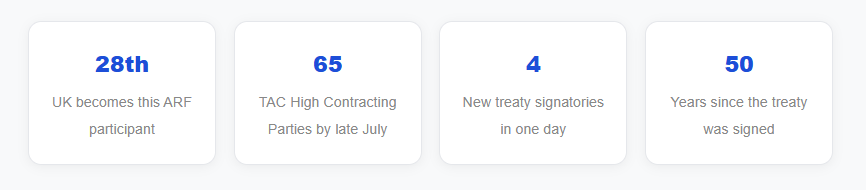
What started as an agreement between five neighboring countries has grown into something far bigger. As of late July 2026, the TAC counted 65 High Contracting Parties, according to the EU's own diplomatic service, a number that includes major powers like the United States, China, Russia, and now, five EU member states that joined the list at this exact gathering.

The Treaty Gets Four New Names
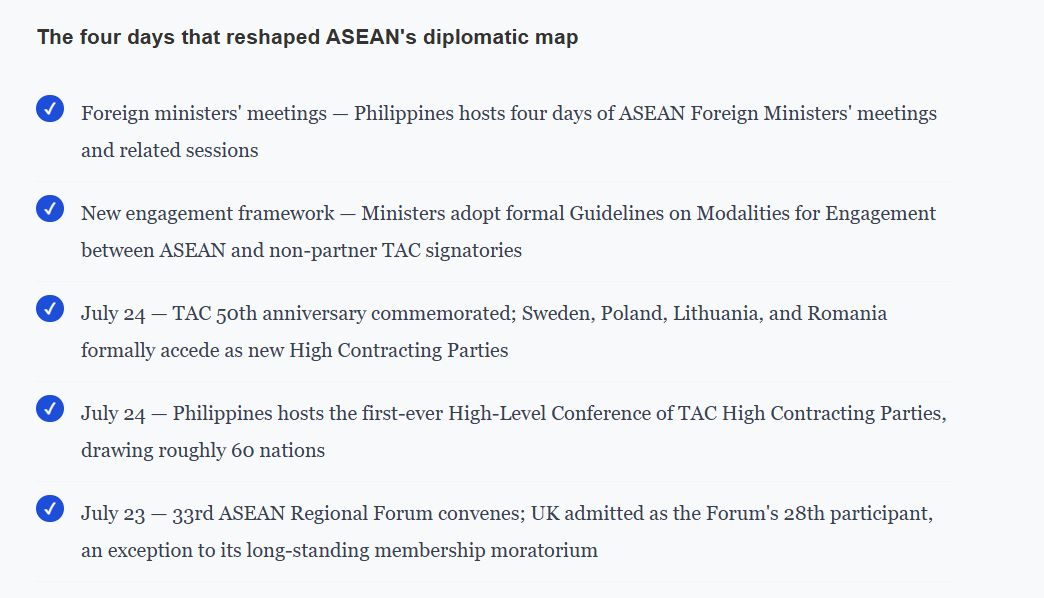
The anniversary ceremony itself carried real diplomatic weight. Sweden's Defense Minister Pål Jonson, Poland's State Assets Minister Wojciech Balczun, Lithuania's Foreign Minister Kęstutis Budrys, and Romania's Education and Research Minister Mihai Dimian each formally signed on behalf of their countries, officially making them the treaty's newest High Contracting Parties.
Philippine Foreign Affairs Secretary Ma. Theresa Lazaro, who chaired the proceedings, tied the moment directly to the treaty's growing relevance rather than treating it as a formality. "As the community of high contracting parties continues to grow, so too does our collective responsibility to uphold these principles in the interest of regional and global peace, stability, and prosperity," she told the gathered ministers and representatives.
The Treaty of Amity and Cooperation has grown from just five founding signatories in 1976 to 65 High Contracting Parties by late July 2026, a nearly thirteen-fold expansion that now includes major global powers, regional blocs like the European Union, and, as of this summit, four additional EU member states.

Then There's the UK's Unusual Entry
The most eyebrow-raising development of the week didn't come from the treaty ceremony at all, it came a day earlier, at the 33rd ASEAN Regional Forum. The ARF, a separate but related security dialogue that brings together ASEAN members and key external partners to discuss regional stability, formally admitted the United Kingdom as its 28th participant.
What makes that genuinely notable is the specific language used to describe it: the UK's admission was granted "as an exception to the moratorium," according to official reporting on the session. The ARF has, for a considerable stretch of time, kept its participant list essentially closed to new members, treating expansion as something to approach cautiously rather than routinely. Breaking that pattern specifically for London signals a level of diplomatic priority that doesn't get extended lightly, particularly at a moment when Indo-Pacific security dynamics are drawing outside powers deeper into the region's institutions.
A Long-Term Plan, Not Just a Photo Op
Beyond the individual signing ceremonies, ASEAN foreign ministers used the gathering to formally adopt the Manila Plan of Action, a ten-year framework running from 2026 through 2036 meant to guide the ASEAN Regional Forum's future direction. Ministers also approved new Guidelines on the Modalities for Engagement between ASEAN and TAC High Contracting Parties that don't yet hold formal partnership status with the bloc, described by Philippine officials as a specific priority of their country's chairship this year, aimed at giving structure to a relationship that had, until now, lacked a clear framework for deeper cooperation.
European Union High Representative Kaja Kallas made the trip to Manila herself to represent the bloc at both the ARF Ministerial and the treaty anniversary events, underscoring how seriously outside powers are treating ASEAN's convening role right now. The EU has actually held High Contracting Party status under the TAC since 2012, making its continued engagement here less a new development and more a reaffirmation at a moment of heightened attention.
Questions People Are Actually Asking
What's the practical difference between the TAC and the ASEAN Regional Forum? The TAC is a foundational peace and non-aggression treaty, essentially a shared code of conduct for how signatory states agree to treat each other diplomatically. The ARF is a separate, ongoing security dialogue forum where members discuss specific regional security issues. Countries can be part of one without automatically being part of the other, which is part of why the UK's ARF admission and the TAC's new signatories were technically two different tracks happening in the same week.
Why would the UK need an exception to join the ARF? The ARF has maintained a moratorium limiting new participants for an extended period, generally treating its membership as something to expand only in specific, carefully considered circumstances rather than on an open or rolling basis. An explicit exception being granted signals that ASEAN member states saw particular strategic value in bringing the UK formally into the forum's discussions.
Does acceding to the TAC create binding legal obligations? Yes, in the sense that signatories formally commit to the treaty's core principles, including peaceful dispute resolution and non-interference. It doesn't create a mutual defense pact or economic union; it's closer to a shared diplomatic code of conduct that shapes how signatory states are expected to engage with the Southeast Asian region and each other.
What This Week Actually Adds Up To
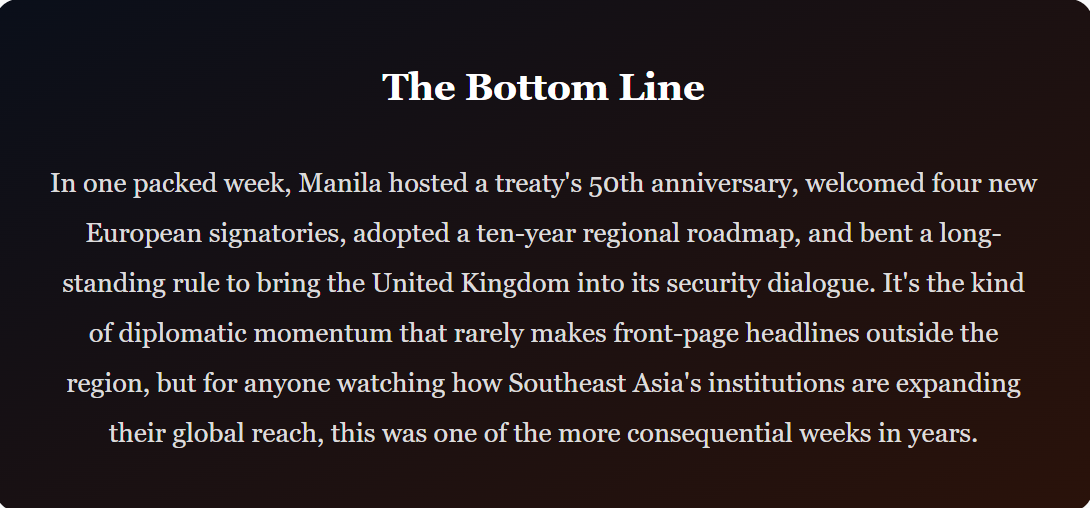
It would be easy to read all of this as a routine diplomatic calendar item, ministers sign documents, host countries issue statements, and everyone moves on to the next summit. But the specifics here point to something more deliberate: a Philippine chairship using its year at the helm to expand ASEAN's diplomatic reach in multiple directions at once, deeper into Europe through new TAC signatories, and further into a security dialogue with a major Western power through the UK's unusual ARF admission.
Whether the Manila Plan of Action's ten-year framework and the new engagement guidelines actually translate into deeper cooperation, rather than simply more names on more treaty documents, will depend heavily on what member states and their new partners do with these openings over the coming years. For now, what's clear is that Manila spent four days in late July functioning as the genuine center of Asia-Pacific diplomatic activity, and the region's institutions came out of it measurably larger than they went in.
A note on this reporting
Details in this piece reflect official statements and releases from the Philippine Department of Foreign Affairs, the European External Action Service, the Philippine News Agency, and GlobalSecurity.org, current as of late July 2026.