 William BensonVIEW PROFILE →
Wearable Tech 2.0: The Devices Quietly Replacing Your Smartwatch to Track Your Brain and Stress in Real Time
Smart rings, neurofeedback bands, and biometric patches are pulling attention away from the wrist, and toward something a lot more personal: your stress response before it turns into a bad day.
Smart rings, neurofeedback bands, and biometric patches are pulling attention away from the wrist, and toward something a lot more personal: your stress response before it turns into a bad day.
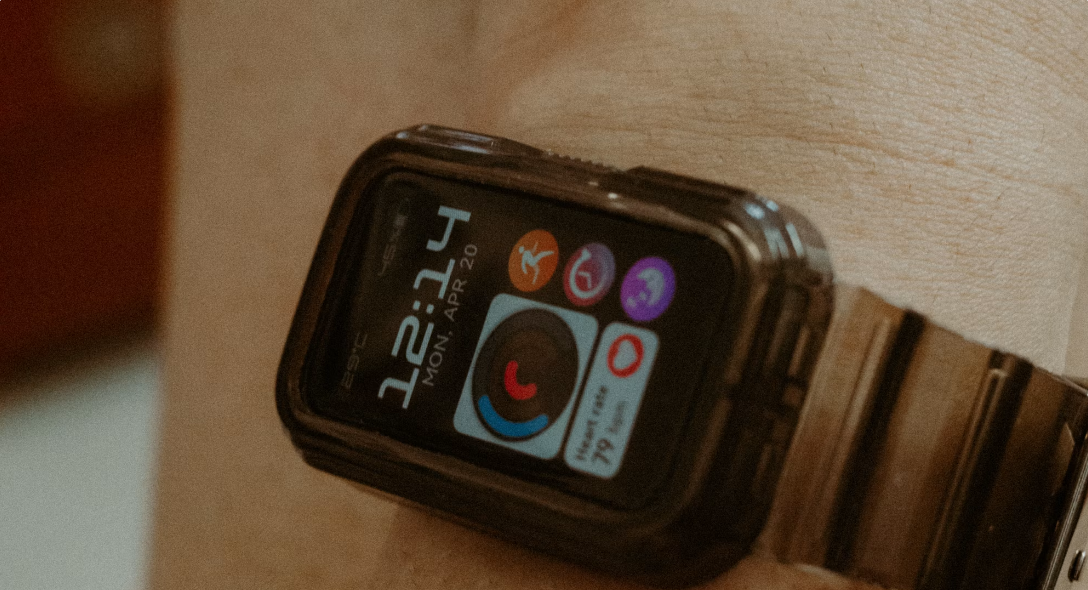
There's a small, slightly uncomfortable moment a lot of smartwatch owners have had recently: glancing down at a screen that's telling them their heart rate, their steps, their calendar, their texts, and somehow still nothing useful about why they feel this exhausted by 3pm. The watch knows everything except the one thing that actually matters that day. That gap is exactly where a new category of wearable has quietly moved in, not with a bigger screen or more notifications, but with less noise and a much more specific question: how are you actually doing, right now, underneath the data you already have. Over the last year or so, the wearable conversation has shifted in a way that's easy to miss if you're only half paying attention to it. The smartwatch isn't disappearing, and it's still the device most people reach for first. But a second wave of hardware, smart rings, EEG headbands, and skin-worn biometric patches, has started pulling serious attention from people who've realized that a screen buzzing on your wrist all day isn't the same thing as actually understanding your own body. What's replacing it isn't one single gadget. It's a different philosophy about what a wearable should even be doing. Why the smartwatch is starting to feel like last decade's idea None of this is really about the smartwatch failing. Devices like the Apple Watch Series 11 remain genuinely excellent at what they were built for: GPS-tracked workouts, on-wrist notifications, ECG readings, and a sensor suite broad enough to cover most of what an active person wants during the day. The problem, if you can call it that, is more about friction and fit. A smartwatch has to be charged nightly in most cases, which means it's either on your wrist competing with a partially depleted battery through the night, or it's on the nightstand missing exactly the hours where sleep and recovery data matter most.
There's also a more subtle issue: a watch face is built to compete for attention. Notifications, app icons, haptic pings, all of it is designed to pull your eyes down to your wrist throughout the day. For someone who's already stretched thin by notifications from every other device in their life, a watch that adds to that pile can end up feeling like part of the problem it's supposed to be helping with. That tension, a device meant to support your mental state that ends up adding cognitive noise instead, is a big part of what's pushing people toward quieter alternatives.
The smart ring takeover: less screen, more signal
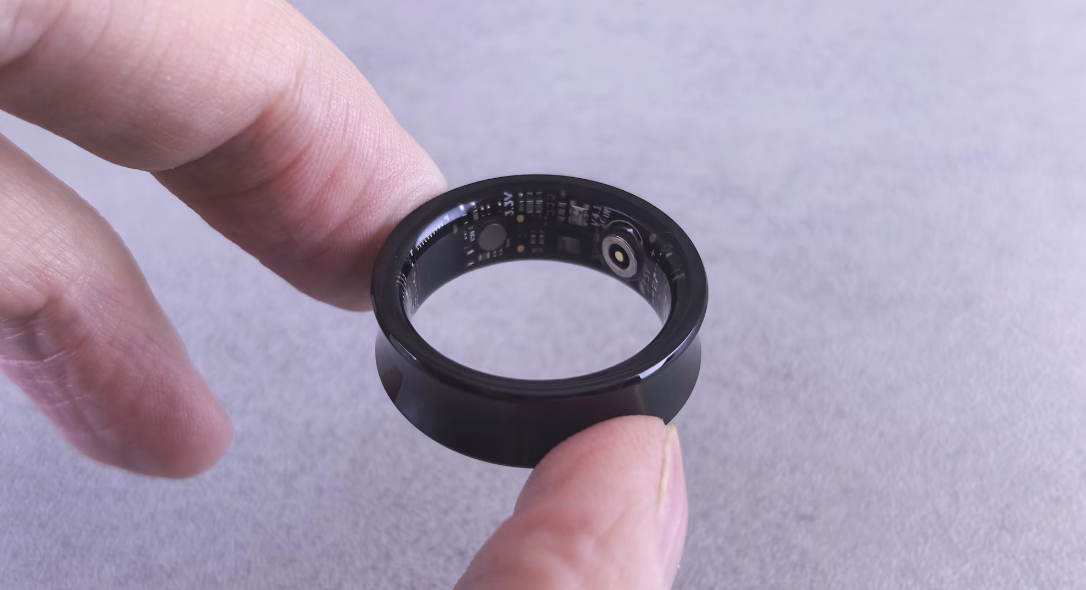
The clearest sign of where wearables are heading sits on the finger, not the wrist. Smart rings have gone from a niche biohacker accessory to a genuinely mainstream category, and the current generation of devices makes a compelling case for why. The Oura Ring 5 remains the category's best-known name, built around sleep staging, cardiovascular capacity, and long-term stress resilience trends that update automatically in the background. RingConn's Gen 3 has carved out its own following by skipping the recurring subscription fee entirely while still packing in vibration alerts and roughly two weeks of battery life. Samsung's Galaxy Ring 2 and the Ultrahuman Ring AIR round out a field that's grown more competitive, and more genuinely useful, with almost every release cycle.
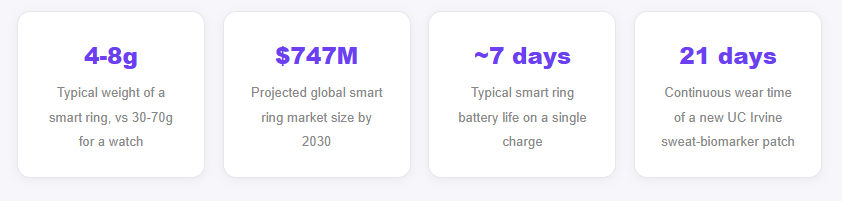
What actually makes the ring format work isn't just comfort, though weighing a fraction of a smartwatch definitely helps. It's blood flow. The finger carries more consistent circulation than the wrist, which gives ring-based sensors a real physiological advantage for passive monitoring, especially overnight when a person is still and heart rate variability data is at its cleanest. A smartwatch picking up your pulse during a run has to fight through motion and wrist movement. A ring sitting quietly on your finger while you sleep doesn't have that problem.
The appeal of a ring isn't that it does more than a watch. It's that it disappears into your life while still doing the one thing that actually matters: collecting clean, continuous data without asking you to look at it.
— a pattern echoed across nearly every 2026 wearable comparison guide
The trade-off is obvious and most people who buy a ring already know it going in. There's no display, no maps, no quick replies, nothing to glance at mid-run. For someone who genuinely wants real-time coaching during a workout, that absence is a dealbreaker. But for the much larger group of people whose real goal is simply understanding their sleep, recovery, and baseline stress levels without another screen competing for their attention, the ring has become the more honest tool for the job.
Neurofeedback bands: wearables that read your brain instead of guessing at it
If smart rings represent a refinement of what wearables already did, neurofeedback headbands represent something closer to a genuine category shift. Instead of inferring your stress level from heart rate variability and skin temperature the way a ring or watch does, EEG-based headbands measure electrical activity in the brain directly, then translate that raw signal into something a person can actually train against in real time.
Muse's S Athena headband is currently one of the most talked-about devices in this space, combining EEG with fNIRS, a second sensing method that tracks blood oxygenation in brain tissue, to give a more complete picture of mental state than either technology could offer alone. FocusCalm takes a simpler, cheaper approach, distilling up to 1,200 EEG data points per second into a single 0-to-100 score people can watch shift as they practice staying calm. Neurable has gone a different direction entirely, building EEG sensors directly into a pair of over-ear headphones, so brain activity gets tracked passively during ordinary tasks like working or listening to a podcast, without ever putting on a dedicated headband.
What "instant burnout alerts" actually means in practice
The phrase gets thrown around loosely, but the underlying mechanism is fairly specific. These devices aren't diagnosing burnout as a clinical condition, nobody in this space claims that. What they're doing is flagging a pattern, a sustained shift toward higher-frequency brain activity associated with stress and reduced recovery, before it builds into the kind of exhaustion a person only notices once it's already taken hold. Pison PERFORM approaches the same idea from the wrist instead of the head, combining neural sensing with heart rate variability and skin conductance to estimate focus, vigilance, and sleep debt throughout the day.
Worth knowing before you buy one
Most neurofeedback wearables work best as a training tool, not a passive tracker. The benefit comes from short, repeated sessions where you actively practice shifting your mental state, not from wearing the device all day and waiting for insight to arrive on its own.
Biometric patches: the skin-worn sensors chasing your stress hormones
The most experimental corner of this shift is happening on the skin itself, not the wrist or finger. Continuous glucose monitors proved years ago that people would happily wear a small adhesive sensor for weeks at a time if it delivered genuinely useful health data, and researchers have spent the years since trying to extend that same idea to a much wider range of biomarkers, cortisol chief among them.
A team at UC Irvine published a flexible, battery-free patch in Nature Biomedical Engineering in May 2026 that tracks four separate sweat biomarkers, cortisol, glucose, lactate, and urea, continuously for up to three weeks, pairing wirelessly with a phone or a watch-style reader. Cortisol specifically maps closely to stress, which makes it a far more direct signal than the indirect proxies, like heart rate variability, that rings and watches have relied on for years. Companies including Biolinq and Adaptyx Biosciences are pursuing similar multi-analyte patches, while EnLiSense already has a sweat-based cortisol-tracking wearable on the market, reading the hormone through sweat rather than the subdermal fluid that some newer research prototypes are targeting.
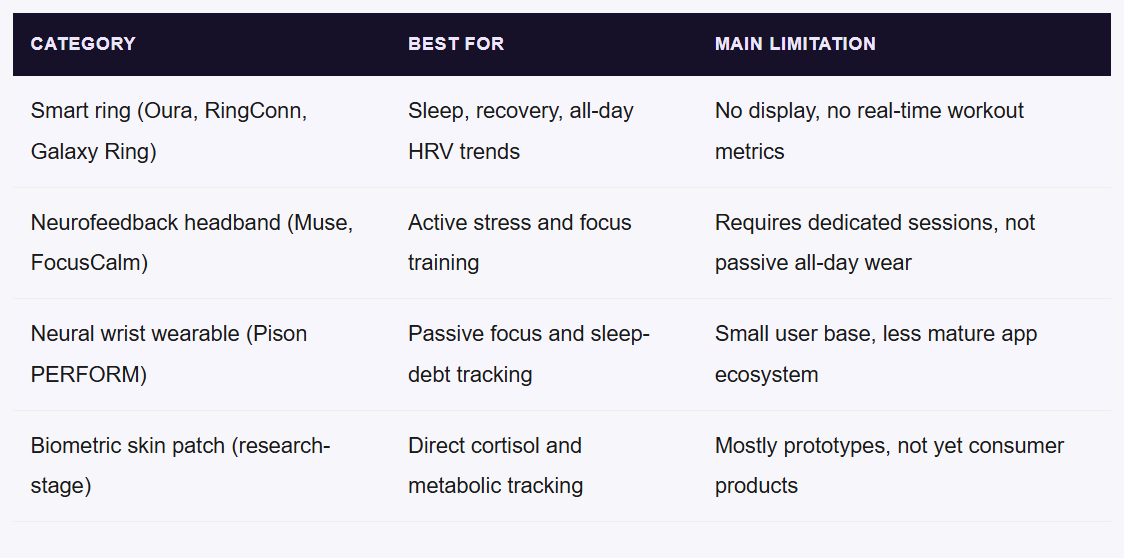
It's worth being honest about where this particular piece of the story actually stands. Most of the multi-biomarker sweat patches making headlines in 2026 are still research prototypes, not products a person can order today. The path from a peer-reviewed paper to a shelf-ready device usually involves years of validation, regulatory review, and manufacturing work that hasn't happened yet. The consumer devices already on the market, EnLiSense among them, tend to track a narrower slice of what the research prototypes promise. The technology is real and moving quickly. The fully realized version of it is still a few years out.

What this actually changes for the average person
Strip away the branding and the sensor specs, and what's really shifting is fairly simple. Health wearables spent their first decade optimizing for physical output, steps, calories, distance, heart rate zones. This next wave is optimizing for something harder to quantify but arguably more important day to day: how much capacity a person actually has left before their mind, not their body, starts to give out.
The catch nobody puts in the marketing copy
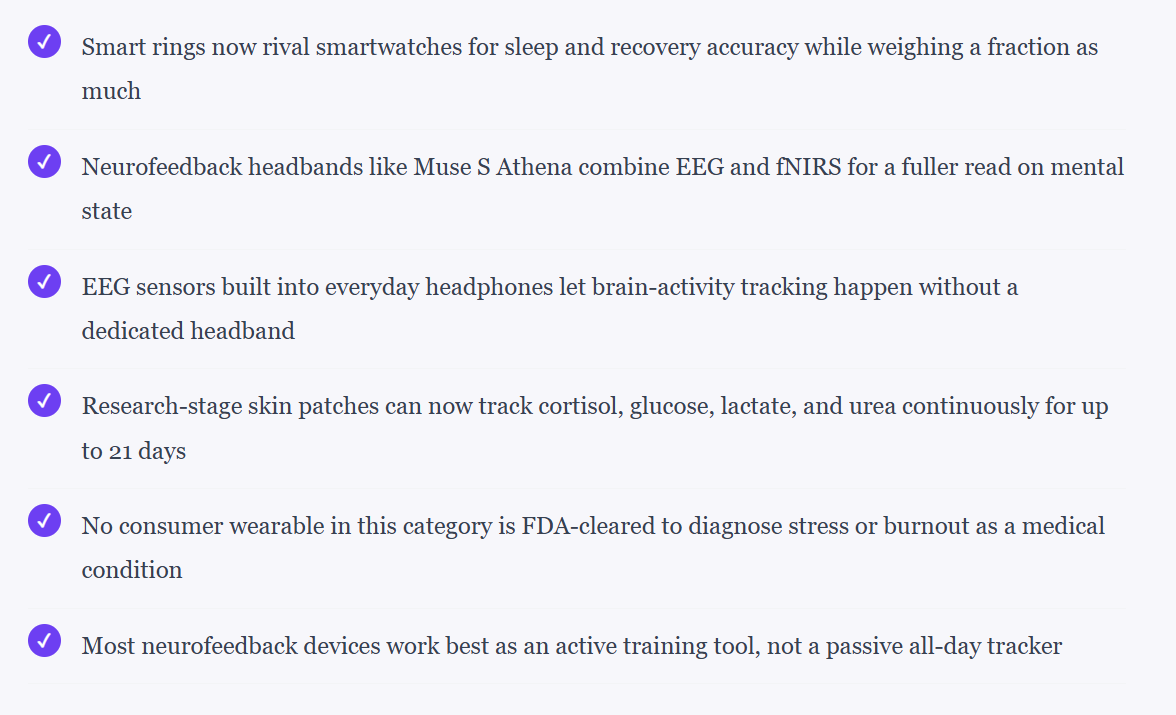
None of this is a free upgrade. Smart rings still typically require a monthly subscription to unlock full historical insights, the way Oura's app does. Neurofeedback headbands demand actual practice and consistency to show a benefit, they're not something you strap on and passively benefit from like a fitness tracker. And every device in this category, ring, headband, or patch, comes with the same honest disclaimer: none of it is a diagnostic tool. A rising stress score is a prompt to pay attention, not a medical verdict, and anyone dealing with a genuine mental health concern still needs an actual clinician, not an app score, to make sense of it.
There's also a quieter risk worth naming: turning your own nervous system into a dashboard you check obsessively can, for some people, become its own source of anxiety. The best use of this category tends to be light-touch, glancing at a weekly trend rather than refreshing a daily score, treating the data as one input among several rather than the final word on how a day is actually going.