 William BensonVIEW PROFILE →
What a Toppled Tower of Blocks Can Teach Us About Failing Better
Watch a toddler's tower of blocks collapse and watch an adult's project fall apart, and you'll notice something strange: they're barely having the same experience at all.
Watch a toddler's tower of blocks collapse and watch an adult's project fall apart, and you'll notice something strange: they're barely having the same experience at all.
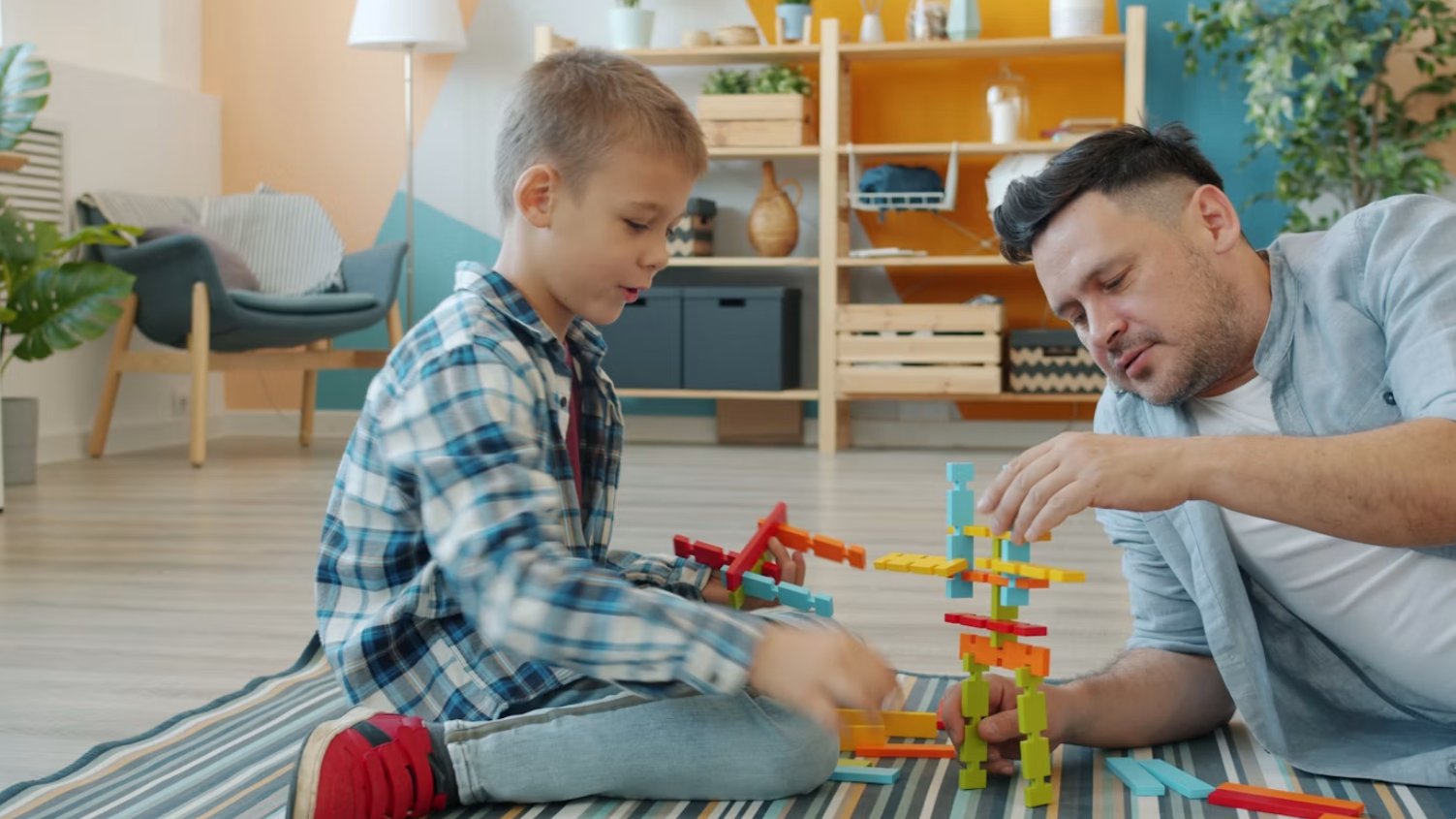
A four-year-old builds a tower out
of wooden blocks. It gets to eight, wobbles, and crashes to the floor. For
about four seconds, there's a genuine howl of frustration, maybe even a small
fist slammed against the carpet. And then, almost unbelievably fast, the blocks
are back in his hands and the tower is rising again, this time with a wider
base. No spiral. No story about what this says about him. No lying awake that
night replaying it. Just: that didn't work, try again. Most adults, watching
their own version of a collapsed tower play out at work or at home, would still
be turning it over in their heads three weeks later.
The Four
Seconds That Separate Kids From the Rest of Us
Developmental psychologists have spent decades studying exactly
this gap, and what they've found is less about children being naturally braver
and more about children simply having a different, and arguably healthier,
relationship with the moment failure actually happens. Clinical experts who
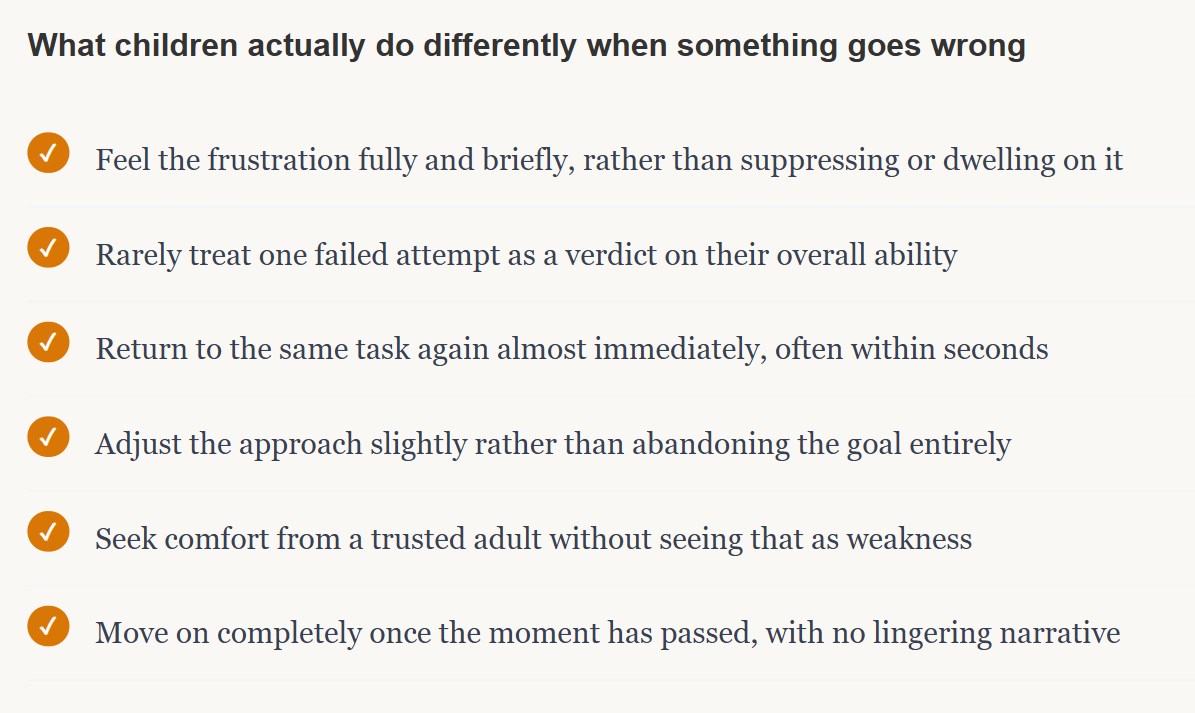
work with kids describe a fairly consistent sequence: the child feels the
disappointment fully, often loudly, and then, once that wave passes, moves on
without treating the failure as information about who they are. The feeling comes
first. The story about the feeling, the part that tends to trap adults, mostly
doesn't come at all.
That sequencing matters more than it sounds. Skipping straight
to "bounce back" without letting the frustration surface first
doesn't actually make a child more resilient, it just buries the reaction
somewhere it resurfaces later. Letting the disappointment move through fully,
and then setting it down, appears to be a large part of what makes a child's
recovery from failure look so much faster and cleaner than an adult's.
Why Adults Fail So Differently
Somewhere between childhood and adulthood, failure stops being an isolated event and starts becoming evidence. A missed deadline isn't just a missed deadline anymore, it's proof of something, unreliability, incompetence, falling behind people we're quietly comparing ourselves to. Researchers who study fear of failure trace much of this shift back to childhood itself: when praise only reliably follows perfect outcomes, children start associating mistakes with disappointing someone they love, and that association, left unaddressed, tends to calcify into adulthood as quiet, persistent self-protection.
The result, for a lot of adults, is a set of habits that look nothing like a toddler rebuilding a block tower: procrastination on things that might not go well, over-preparing to the point of paralysis, or avoiding the attempt altogether so the failure never technically happens. None of this is weakness in the way it's often framed. It's a defense system, built early, doing exactly what it was built to do, just at a cost most adults never fully clock.
What the Research Actually Shows About How Kids Process Setbacks
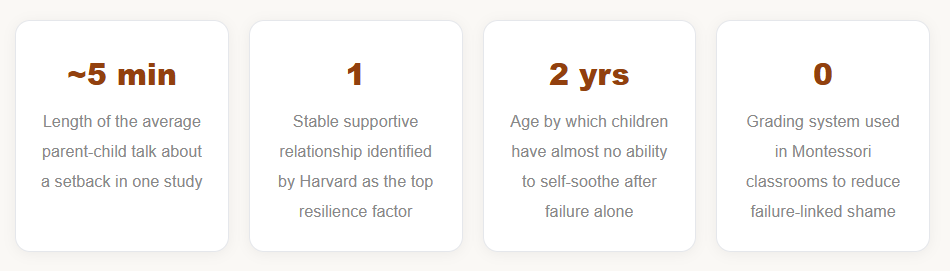
One study that closely analyzed real mother-child conversations about mistakes found something worth sitting with: even a single, brief conversation about a past setback, often lasting no more than five minutes, was meaningfully associated with how much a child feared failure going forward. It wasn't the frequency of these conversations that mattered most, it was whether they happened with warmth at all, offering support and guidance rather than judgment, even briefly.
Cross-cultural research adds an important complication here. A study of middle school students found that when parents view failure strictly as a sign of insufficient effort or lack of ability, a stricter, more judgment-based framing common in some cultural contexts, students didn't necessarily become less resilient. In some cases, that stricter view correlated with a stronger academic recovery, suggesting the relationship between how failure gets framed and how well someone bounces back from it is genuinely more complicated than a single universal formula. What both strands of research agree on is this: children pick up their entire framework for handling failure primarily by watching how the adults around them handle their own.
The Adult Habit That Gets in the Way: Rumination
The single biggest difference between how children and adults handle failure isn't confidence, it's what happens after the initial sting fades. Children, for the most part, don't ruminate, they don't have the same capacity yet to build an extended internal narrative around a single bad outcome. Adults do, and that capacity, useful for genuine reflection and planning, becomes a liability the moment it turns into replaying the same failed moment on a loop without ever actually resolving it.
Psychologists who study resilience describe healthy processing as feeling the disappointment, extracting whatever useful lesson exists, and then, crucially, setting it down. Rumination is what happens when that last step never actually completes.
Practical Ways to Borrow a Child's Approach to Failure
None of this means adults should aim for a childlike lack of self-awareness, the reflective capacity adults have is genuinely valuable when it's used well. But several concrete habits, drawn directly from how children process setbacks, translate surprisingly well into adult life. Naming the feeling out loud, even briefly, the way a parent might acknowledge a child's frustration, appears to shorten how long the emotional charge of a setback actually lingers, compared to pushing straight past it unacknowledged.
Reframing the internal question also matters more than it might seem. Swapping "what does this say about me" for "what would I try differently next time" mirrors almost exactly the shift researchers recommend parents model for children, moving the focus from identity to information. And perhaps most practically: setting a rough time limit on processing a setback, an hour, an evening, a weekend, rather than letting it run indefinitely, borrows directly from how briefly children's own reactions actually last before the rebuilding starts again.
A Few Honest Questions People Are Actually Asking
Isn't some rumination actually useful for genuinely learning from a mistake? A limited amount of reflection is genuinely useful, and different from rumination. The distinction researchers draw is whether the reflection produces something, a lesson, a plan, versus simply replaying the moment without resolution. The former helps. The latter mostly just prolongs the discomfort.
Can adults actually relearn this after years of a different pattern? Resilience researchers are fairly consistent on this: these are learned behaviors and thought patterns, not fixed traits, which means they can be rebuilt at any age, though it typically takes deliberate practice rather than simply deciding to feel differently.
Does this mean parents should never comfort a child after a failure? Not at all. The research points the opposite direction: acknowledging a child's disappointment, rather than rushing past it to reassurance, is exactly what helps that reaction move through and resolve quickly instead of getting buried.
What This Actually Means Day to Day
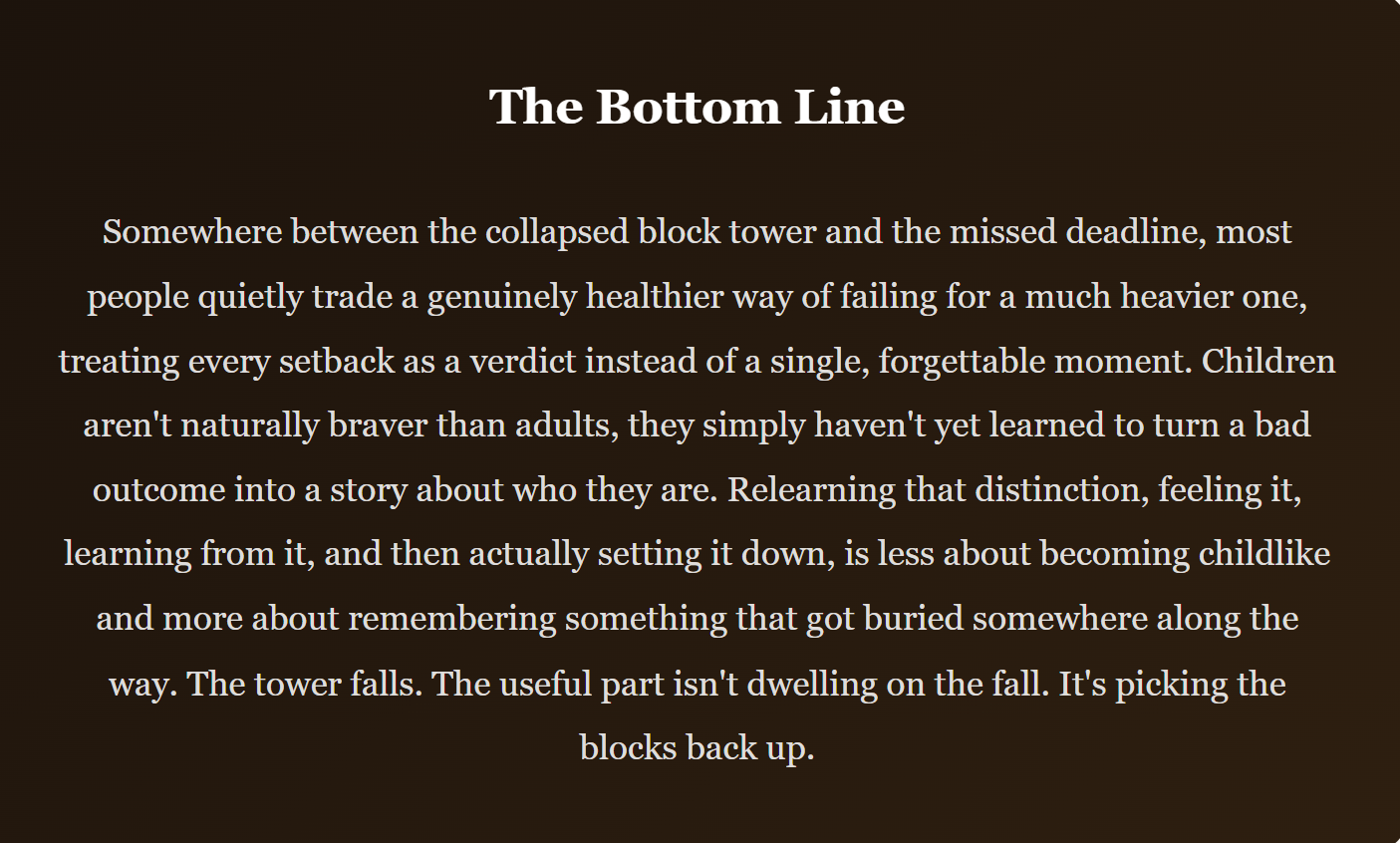
There's a genuine, practical takeaway buried in all of this, and it's smaller and more actionable than it might first appear. It isn't "be more resilient" as a vague aspiration, it's specific: let the disappointment land fully for a short, bounded stretch of time, resist the urge to turn one outcome into a verdict on your overall worth or competence, and then, deliberately, put it down and try again with a slightly adjusted approach. That's essentially the entire sequence a four-year-old runs through in under a minute with a pile of blocks. Adults just tend to add several extra, unhelpful steps in the middle, mostly involving stories about what the failure supposedly proves.
None of this erases the very real difference in stakes between a fallen tower of blocks and a missed promotion or a failed relationship. Adult failures often carry consequences a child's never do. But the emotional mechanics underneath, feel it, extract the useful part, set the rest down, hold up remarkably well across both, and they're worth relearning on purpose rather than assuming they simply disappeared with childhood.
A note on this piece
This article reflects general psychological research on resilience and failure processing, not personalized advice. If a fear of failure or persistent rumination is significantly affecting your daily life or wellbeing, a licensed therapist or counselor can offer support tailored to your specific situation.